ARA San Juan sinking: only Villamide convicted, three sailors acquitted in Santa Cruz
The Federal Oral Court in Santa Cruz convicted Captain Claudio Villamide to three years suspended imprisonment for the sinking of the ARA San Juan. Three co-defendants were acquitted unanimously.
Judgment in the ARA San Juan case: individualised criminal responsibility for Villamide
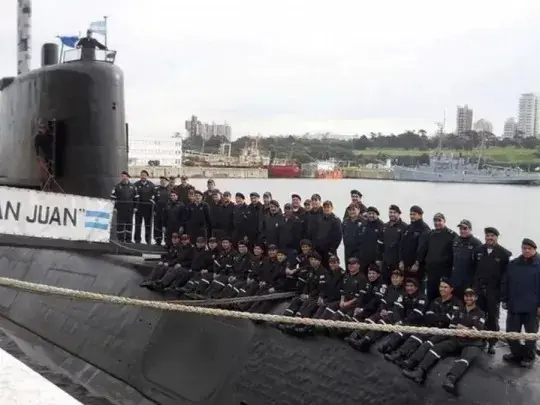
The Federal Oral Court of Santa Cruz released the grounds for its judgment in the sinking of the submarine ARA San Juan, which occurred on 15 November 2017 with 44 crew members aboard. According to diarioprimeralinea.com.ar, the judges convicted by majority the ship's captain Claudio Javier Villamide to three years of conditional imprisonment and special disqualification for twice that period, and acquitted unanimously the other three sailors who had gone to trial: Luis Enrique López Mazzeo, Héctor Aníbal Alonso and Hugo Miguel Correa.
The central point: the submarine set sail with known deficiencies
Judges Mario Reynaldi, Enrique Baronetto and Luis Giménez—the latter dissenting in favour of Villamide's acquittal—reconstructed in 767 pages the submarine's final hours and analysed the role of each member of the chain of command. The court found it established that the ARA San Juan set sail on 25 October 2017 "in deficient technical and operational conditions", a situation that, according to the ruling, was known to all four defendants. Corrective and scheduled maintenance cycles had not been completed, and technical reports and prior requests documented this.
For the judges, what occurred "was not due to an instantaneous, fortuitous and unforeseeable fact" that could not have been avoided. The ruling notes that the officers had, by virtue of their posts, a "special duty of care" with functions linked to safety, readiness, training and maintenance of naval vessels.
The conviction of Villamide
Villamide was convicted as the perpetrator of the crime of failure to perform duties as a public official, in concurrent ideal concurrence with aggravated negligent damage resulting in death. The grounds attributed to him a central position as Commander of the Submarine Force and maximum operational authority over those units. The court held that he knew of the technical deficiencies and had direct involvement in planning the operation.
A decisive element was the manoeuvre with the E19 valve. According to one of the hypotheses analysed during the trial, that manoeuvre was relevant to the development of events: "Villamide concealed from López Mazzeo the manoeuvre of atmospheric homogenisation or oxygen equalisation being carried out with the E19 on the SUSJ", the grounds state.
Why López Mazzeo was acquitted
In analysing López Mazzeo's responsibility, the court recognised that the Court of Appeal had identified various alternatives that he could have adopted to prevent the submarine from setting sail in those conditions: to control the repairs, to inspect them or directly to veto the sailing. The Court of Appeal had characterised the omission of all those actions as "the utmost negligence in the performance of his duties".
However, that prior assessment was not sufficient to sustain a conviction. Upon examining the evidence produced during the trial, the judges found no causal link necessary between López Mazzeo's conduct and the sinking. Ignorance of the manoeuvre with the E19 valve—concealed by Villamide—"absolved him of all responsibility for any consequences that might occur", according to the ruling, and allowed him to reasonably trust that the commander was exercising his functions in accordance with regulations.
The role of Alonso and Correa according to the court
In the cases of Alonso and Correa, the judges also centred their analysis on the distribution of competencies within the Navy. The grounds emphasise that the General Staff performed an advisory function and that "the commander has the final say". The court also noted that Alonso and Correa could not directly issue orders to Captain Pedro Fernández, who was under Villamide's orders and died in the sinking.
The principle defining the judgment
The ruling establishes clearly the governing criterion: it was not enough to hold a position within the chain of command to be criminally liable. It was necessary to demonstrate, for each defendant individually, a concrete conduct causally linked with the sinking. The grounds indicate that the judges distinguished responsibilities according to the specific functions of each member and to what each one knew or could know at the time of the events.
"Each of them or all of them together constitute the utmost negligence in the performance of their duties", reads the passage of the ruling concerning the obligations of control, maintenance and safety that fell upon the chain of command.
Complainants consider appealing the acquittals
The complainants, representing relatives of the 44 deceased crew members, indicated they would consider appealing the acquittals of López Mazzeo, Alonso and Correa, and would also claim civil compensation. The final judgment thus establishes three years of suspended imprisonment for Villamide and acquittal for the other three sailors tried, closing—at least in this instance—the trial in the ARA San Juan tragedy.
Source: Google News PR — San Juan