Conference in Macapá debates organised crime and land conflicts on Brazil-France border
The TJAP concluded the II Transnational Conference in Macapá with panels on organised crime and land issues on the Amazonian border with French Guiana.
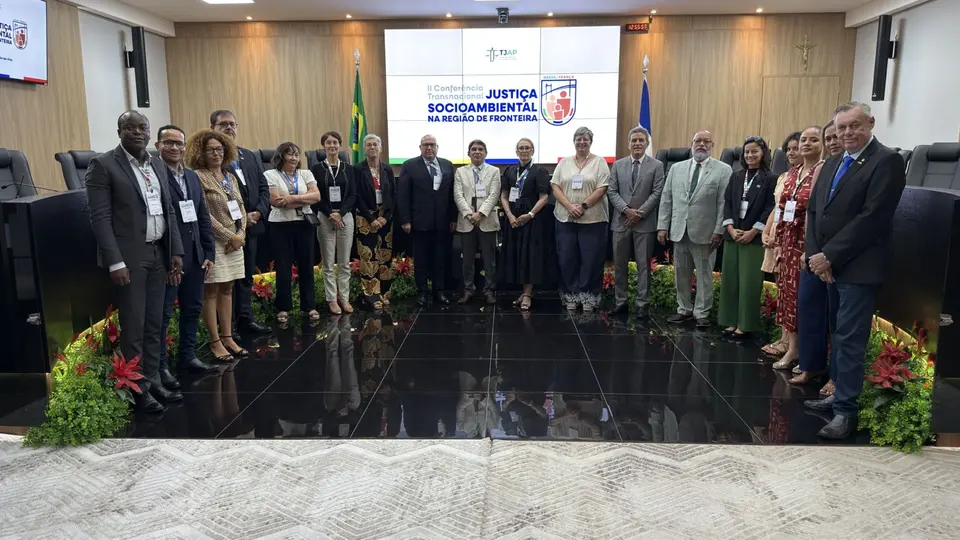
TJAP concludes transnational conference focusing on environmental crime and land regularisation in the Amazon
The Court of Justice of Amapá (TJAP) concluded, on Wednesday (18 November), the II Transnational Conference: Socio-Environmental Justice in the Border Region (Brazil/France), in Macapá. According to reporting from diariodoamapa.com.br, the event brought together magistrates, prosecutors and specialists from Brazil and French Guiana over three days to discuss common legal challenges in the Amazonian region.
The conference, which began on Monday (16 November) at the headquarters of the Amapá Judiciary, continued the partnership between TJAP and the Court of Appeal of Cayenne. The French delegation comprised approximately 20 members. The meeting followed the first edition of the event, held in French Guiana in 2025, with the aim of promoting the exchange of experience in addressing shared problems on the Amazonian border.
The president of TJAP, Justice Jayme Ferreira, evaluated the institutional exchange positively. "These were extraordinarily rich days of exchange, of fantastic experiences. We learned a great deal from the circumstances, from the conditions in which each one of us works. And more than that: the Amazon gains, Brazil gains, French Guiana gains, because we discussed highly relevant questions relating to the environment, the protection of our wealth, the protection of our waters and, above all, the union and the perfect application of justice for the peoples of both countries," Ferreira stated.
Organised crime and environmental resources as illicit instruments
The fifth panel of the event, held at 9 a.m. on Wednesday, addressed the theme "The environment and organised crime on the Guiana Plateau". The panel was chaired by the Judicial Ombudsman of TJAP, Justice João Lages, and brought together presentations from the State Prosecutor of the Public Ministry of Amapá and adviser to the National Council of the Public Ministry (CNMP), Ivana Cei; the State Prosecutor of the Public Ministry of Pará and Master's student in Constitutional Law, Diego Lima Azevedo; and the Deputy Prosecutor of the Republic before the Court of Cayenne, Stéphanie Rabat.
Justice João Lages emphasised that environmental questions cannot be separated from the activities of organised crime. "We are not simply talking about the environment, but about crimes committed on the borders by organisations that use environmental resources as an instrument for illicit activities, including money laundering. A meeting like this represents cooperation between countries and the possibility of overcoming differences between legal systems to combat organised crime," the magistrate stated.
Prosecutor Ivana Cei reinforced the need for information exchange between the two countries. "The idea is to exchange experiences about Brazilian reality and to learn what occurs on the other side of the border. We need to understand the problems related to the activities of criminal gangs and the increase in environmental crimes and other illicit practices by these organisations," noted the CNMP adviser.
Land conflicts in the Amazon concentrate diversity and overlapping rights
The sixth and final panel, which began at 10 a.m., addressed "Land Issues in the Amazon" and was chaired by the Vice-President of TJAP, Justice Carlos Tork. Presentations were given by Justice and Doctor of Legal Sciences Carmo Antônio de Souza, State Prosecutor and Associate Professor of Environmental Law at the Federal University of Amapá (Unifap) Marcelo Moreira, and the President of the Court of Appeal of Cayenne, Béatrice Almendros.
Carmo Antônio de Souza addressed the complexity of land conflicts, pointing to the overlapping of registrations and the presence of distinct groups in the same territory as central factors of the problem. "The Amazon has never been a demographic void. We have indigenous peoples, quilombola communities, riverine communities, small and large producers who share this territory. In light of this diversity and the conflicts related to possession and property, the Judiciary acts as an agent of pacification, with technical visits, dialogue and mediation to ensure the rights of those involved," highlighted the Senior Justice of the TJAP Court.
Souza also explained the role of the Land Solutions Commission of the Judiciary, of which he is coordinator, in the search for consensual alternatives to territorial litigation.
Closure reaffirms cross-border cooperation
The activities were concluded with the Closing Panel, following consolidation of the legal and institutional discussions focused on socio-environmental protection and cross-border cooperation between Brazil and France.
The Vice-President of TJAP, Justice Carlos Tork, synthesised the results of the meeting. "These three days have been highly productive from a technical and legal perspective, but also for the human and fraternal encounter. Our problems are common, from land questions and climate change to the activities of criminal groups. To cooperate better, we need to know each other and understand the reality on both sides of the border," concluded Tork.
Source: Google News BR — Crime