76 hostages in Cartagena supermarket: Colombia suffers six attacks in 72 hours
Colombian police confirmed 76 hostages in a Cartagena supermarket during 17 hours. The country is going through a serious security crisis with six attacks in 72 hours.
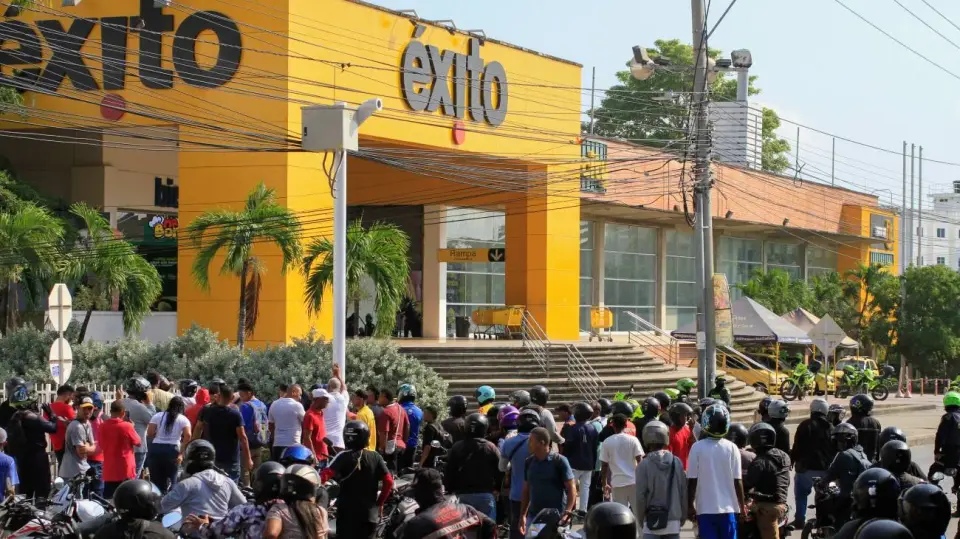
Security crisis in Colombia: 76 hostages, drones and car bomb on anniversary of FARC
Colombia's police confirmed that 76 people were held hostage on Tuesday in a supermarket in Cartagena de Indias, a figure considerably higher than the thirty initially reported, according to perfil.com. Three robbers kept control of the commercial establishment for 17 hours, until law enforcement forces regained control shortly after midnight.
The incident occurred amid a serious security crisis that in just 72 hours rocked the country with six attacks. The violence coincided with the tenth anniversary of the peace agreement signed with the now-defunct FARC guerrilla and left dozens injured and one soldier dead.
Car bomb in Villavicencio and power outage in five departments
The critical point of the crisis occurred on Monday night, on the eve of that anniversary, with the explosion of a car bomb in front of the seat of the Meta State Governor's office in Villavicencio. The attack left around thirty injured and caused damage to the electrical network that resulted in a massive blackout in another five departments in the southwestern part of the country.
President Abelardo de la Espriella identified as responsible Ómar Pardo Galeano, alias "Antonio Medina", one of the leaders of the dissident faction of the Central General Staff (EMC) of the FARC led by Néstor Vera Fernández, nicknamed "Iván Mordisco". De la Espriella also assured that several additional attacks in that same Meta department were thwarted.
Drone attacks attributed to the ELN
Violence also struck urban areas with an emerging method: drone attacks. On Monday a drone attack was recorded against police facilities in Cúcuta, in the northeastern part of the country. That same day, just hours later, another drone struck a police station in the municipality of Curumaní, in the department of Cesar.
Both attacks were attributed to the National Liberation Army guerrilla (ELN), an organisation that also reportedly was behind the incident that began this wave of violence the previous Saturday, in the Cesarean municipality of La Jagua de Ibirico, where a soldier died.
On Tuesday, a new drone attack affected police facilities in the township of Campo Dos, in Tibú, a municipality located in Catatumbo. That region is one of the hottest focal points of Colombian armed conflict, a scene of dispute between FARC dissident factions and the ELN for control of territory key to drug trafficking, illegal mining and other illicit economies.
According to Defence Ministry data, the use of drones for offensive purposes grew steadily during the first two months of De la Espriella's term. In 2026 so far 350 cases have been recorded, an average of one per day and an increase of approximately 140% compared to the previous year.
The biggest challenge for De la Espriella
President De la Espriella, in office since last August, faces his biggest test of government with this wave of violence. The president attributes the increase to his own bombing campaign—up to ten in three months—and operations against armed groups, which, according to his interpretation, provoked the violent response from these organisations.
Ten years of the peace agreement: unfulfilled promises
On Tuesday exactly a decade passed since the signing of the peace agreement with the FARC, the ambitious plan with which Colombia attempted to end more than half a century of armed conflict with the oldest guerrilla organisation in Latin America.
The anniversary arrived marked by shadows. During these ten years, the Colombian State demonstrated recurring incapacity—and on occasions negligence, according to critics—to implement what was agreed, particularly the pending agrarian reform in a country with profound inequality in land distribution, identified as one of the historical origins of the conflict.
The first years of the agreement did record unprecedented declines in homicides and kidnappings, and more than 13,600 guerrillas laid down their arms. However, the vacuum left by the FARC after its dissolution was progressively filled by old and new armed actors, in the face of the effective absence of the State in vast areas of the national territory.
Source: Google News BO — La Paz