Bogotá Court Convicts 20 Former Paramilitaries from Arauca for Sexual Slavery
The Justice and Peace Chamber condemned 20 former members of the Vencedores de Arauca Bloc for 105 crimes against 165 victims. Compensation exceeds 70.300 billion pesos.
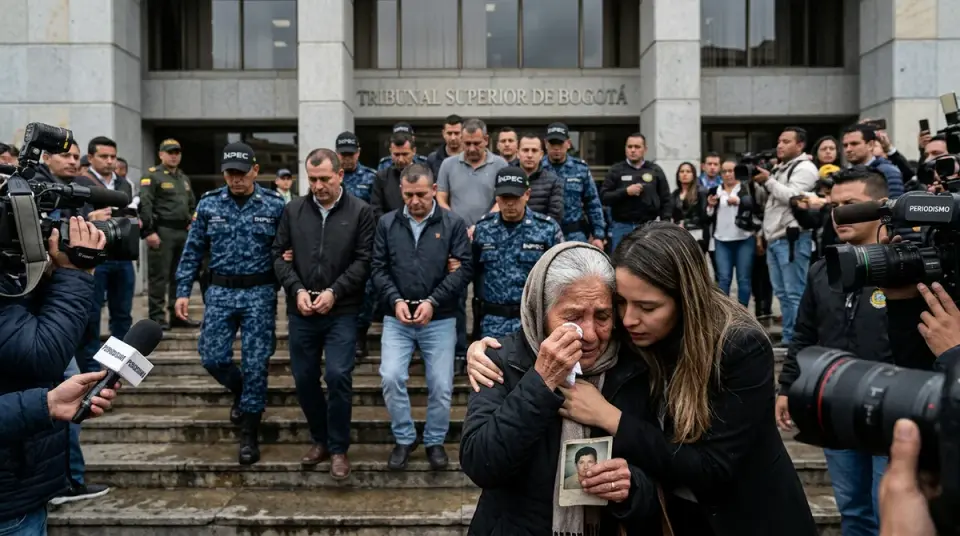
Justice and Peace Chamber Imposes Historic Conviction for Sexual Crimes by Paramilitarism in Arauca
The Justice and Peace Chamber of the Superior Court of Bogotá convicted 20 former members of the Vencedores de Arauca Bloc for sexual slavery and forced prostitution, setting compensation of more than 70.300 billion pesos for the victims, according to ifmnoticias.com.
The ruling, handed down on 25 November within the framework of the International Day for the Elimination of Violence Against Women, declares the responsibility of the 20 defendants in 105 criminal acts that directly affected 165 victims. The Vencedores de Arauca Bloc was a structure of the now-extinct United Self-Defence Forces of Colombia (AUC).
"The Last Tear": at the centre of the crime
One of the central chapters of the sentence refers to what occurred at "La Última Lágrima", a brothel located in the Puerto Gaitán hamlet, in rural area of the municipality of Tame, Arauca. Women from different regions of the country were taken to that place, subjected to systematic forms of sexual violence under the control of the paramilitary group.
The court ruled out that the establishment was a place where sex work was exercised freely or autonomously. The sentence describes the site as a space completely subjected to the dominion of the armed structure, where permanent coercion prevailed, territorial control through firearms and an absolute absence of consent on the part of the women held there.
For these reasons, the magistrates classified the acts under the charges of sexual slavery and forced prostitution, crimes considered by international law as serious violations of human dignity and crimes against humanity.
Reparation of more than 70,000 billion pesos
In the integral reparation proceedings, the Chamber calculated exact compensation of 70,308,347,642 pesos, a figure designed to compensate for the impact on the life and integrity of the victims identified in the proceedings.
To ensure that these resources reach those affected, the court ordered precautionary measures on 37 real estate properties valued at approximately 10,883 million pesos. The court order stipulates that both the fruits and economic returns generated by these properties must be allocated exclusively to reparation.
Some press reports characterised the measure as a seizure; others noted that it involves the extinction of ownership rights, a process through which the State assumes ownership of assets linked to illegal activities or armed groups.
Collective reparation for communities in Arauca and Casanare
The sentence granted recognition as collective reparation subjects to various communities that suffered paramilitary assault: the inhabitants of Tame, Arauca, Puerto Rondón, Cravo Norte and Saravena, in the department of Arauca, and the community of Hato Corozal, in Casanare. For these collectives, justice ordered measures aimed at the recovery of the social fabric, the dignification of victims, the preservation of historical memory and the implementation of guarantees of non-repetition.
Legal framework: Justice and Peace
The proceedings were conducted under Law 975 of 2005, known as the Justice and Peace Law, created to judge members of illegal armed groups who decided to collectively demobilise. The main benefit for those convicted is access to an alternative sentence of between five and eight years in prison, a significant reduction compared to ordinary sentences under the Colombian Penal Code.
To maintain this benefit, the convicted individuals have an obligation to confess to all of their crimes, contribute to historical truth and actively participate in the reparation of victims. If it is proven that they have failed to meet these commitments or hidden information, they lose the right to the alternative sentence and must serve the full sentences of ordinary justice.
To date, known judicial reports have not specified the individual sentences imposed on each of the 20 convicted individuals nor have they released the complete list of their names.
First instance, with possibility of appeal
As a first-instance decision issued by the Justice and Peace Chambers, the ruling may be appealed before the Criminal Cassation Chamber of the Supreme Court of Justice, the instance that would have the final say on the firmness of the sentence.
The Vencedores de Arauca Bloc maintained a strong presence in the departments of Arauca and Casanare for years. Its official demobilisation took place in December 2005, as part of agreements between the national Government and the AUC.
Source: Google News CO — Bogotá