MOKAS as "institutional shield" for Anastasiades – findings raise responsibilities of Rossidou-Papakyriakou
The Anti-Corruption Authority's findings identify indications of abuse of power by former President Anastasiades and possible criminal responsibilities of the former head of MOKAS.
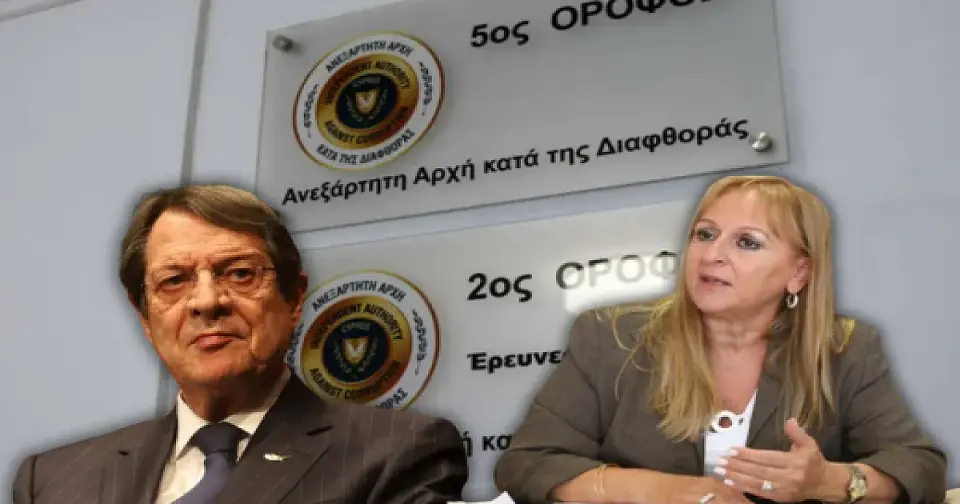
How MOKAS allegedly operated in favour of Anastasiades – what the Anti-Corruption Authority records
The Anti-Corruption Authority identifies indications of possible abuse of power by former President of the Republic Nicos Anastasiades, as well as possible criminal responsibilities of the then head of the Unit for Combating Money Laundering Offences (MOKAS), Eva Rossidou-Papakyriakou. These emerge from the Authority's statement on the book "Mafia State" by Makarios Drousiotis, as reported by Politis.
The 2019 investigation and the OCCRP publication
The disputed chapter of the findings concerns the manner in which MOKAS investigated, in 2019, allegations linking the law firm Nicos Chr. Anastasiades & Associates with suspicious financial flows. The impetus was provided by an OCCRP publication in August 2019, under the title "Bank Records Link President of Cyprus to 'Troika Laundromat'", which alleged that the firm facilitated the laundering of proceeds from illegal activities, channelling millions of dollars through shell companies and operating as an intermediary for high-risk clients.
Following the publication, the then President publicly stated that since his election to the presidency of DISY in 1997 he had been a "silent shareholder" with no involvement in the firm. The Authority, however, records that evidence shows that Anastasiades maintained an active role and general oversight of the firm's activities until his resignation from the position of general partner on 26 February 2013.
The public appeal to MOKAS
The critical point in the findings is the public appeal made by the then President to MOKAS, requesting the investigation of the OCCRP allegations. According to the Authority, the use of the presidential office on a matter that directly affected personal and family interests – the private company bore his name and his two daughters were shareholders – raises serious concerns about arbitrary institutional intervention, inappropriate exercise of political influence and possible abuse of power.
Particular weight is given to the timeline. The then head of MOKAS, Eva Rossidou-Papakyriakou, maintained that the Unit acted on its own initiative following the reading of the publication. The Authority, however, records that MOKAS had already received an official referral from an audit firm for the same transactions eight days before Anastasiades' public appeal, without taking any action until the public intervention of the then President.
Criticism of the quality of the investigation
The statement also exercises direct criticism of the manner of conducting the investigation. Although MOKAS is the central national Financial Intelligence Unit and had a duty to actively investigate and secure evidence, the Authority considers that it merely accepted explanations without independent verification. MOKAS allegedly failed to secure adequate documentation for the origin and destination of the funds being examined, despite the existence of indications that justified further criminal investigation.
According to the statement, the transaction records presented clear indications of money laundering: shell companies registered in the Caribbean, transactions worth 220 million dollars through high-risk countries, inter-company financing, loans to related parties and loan modifications with zero interest. According to the Authority, such mechanisms could obscure illegal transactions, but were overlooked in the conduct of the investigation.
The public "exoneration" and the questions it raises
An important factor is also the fact that, although MOKAS findings are normally not made public, Rossidou-Papakyriakou issued a public statement on 20 December 2019. In it she stated that the investigation had found "nothing blameworthy", publicly exonerating both the then President and the law firm. The Authority considers that the MOKAS findings did not constitute an accurate representation of the evidence that had been collected and that warning indications were overlooked.
Indications of abuse of power on the balance of probabilities
In its conclusion, the Authority states that there are sufficient indications – on the balance of probabilities level, not on the criminal level of proof beyond reasonable doubt – of possible abuse of power or attempted abuse of power by Anastasiades. His public intervention to MOKAS is presented as probable use of a state Financial Intelligence Unit for the protection of his own public image and that of the company that bore his name.
For Rossidou-Papakyriakou, the Authority records possible criminal responsibilities for abuse of power and breach of official duty. The inadequate manner of conducting the investigation, the acceptance of explanations without independent scrutiny and the unjustified inaction in the face of indications of illegality constitute, according to the statement, a substantial deviation from the principles of proper exercise of duties of a national Financial Intelligence Unit.
The MOKAS case is thus highlighted as one of the most institutionally sensitive chapters of the findings; it raises in question not only the substance of the allegations regarding suspicious financial flows, but primarily whether an independent inspection mechanism operated with the required autonomy from the executive power.
Source: Politis