Shot fired at 14-year-old in Schwabing: Why tasers were not an option
Following a shooting of a teenager in Munich, police explain why tasers fail in such situations. Trade unions reject racism allegations.
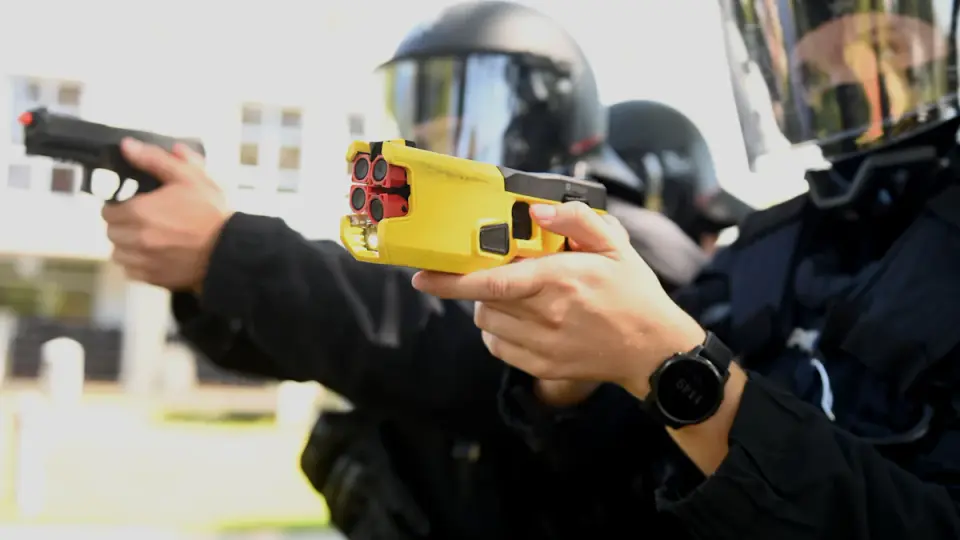
Shot in Schwabing – Police explain limitations of taser
A police officer fires on a 14-year-old holding a deceptively realistic-looking airsoft pistol. Why was no taser deployed? Munich police demonstrated on Monday before journalists at the riot police training grounds the conditions under which the so-called distance electrical impulse device – Deig for short – can be effectively deployed at all. According to the Süddeutsche Zeitung, the shot fired last Tuesday in Schwabing was, in the police's assessment, without alternative.
Demonstration shows operational limits
In a simulated scenario at the training ground, an actor yells at officers, strikes a tree trunk with a baton and runs towards the police. The officer calls out: "Taser, taser, taser!" – but training instructor Birk Petrak makes clear that this situation is actually barely suitable for the Deig. As soon as someone with a weapon runs towards police, drawing the service pistol is often the only safe option to protect the lives of the officers, Petrak explains.
A Deig functions via two insulated cables with projectiles equipped with barbs attached at their ends. They catch in the clothing of the target and send a current of two to four amperes at one kilovolt voltage through the body, which leads to muscle contractions and immobility. For the device to have full effect, the two projectiles must hit the body as far apart as possible – the larger the so-called current path, the more muscles and nerves are affected.
Distance and movement as decisive factors
If the distance is too short, the Deig fails. When a woman was shot in a supermarket in August 2024, she faced the officers with a knife at approximately two metres distance – too close for effective use. Contact devices, where officers must physically approach the assailant, are also scarcely an option with armed persons, as this would be life-threatening.
In the Schwabing case, the police would have had to cover several metres to reach the 14-year-old. Had the teenager genuinely been determined to shoot, he could have fired during that time. The risk in such dangerous situations is simply too high, says instructor Petrak. In these moments, "the firearm remains the most expedient means".
Taser only in specialist units – pilot projects underway
Bavarian patrol officers currently are, as a rule, not equipped with the Deig. The device has so far been primarily used in closed units such as the riot hundred-person squad. The reason: to safely restrain an assailant after Deig deployment, at least four officers are required. Moreover, at least one officer must always hold a service weapon at the ready in case the device does not have the desired effect.
Pilot projects for taser deployment in patrol duty are currently running in Augsburg and Regensburg. Federal Interior Minister Alexander Dobrindt (CSU) advocates for broader provision and has campaigned for its use with the Federal Police.
Tasers could be useful, for example, with persons threatening to take their own lives and holding a knife to their throat – that is, in situations where no immediate attack on officers is threatened.
Police president: shot was "without alternative"
Munich's police president Thomas Hampel described the shot fired at the 14-year-old as "without alternative". Johannes König, district chair of Munich's Left party, had previously criticised that there must be "alternatives to this potentially lethal course of action". The debate over whether officers could not have fired at the legs is rather theoretical in nature, says Jürgen Köhnlein, Bavaria state chair of the German Police Union (DPolG). In situations involving firearms or knives, any distance of less than seven metres to a suspect is "absolutely life-threatening".
Union rejects racism allegations
Following the incident in Schwabing, representatives of the Kurdish Centre had raised the question of whether police would also have fired if the teenager, who came from Turkey, had been German. The Police Union (GdP) sharply rejected these allegations. Florian Leitner, the Bavarian state chair, called it "incredible" that such a suspicion should be voiced.
"This insinuation leaves me speechless and is an impertinence," Leitner stated. "The origin or nationality of a perpetrator is completely irrelevant in a life-threatening operational situation." At the same time, he defended the officer's shot, despite the teenager not carrying a real weapon: "Our colleagues cannot wait first to see if there actually is shooting. Then it is too late."
Köhnlein of the DPolG concurred with this assessment and emphasised that officers in such operational situations do not have time to verify whether a weapon is real.
Source: Süddeutsche Zeitung