Four children murdered in Guayaquil: 16 soldiers detained for enforced disappearance
Four minors aged between 11 and 15 were apprehended, tortured and thrown into a river in Guayaquil. Sixteen soldiers face charges for enforced disappearance.
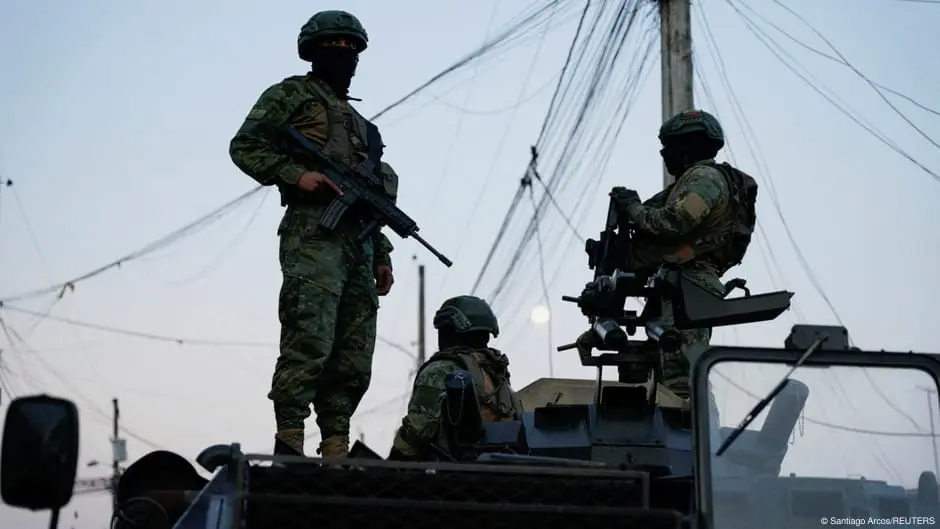
Four children from Guayaquil: tortured and burned by Ecuadorian soldiers
Saúl, Josué, Ismael and Steven went out to play football on a pitch in the Las Malvinas neighbourhood in south Guayaquil. The oldest was 15 years old; the youngest, 11. On 8 December they did not return home. According to dw.com, 16 soldiers apprehended them that day; their charred bodies were found floating in the river on 24 December.
"Come back, we have to play," cried one of their friends during the funeral, held in late December.
Charges for enforced disappearance
The 16 soldiers involved have been formally charged and are being held in preventive detention. "Legally speaking, this is an enforced disappearance," affirms Fernando Bastías, lawyer for the Permanent Committee for the Defence of Human Rights in Ecuador. "Because there was an illegal detention and an incommunicado detention of four children by State agents," he explains.
Bastías points out that investigations should determine whether it was the 16 soldiers who tortured, burned and threw the minors into the river. "It is most likely that a separate investigation will be opened for extrajudicial execution," the lawyer specifies.
Franklin Ramírez Gallegos, research professor in the Political Sociology programme at FLACSO Ecuador, goes further: "These murders increasingly have the profile of a State crime, in which the patrols are direct perpetrators."
Official response
The Defence Ministry issued a statement reaffirming "the commitment to truth so that this case is conducted with complete transparency until those responsible are found." President Daniel Noboa, for his part, declared on radio that the government is "on the side of justice" and that it will not cover up anyone involved, whether civilian, police or military. Noboa also suggested to a commission that the four minors be recognised as national heroes.
Militarisation of security, identified as cause
For Bastías, what happened is not an isolated incident. "There is a systematisation of patterns of grave human rights violations," he argues, citing at least seven cases of enforced disappearances already recorded in Los Ríos province. The lawyer identifies as a structural cause "the militarisation of citizen security" and emphasises that there is "an order, a political responsibility, in the deployment without control for citizen security tasks."
The decree of 9 January 2024, through which Noboa declared the "existence of internal armed conflict" and mobilised the Armed Forces on a national scale, is singled out by human rights organisations, intellectuals and activists as one of the principal antecedents of the case. "Noboa's decree on 'internal war' represented a moment of legitimisation of the strategy of militarisation of public security," evaluates Ramírez Gallegos.
Numerous human rights organisations in the country signed a joint statement in which they attribute direct responsibility to the executive security policy: "The four children of Malvinas are the face of enforced disappearances resulting from the executive security policy."
Criminalisation of poverty and racial profiling
Ramírez Gallegos also points to a "logic of criminalisation of poverty and racial profiling, through which skin colour is associated with dangerousness and criminality," which would have operated as an enabling framework. According to the sociologist, part of Ecuadorian society "accepted in some way this strategy of war, Bukelist in nature, of punitiveness, of an iron fist."
"People no longer believe in the State"
Carolina Andrade, political scientist and security analyst interviewed by dw.com from Guayaquil, describes a deep institutional confidence crisis. "People no longer believe in the State, because it has been dismantled over recent years, and the only thing left is public force," she indicates. Andrade also emphasises the absence of effective civilian control over security forces: "There is no direct political-civilian control by authorities over public force, neither military nor police."
The analyst, a member of the Network of Political Scientists "Not Without Women," frames the case within the electoral context that began on 5 January. "Two types of models will be put in dispute: one that promotes continuing with the internal armed conflict, with the violation of rights, and others that propose more comprehensive alternatives based on peacebuilding," she defines.
Andrade concludes that it is necessary to advance "a purging and strengthening of the justice system" and recover "civilian control of public force to strengthen internal controls and transparency."
The families of the four children from Guayaquil continue waiting for answers.
Source: Google News EC — Guayaquil