Femicides and organised crime advance in Ecuadorian Amazon, according to FLACSO
A FLACSO Ecuador study reveals that between 2020 and 2025 lethal violence and femicides grew simultaneously in the Amazon, with a focus on the oil and border corridor in the north.
Femicidal violence in the Ecuadorian Amazon grows alongside organised crime
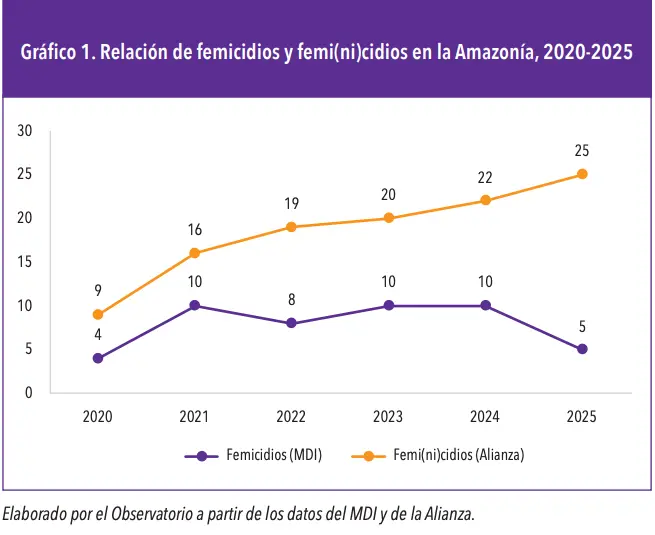
Confirmado.net reports that the sixth bulletin of the Observatory of Gender-Based and Sexual Violence of the Latin American Faculty of Social Sciences (FLACSO Ecuador) documents parallel growth in intentional homicides and femicidal violence in the Ecuadorian Amazon between 2020 and 2025. The most concerning concentration is registered in the territories of the oil and border corridor in the north of the country.
The report warns that, whilst femicides maintain a predominantly intimate, family or sexual character, cases linked to criminal structures show a growing presence. This introduces new dimensions of risk for women in the region and requires a reconsideration of institutional responses.
Rates exceeding those of the Coast
One of the bulletin's central findings is that the Amazon, despite recording fewer victims in absolute numbers than other regions of the country, presents rates of femicidal violence that are especially high. The Amazonian province with the highest incidence even exceeds the coastal province that registers the highest rate nationally.
The Observatory uses figures per 100,000 inhabitants or per 100,000 women, depending on the phenomenon analysed, precisely to prevent the Amazon's smaller population size from obscuring the relative magnitude of violence. However, the bulletin warns that in small populations variations of a few cases can produce significant statistical changes, so rates should be interpreted with caution.
Three regional configurations
The research identifies three distinct patterns of violence in Ecuador.
On the Coast, femicides appear closely linked to the expansion of criminal systems. Earlier studies by the same Observatory noted that the majority of such acts were linked to these structures and were carried out using firearms.
In the Highlands, general lethal violence experienced an increase, whilst femicides remained relatively stable and retained a predominantly intimate, family or sexual character.
The Amazon presents a third reality: lethal and femicidal violence increased simultaneously. The murders of women in contexts of intimate partnerships, family or sexual violence remain predominant, but the study records a growing presence of cases related to criminal organisations.
The oil and border corridor, zone requiring greater attention
The report emphasises that the parallel growth of both types of violence was especially pronounced in the territories of the oil and border corridor in the northern Amazon. These zones present specific territorial and economic characteristics that, according to the Observatory, must be considered when analysing the evolution of violence and when designing intervention policies.
The bulletin examines the situation in the six Amazonian provinces and compares patterns of femicidal violence with records of intentional homicides from the Interior Ministry and official femicide statistics.
Relationship with organised crime: correlation, not causality
The study stresses that the simultaneous growth of homicides and femicides does not, by itself, demonstrate that all cases result from the actions of criminal organisations. The research expressly distinguishes between violence of an intimate, family or sexual character and that linked to criminal systems, a differentiation it considers fundamental to understanding specific risks and articulating appropriate responses.
This is the third research project by the Observatory within the line dedicated to relationships between gender violence and criminal systems.
Implications for public policy
The results raise questions about the capacity of public policies to respond to manifestations of violence with different profiles. The persistence of femicides in the intimate sphere demands strengthening prevention, protection and care mechanisms for women. At the same time, the growing presence of acts associated with criminal structures demands a broader understanding of security conditions in the affected territories.
The Observatory notes that it is essential to have disaggregated information that permits the identification of risk patterns differentiated by province, consideration of border dynamics and evaluation of the response of competent institutions to each type of violence.
Source: Google News EC — Crime