Police officer testifies before judge on possible communications sabotage in Ceuta
A subinspector of the National Police claims that operational communications services failed during the mass influx of migrants in Ceuta on 30 and 31 July. The judge is investigating whether Morocco carried out a coordinated sabotage operation.
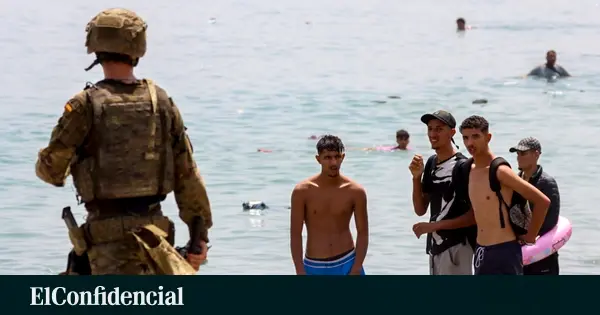
Communications deficiencies during the Ceuta crisis
According to elconfidencial.com, a subinspector of the National Police who was at the Ceuta border during the mass influx on 30 and 31 July testified before National Court magistrate María Tardón about serious problems in operational communications infrastructure. The officer warned of systemic failures that could have been caused by sabotage from Morocco.
The officer arrived at the border post at around 13:00 on 30 July, during one of the most critical moments of the crisis. During his testimony, he described how shortly after arriving he saw Gonzalo Sanz lurking around the border post. Sanz had previously been head of cabinet for the former government delegate in Ceuta. Sanz asked him to accompany him to speak with the Moroccan Police, insisting: "He tells me to please accompany him to go and speak with the Moroccan Police. And I said to him: 'What is happening? I do not understand anything'. Then he replied to me: 'I will tell you about it someday'", the subinspector recounted to the judge.
When he approached the border to contact Moroccan forces officials, the officer received a surprising response. A Moroccan superior named Mustafá simply told him that nothing was happening and that everything was normal. The officer's reaction was one of indignation. "That everything is normal?", he said irritably before the judge, and even admitted: "I became quite angry".
The communications failure as central focus
The witness observed that migrants were not only entering by swimming, but also on foot along El Tarajal beach. This prompted him to attempt to contact his superior to convey the seriousness of the situation and the passive attitude of Moroccan officers. It was then that he detected the most serious problems in operational communications.
"It was not working. Everything was chaotic in that regard, because I also did not know that they were probably also attacking us through communications", the officer recounted. Faced with difficulties in communicating by telephone, he resorted to WhatsApp to contact his superior and ask him whether they should continue with normal border operations. The response was clear: "Until it is announced, the Delegation does not close".
Apparent coordination of the Moroccan Police
As the influx of migrants continued to increase, the officer observed several Moroccan officers in plain clothes who appeared to be actively directing migrants towards Ceuta. "The Moroccan Police is supporting this. So I took some photos in which the passivity of people who are directing the masses towards the breakwater is visible", he added in his statement.
When the judge questioned him, the subinspector affirmed that he had identified Moroccan police, military personnel and auxiliary forces agents coordinating the mass movement. He even claimed to have seen several officers in the water giving instructions and forming a human chain to facilitate migrants reaching the other side of the beach.
Corroboration and new investigative lines
The officer's account has been confirmed by other National Police officers who testified before the judge, as well as through graphical evidence already in the court's possession. However, this officer was the first to alert to the possibility of communications sabotage driven from Morocco.
Another officer who testified before the judge reported that communications problems had been occurring for at least ten days before the mass influx. The witness asserted that in the border area there were interferences coming from Morocco.
On the basis of these testimonies, magistrate María Tardón has tasked the Police's General Information Commissariat with producing a new report which must document possible anomalies detected in operational communications between 28 July and 5 August. She has also required the Civil Guard's Service Operations Centre (COS) in Ceuta to submit recordings of calls received between 00:01 on 30 July 2026 and 23:59 on 31 July 2026.
The investigation seeks to clarify whether there was a coordinated action from high levels of the Moroccan authorities to destabilise Spanish border security during those critical days in Ceuta.
Source: Google News ES — Crime (es)