Cyberattacks in France: young hackers selling your data for 1,000 euros
An 18-year-old adolescent placed in detention following the hacking of 678,000 taxpayers. TF1 Info reveals the inner workings of an underground market fuelled by very young hackers.
Stolen data, stolen weapons: the hidden face of cyberattacks in France
The massive hacking of the French Shooting Federation (FFTir), which occurred in October 2025, is at the heart of an affair that illustrates the concrete consequences of personal data theft. According to TF1 Info, a burglary committed one month later at the home of Angelo, a recreational shooter for ten years, could be a direct result. A hooded and gloved individual forced open his glass door after first disconnecting the surveillance camera. "With a screwdriver, quite simply, he came to gain leverage, and by effect of leverage... the door opens," recounts the victim.
The burglar headed without hesitation to the bedroom and then the office, leaving with two safes containing two semi-automatic pistols, ammunition, a passport, money and precious metals. The safes were later found in woodland by walkers, emptied of their contents. "There is no approximation, it is almost military. He heads towards the areas he has already targeted, certainly, and he leaves directly. It is an operation that must last less than five minutes," estimates Angelo, convinced he was targeted because of an email received from the federation a month before the incident, informing him that his data had been stolen.
An underground market that knows no sectoral boundaries
The personal data of millions of French people fuel a vast online market. Sporting federations, telecommunications operators, health insurance providers, health services, small and large companies, state administrations: no sector is spared. The stolen information is resold on specialised forums. The most sought-after data concerns weapon holders or those with cryptocurrencies, but also health data and banking details.
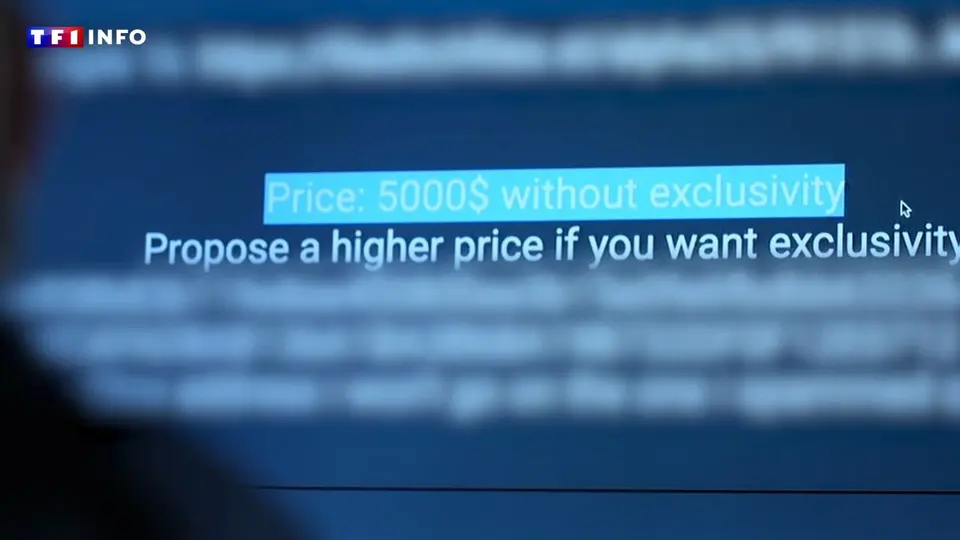
A hacker, presenting himself as a minor and living with his mother somewhere in Europe, agreed to describe to TF1 Info journalists how this world functions. He claims responsibility for hacking numerous French websites, including, according to him, a health insurance provider's database containing the banking details of 770,000 individuals. "When I have IBANs or more than a million lines, I sell [...] For the same database, I can receive between 200 and 1,000 euros. Sometimes I sell it to multiple buyers, either in full or just excerpts," he explains.
On his motivations, he is direct: "It is above all for the challenge." He adds: "It makes me laugh when the French government or a company say they have just detected us, when in reality we have been there for months."
The profile of a hacker: young, solitary, seeking recognition
As arrests mount, a profile emerges. The hackers involved in these affairs are young, often minors. They act alone or in small groups, driven by the search for challenge and notoriety within their community. Maître Julien Roelens, lawyer at the Paris Bar, defends a young man questioned in summer 2025 along with three other suspects. His client, previously unknown to the justice system, is suspected of cyberattacks against numerous French victims from abroad. He faces up to ten years in prison.
"It is a very solitary path. These are young people who educate themselves, who are often in the darkness of their bedroom, on their computer. It is pride, it is immaturity and it is the desire to show this community a little bit that one is capable of circumventing the security system of such and such a company in one night," indicates the lawyer.
An 18-year-old adolescent, suspected of being one of the hackers behind the hacking of the tax authorities — which affected the data of 678,000 taxpayers — has been placed in provisional detention in Paris.
Data cross-referenced to know almost anything about almost anyone
When a hacker publishes stolen data, it is immediately seized by other cybercriminals, who cross-reference it with information from previous leaks. A pirate contacted by the TF1 Info team offers this service to his clients for around one hundred euros. "Personal information, civil status records, customer files, photos, numbers. There is a lot of it, I swear, there is too much actually," he assures. On the use made of it, he shows indifference: "I have no remorse about this. I do not look at the type of clients and what they do with it."
To concretely measure the extent of this available data, TF1 Info journalists asked Clément "Saxx" Domingo, a cybersecurity expert, to search for publicly accessible information about a news reporter cameraman from the newsroom. "Just by typing his first name and surname, we can see there are already very many elements that come up," indicates the expert. Address, telephone number, banking details, certain online purchases, holiday reservations and even the maiden name of his partner are thus recovered. This information interests fraudsters, identity thieves and burglars, but also, according to the expert, foreign states and French companies seeking to enrich their customer files.
The state facing a growing threat
Faced with the multiplication of incidents, Prime Minister Sébastien Lecornu has called for the creation of a new cyber unit tasked with intervening rapidly in the event of a serious attack against state computer systems. The resurgence of hacking in recent months now requires a major institutional response, whilst the perpetrators of these offences remain, in many cases, difficult to locate and prosecute.
Source: TF1 Info