Apprenticeship fraud: 1.5 to 3 billion euros at risk, Court of Auditors warns
The Court of Auditors estimates that 10 to 20 per cent of apprenticeship spending is exposed to risks of fraud and abuse. Widespread and poorly coordinated control failures facilitate embezzlement.
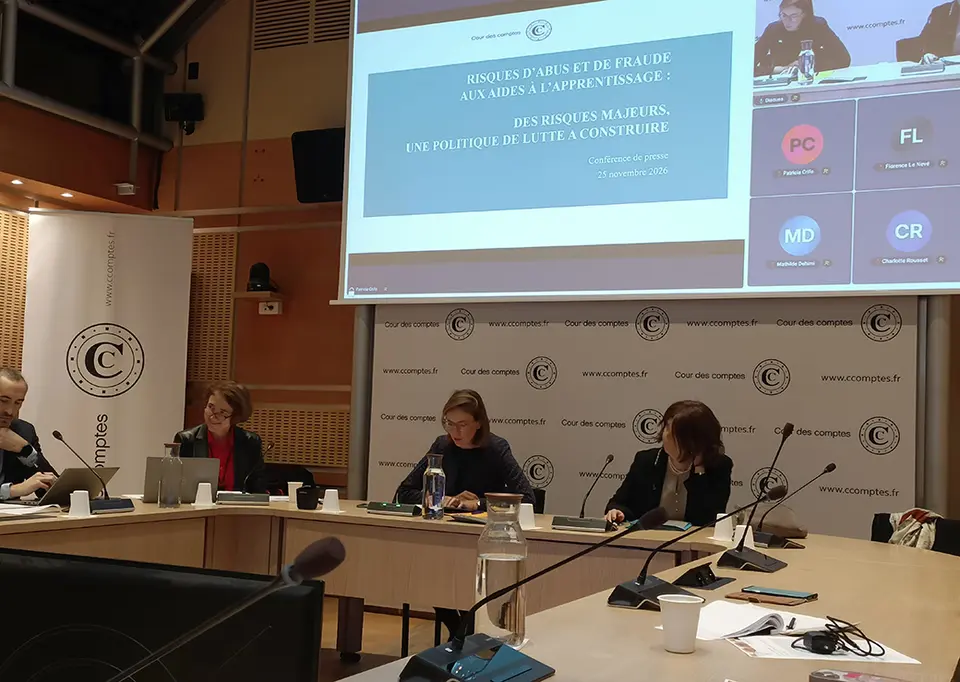
Massive fraud risks in the French apprenticeship system
According to banquedesterritoires.fr, the Court of Auditors issued a damning assessment of the French apprenticeship system on Wednesday 25 November. Between 1.5 and 3 billion euros — equivalent to 10 to 20 per cent of total spending — are at risk of fraud or abuse, according to estimates from the country's highest financial authority.
These expenditures, distributed in the form of employer subsidies and funding for apprenticeship training centres, present sufficiently serious gaps to warrant thorough verification. The president of the Court, Amélie de Montchalin, emphasised that the issue is not whether to be for or against apprenticeship, but to ensure that the system "fully fulfils its purpose and genuinely enables young people to acquire skills and achieve sustainable employment access".
Insufficient regulation accompanies the expansion of the scheme
The explosion in the apprenticeship system "has not been accompanied by regulation commensurate with the challenges", Amélie de Montchalin stated, pointing to a "fragile" structure. The Court of Auditors emphasises that "control requirements were insufficiently considered at the design stage of the scheme, while the prevention, detection and handling of abuse and fraud remained secondary".
Numerous warning signals remain unexploited. More than 37,000 companies report over 70 per cent apprentices among their workforce. Around 35,107 companies with no employees — except apprentices — have at least one apprentice, or even three in a thousand cases. These figures reveal atypical situations that may indicate abusive arrangements.
Systematic breaches of the regulatory framework
The regulatory threshold sets the limit of two apprentices per training master. However, the Court finds that breaching this ceiling accounts for approximately one-third of contracts examined among three skills operators — equivalent to nearly 10 per cent of total apprenticeship spending.
The 10 additional percentage points retained by the Court in its upper estimate correspond mainly to apprenticeship contract terminations that often occur after one year. These terminations allow employers to receive the hiring bonus twice upon re-hiring. Beyond these documented elements, the Court lists other fraudulent schemes: fictitious contracts, identity theft, training not delivered, overbilling and organised fraud.
Responsibility diluted among multiple actors
The system involves multiple players: the State pays bonuses to employers, whilst skills operators — the Opco — receive contracts and distribute funding levels to training centres. This fragmentation dilutes responsibility. "Control responsibilities are very poorly coordinated. Controls are very heterogeneous. Information between the actors supposed to exercise control does not circulate", Amélie de Montchalin stressed.
The gap between the Court's risk estimate and fraud actually detected is striking. The payment services agency — the body disbursing hiring bonuses — recorded 8 million euros in files suspected of fraud in 2025. The inter-ministerial anti-fraud mission (Micaf) puts forward 10 million euros. The Court notes that less than 1 per cent of funds managed by the Opco were subject to blocking measures.
Ministries downplay the findings
The offices of the Labour, Education and Professional Training ministers consider the assessment "somewhat severe", whilst acknowledging a "coordination defect". They dispute the percentage advanced by the Court, described as maximalist, preferring estimates from the payment services agency and Micaf.
They also argue that exceeding the threshold of two apprentices per training master "is not fraud". Regarding the insufficiency of regional professional training control staff — 162 agents for 4,000 training organisations — the ministries urge the skills operators, which have around 8,000 agents, to "raise their game".
A digital platform to strengthen controls
The government has planned, in the 2027 finance bill, the creation of a single digital platform for the transmission of apprenticeship and professionalisation contracts. It aims to "pool resources and information systems, generate efficiency gains and address control and fraud-fighting challenges".
Source: Google News FR — Crime (fr)