Trial of Émilie König: former jihadist asks forgiveness from victims of Daesh
Presented before the special assizes court of Paris on Friday, the 41-year-old accused apologised for her role as an Islamic State propagandist. She faces 30 years' imprisonment.
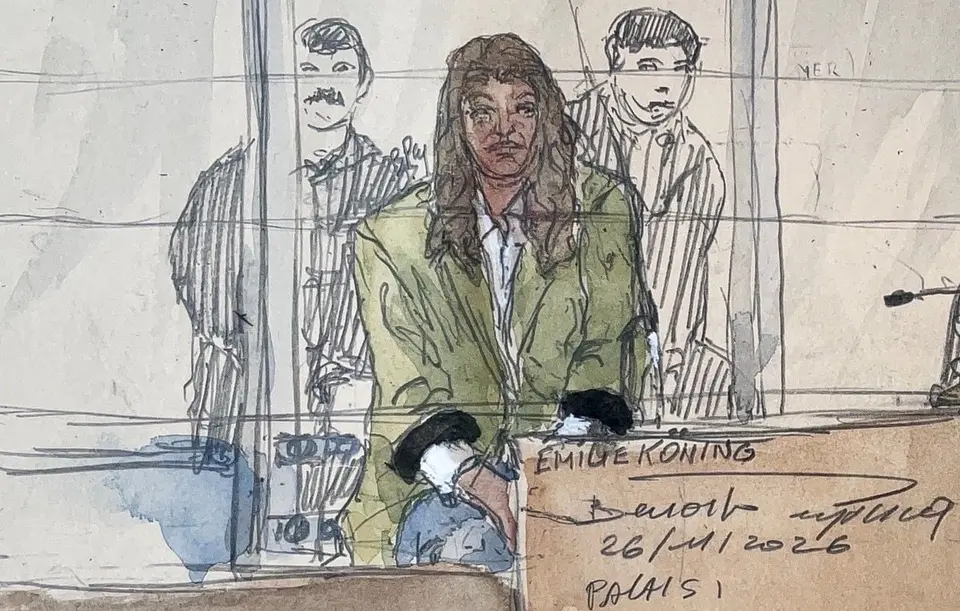
Former jihadist figurehead faces judges
According to 20minutes.fr, Émilie König appeared on Friday for the second day of her trial, accused of "criminal terrorist criminal association" before the special assizes court of Paris. This 41-year-old Breton woman, described as a "figurehead" of Daesh by the National Counter-Terrorism Prosecutor's Office, is keen only to speak and explain herself before the judges.
During her testimony, the accused first wished to apologise. She expresses her regrets to her children, first to her two eldest born before her departure to Syria in spring 2013, who "did not deserve to grow up without a mother". Her three youngest, born in Syria, "did not deserve to know hunger". She also apologises to her mother, to the magistrates and "to the French nation". "I know the impact of the jihadosphere, I am truly ashamed," she states.
König was placed by the United Nations on the list of the most dangerous fighters. She is also the first French woman to appear on the United States "blacklist". Investigators from the DGSI emphasise that she widely disseminated Islamic State propaganda on Facebook, threatening France and posting photographs of herself armed.
A chaotic personal history
The court seeks to trace the thread of her life before entering into the substance of the case. König analyses that her trajectory suffered from the absence of "good foundations from the start". Her father, a gendarme, left her at the age of 2 years. She attempted several times to re-establish contact without great success. Her relationships with her mother are very ambivalent, oscillating between closeness and serious conflicts. In adolescence, tensions were such that she was placed in foster care.
The mother-daughter relationship appears irretrievably broken. In a letter addressed to the court, her mother paints an acerbic portrait of her daughter: a drug user, a liar, a bad mother. She claims to have experienced a "true ordeal" and ends with a final farewell: "This will be the last time in my life, Émilie, that you hear from me."
Before turning to radical Islam, König long oscillated between the world of nightlife and religion. She converted around age 16 but led a life marked by excess: alcohol, drugs, fleeting relationships. She worked in bars and nightclubs. At 20 years old, after her first child, she met a drug trafficker with whom she had a second child, despite suffering violence. "This does not excuse me, it is a certainty, but it explains many things," she says.
Radicalisation online and departure to Syria
König radicalised alone, via the Internet. She was among the first French women to leave for Syria in 2013 and is one of those who remained there the longest — ten years, including five in detention at Roj camp. In Syria, she attracted attention for her increasingly vehement messages on Facebook. In 2014, she claimed that her unborn child would be "a future fighter" and said she was ready to die as a martyr, asserting that she possessed an explosive belt.
According to investigators, she boasted of having brought some twenty women to Syria. It was only after the collapse of the Islamic State that she expressed a desire to return to France.
Between hope and maternal worry
Today, König says she sees her future only through that of her five children. She has reconnected with her two eldest and speaks with pride of her second son's architecture studies. But her emotion returns when speaking of her three youngest, born in Syria. In January 2021, after three years at Al-Roj camp, she agreed that they be repatriated to France and placed with a foster family. "It was a wrench when they came back," she says. She has seen her twin daughters only once since, two years ago. Her son refused to enter the room. "It had been two years since he had seen me, I am a stranger to him," she says in tears.
Facing 30 years' imprisonment, König expects only one thing from this trial: to convince the court that she is "no longer dangerous" and thus be able to resume "her life as a mother".
Source: BFM TV