Polk Murder 1948: New Book Challenges Official Account of Motive
Researcher Spyros Kouzinopulos argues that the American journalist was murdered due to corruption investigations, not because he was heading to meet Markos Vafiadis.
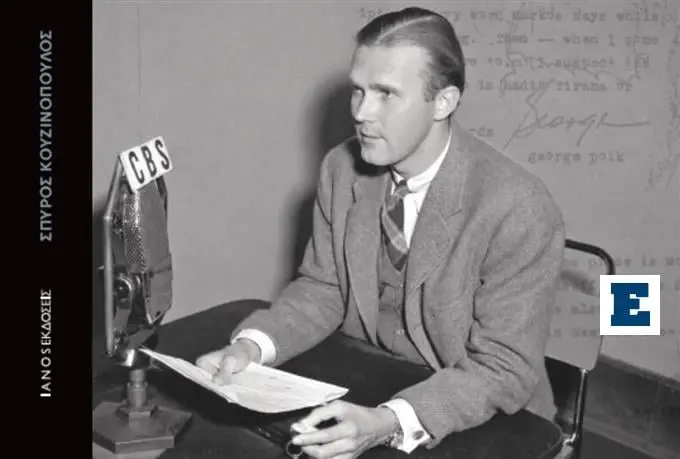
"The Great Deception": New Book Overturns Dominant Account of George Polk's Murder
American war correspondent George Polk was found dead in the Thermaic Gulf in May 1948, with bound hands and a bullet to his head. Eight decades later, the case remains officially unsolved. According to Ethnos, journalist and historian researcher Spyros Kouzinopulos presents in his new book a revolutionary reading of events, directly challenging the account that prevailed both in Greece and in the United States.
The book, titled "The Great Deception in the Polk Case", is published by IANOS editions and is Kouzinopulos's 15th work. Its pages present twelve different accounts of the murder and 26 unanswered questions that continue to weigh on the case.
Pyjamas Instead of Typewriter
Kouzinopulos's central argument is a seemingly simple observation: Polk, if he truly intended to go into the mountains to meet Markos Vafiadis, the leader of the rebels of the Democratic Army of Greece (DSE), should have had his professional equipment with him — camera, typewriter, stationery. Instead, according to the author, he had only his pyjamas in his luggage.
Furthermore, Kouzinopulos notes that Polk and his wife had already purchased return tickets to the United States, departing a few days later. A multi-day trip into the mountains, under conditions of civil war, was chronologically impossible to complete before their departure.
Corruption, Not Rebels
The book's central conclusion is that Polk was murdered because he was investigating corruption scandals and the squandering of American economic aid. The author believes that some who were troubled by these investigations decided to "silence the journalist for good". The official account of the trip to Markos is treated in the book as part of an organised disinformation campaign.
This account had initially been presented by the Thessaloniki Police, and had been adopted both by the Greek government of the time and by American authorities. Kouzinopulos concludes that all the accusations by Greek political, police and judicial authorities regarding the place and manner of the murder are part of an "unprecedented cover-up in the annals", which made the Polk case one of the most characteristic instances of political expediency and judicial error.
The Dead Murderer and the Wrongly Imprisoned
The official trial resulted in the conviction of Grigoris Staktopoulos, editor of the newspaper Makedonia, who remained in prison for 12 years. Kouzinopulos compares him to Alfred Dreyfus, the French officer wrongly convicted in the late 19th century. Justice, the author notes, has refused to this day to restore his name.
Presented by the authorities as the "murderer" was Adam Mouzenidis — who, as it turned out, had already died a month before Polk's murder. This fact led the then prime minister Panagiotis Kanellopoulos to respond sardonically to the question of who killed George Polk: "The certain thing is that Grigoris Staktopoulos was not an accomplice to a murder committed by a… dead man."
Hemingway and the Timeliness of Silence
Kouzinopulos recalls in his book the words of Nobel laureate author Ernest Hemingway, who had written that "if the case of journalist Polk is silenced, this will be a victory for those who believe they can kill the truth by killing the man who seeks to reveal it".
Presentations in Thessaloniki and Athens
The book "The Great Deception in the Polk Case" will be presented on Wednesday 18 November 2026, at 7 p.m., at the Children's IANOS in Thessaloniki, Gregoriou Palama 3. A week later, on Wednesday 25 November 2026 at 5 p.m., it will be presented at IANOS Athens, Stadion 24.
Source: Ethnos