Porto Municipal Police sends case of baton strikes by two officers to public prosecutor
Porto Municipal Police has drawn up an incident report on baton assaults by two officers on the night of 25 October and has sent the case to the Public Prosecutor's Office.
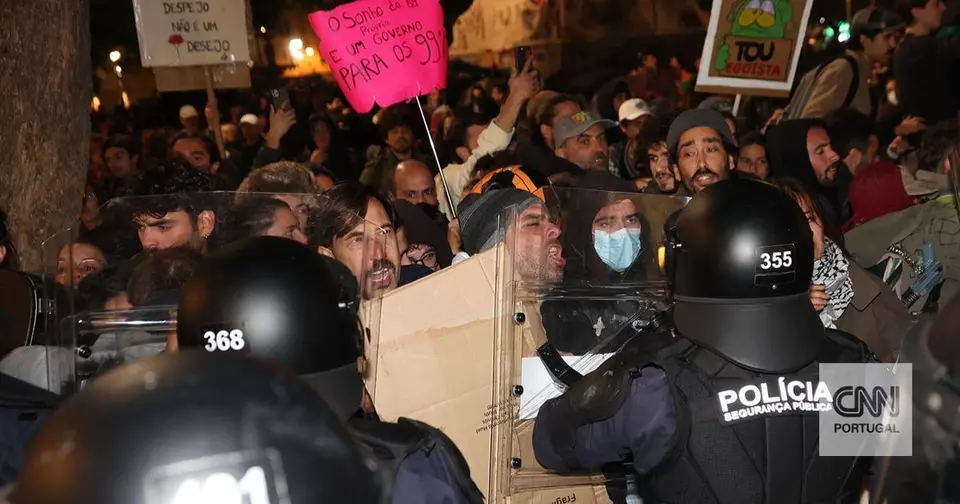
Baton strikes on Rua de Sá da Bandeira referred to Public Prosecutor
Porto Municipal Police has drawn up an incident report on the use of batons by two of its officers on the night of 25 October — the date of the second PSP charge on the Encampment — and has sent the case to the Regional Department of Investigation and Criminal Action (DIAP) of the Public Prosecutor's Office in Porto, CNN Portugal reported.
The information is contained in a response from commander Liliana Marinho to the left-wing Bloco de Esquerda municipal group in the Porto Assembly, to which Lusa had access. According to the document, the municipality "became aware of the existence of a video recording" in which two officers resorted to the use of batons on Rua de Sá da Bandeira, "at a moment before the PSP police intervention at Praça de D. João I".
"The police officers are properly identified, and the corresponding incident report has been drawn up and sent to the DIAP Regional office in Porto of the Public Prosecutor's Office, with the aim of ensuring an impartial and comprehensive assessment of the facts," the response states.
Role of Municipal Police on the night of 25 October
In the same response, the Municipal Police detail how it acted in the police charge of 25 October, which resulted in dozens of injured, several of them seriously, and which preceded a third intervention in the early morning of 1 November.
The operational command post formed by the Porto Metropolitan Command for the demonstration that day included the Municipal Police, but its action "was restricted to the usual institutional cooperation and collaboration", namely in the removal of tents and in the delimitation of the security perimeter and traffic.
The participation of municipal cleaning services — under municipal responsibilities for public space cleanliness — was, according to the same source, requested by the Municipal Police command on 25 October 2026 itself.
The seized goods remain in the possession of the Municipal Police and can be recovered by means of proof of ownership and an application. The tents, in particular, are "seized under a summary offence procedure".
Bloco de Esquerda criticises "fragmented" responses
Municipal deputy Susana Constante Pereira of Bloco de Esquerda considered that the clarifications were presented "in a fragmented manner" and refer to "only one of the pending requests". Nevertheless, she argued to Lusa that "the mayor cannot pretend that the municipality is unaware of what happened, when the responses themselves confirm the intervention of the Municipal Police and municipal services".
Constante Pereira noted that there remains unclear the lack of seizure reports and the "concrete legal basis for the seizures". The deputy also recalled that "the brutal police interventions of 15 October, 25 October and 1 November will go down in the city's history as a stain of shame and will mark this term" of the Porto City Council, chaired by Pedro Duarte (PSD/CDS-PP/IL).
On 29 October, the Porto City Council had already confirmed the existence of "direct coordination" between PSP, Municipal Police and Porto Ambiente in operations on 12 and 15 October, also in response to Bloco de Esquerda.
Housing protests spread to Lisbon and other cities
Protests against the housing crisis began in Porto on 10 October and spread to Lisbon, with gatherings also in other cities. The PSP's actions to disperse the encampments and remove tents at Rossio in Lisbon and at Praça D. João I in Porto resulted in dozens of arrests and dozens of injured, generating widespread criticism.
The Lisbon Encampment decided, on Saturday night, to set up tents again at Praça dos Restauradores, after being unable to return to Rossio. In Porto, the tents also remain at Praça D. João I during the night.
The protesters are demanding the reversal of the new rental law, a halt to the acquisition of housing by real estate funds and rent caps.
Source: CNN Portugal