Sócrates accuses Public Prosecutor of lying and manipulating telephone recordings at new trial hearing
Former Prime Minister José Sócrates contested the way telephone conversations were reproduced in the prosecution case, describing them as false. The next hearing is scheduled for Tuesday.
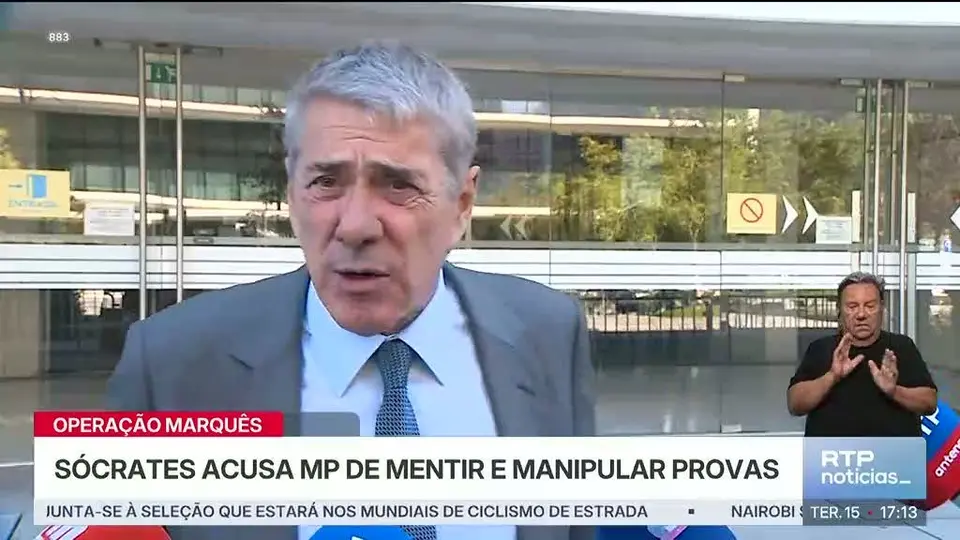
"This is all a lie," shouts Sócrates as he contests telephone recordings in court
According to RTP, José Sócrates raised his voice again on Thursday during a hearing in his trial, accusing the Public Prosecutor's Office of "manipulating conversations" and of lying in the way it reproduced a telephone call in the indictment.
At issue is a call between Sócrates and Carlos Santos Silva, in which the Public Prosecutor claims it was the former Prime Minister who told his interlocutor not to speak about the matter over the telephone again. Sócrates vehemently rejected that version: "The indictment says it was I who said 'don't speak any more on the telephone'! It's hard to believe!" According to the former head of government, it was Santos Silva who uttered that phrase.
When the judge confirmed that was indeed the interpretation contained in the indictment, Sócrates reacted: "Don't reproduce it. That is a violence." Faced with the magistrate's insistence, he added only: "This is worse!"
The former Prime Minister reiterated his thesis of political persecution: "Everything that the right wing hated, the Public Prosecutor persecuted."
Paris flat: "I am not the owner of any flat"
The session also included questions about the acquisition of a flat in Paris, one of the central axes of the indictment. Sócrates guaranteed he had no say in the decision to buy. "I did not know of Carlos Santos Silva's intention to buy the flat. I said nothing about the purchase," he stated.
The former Prime Minister described how it was Santos Silva who, in 2012, negotiated and closed the price of the property with the estate agency, without his prior knowledge. "I don't know the notary, the estate agency. I don't know them. There is only one explanation: I didn't know these people," he said.
Sócrates also questioned the logic of the indictment: "How can I be a hidden owner if I didn't choose the flat? I was not present. They can ask Santos Silva." And he concluded: "I am not the owner of any flat in Paris. I am guilty by association."
Regarding furniture purchased from a shop in Paris—mentioned in the indictment—Sócrates clarified that the purchase was intended for his own home and not that of Santos Silva. "We bought two lamps and a sofa. If I recall correctly. I spent 7,000 euros on this," he indicated, adding that the Public Prosecutor did not include in the investigation a Paris account that he considered relevant.
TGV: Sócrates insists there was no political pressure
After the lunch break, the former Prime Minister wished to resume his reasoning on the TGV competition, describing the indictment related to that subject as "malicious". "I had neither imposition nor intention in bringing forward the competition relating to the TGV," he stated.
Sócrates maintained that the idea of bringing forward the competition came from the Public Works Minister, not from him. He also noted that all members of the competition jury stated in writing that they had accepted a certain clause because of approval from the Court of Auditors, ruling out any pressure from the political sphere. "It is not the responsibility of politics, it is a responsibility assumed by all of them," he clarified.
The judge interrupted his speech several times, asking the defendant to focus on new information and not to repeat arguments already presented. "But are you going to say anything new?" the magistrate asked. Sócrates replied that he would, but that he would end up repeating himself.
The former Prime Minister also accused the Public Prosecutor's Office of conducting "a thorough audit" of his government throughout the proceedings.
Tension with the judge and new confrontation over language
The session was also marked by moments of tension between Sócrates and the court's presidency. The former Prime Minister used the term "rubbish" when referring to content of the indictment—"I read rubbish in the indictment"—and was warned by the judge to moderate his language. "Right, I apologise. Okay, I said rubbish. But what I want to say is: they say there are two accounts. But how so?", he continued.
There was also a discussion about the way Sócrates addressed the prosecutor: the judge asked him to call him by his full name or by his title only. The former Prime Minister responded that he did not recall the magistrate's surname, invoking the fact that he himself had been treated in a disparaging manner in the past: "They called me José Pinto de Sousa."
Next sessions scheduled for Tuesday and Wednesday
Thursday's hearing ended without the issues under analysis being exhausted. José Sócrates is to be heard again next Tuesday, at 10:30, following a witness hearing scheduled for 9:30. A new session is also scheduled for Wednesday, at 14:00.
In the next sessions, the former Prime Minister is expected to address issues related to Paris, namely the events that occurred between 2013 and 2014.
Leaving the courthouse, Sócrates recalled that he had presented three defence lawyers and accused the judge of not having granted sufficient preparation time for the trial.
Source: RTP