Former President Santiago Peña Detained in Paraguay Following Impeachment Removal
Paraguay's Senate removed Santiago Peña by unanimous vote and he was arrested in Asunción. He will testify regarding the collapse of Ueno Bank, which left millions of savers without access to their funds.
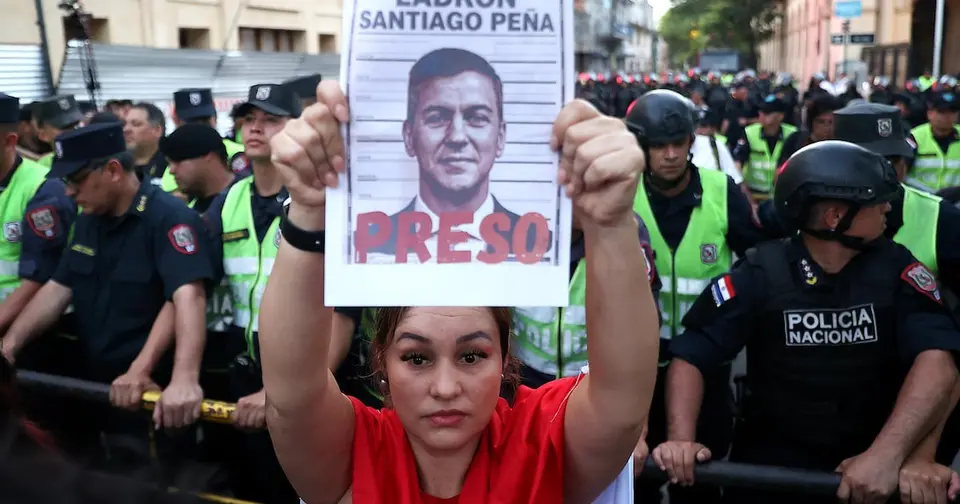
Peña Transferred to Presidential Escort Regiment Following Arrest in Asunción
Paraguay's former president Santiago Peña was arrested on Friday night at his residence in the Santísima Trinidad neighbourhood of Asunción, hours after being removed by the Senate through impeachment proceedings, according to pagina12.com.ar. In the early morning hours he was transferred to the Presidential Escort Regiment (REP), an Army unit responsible for protecting the country's highest authorities, amid protests outside his home.
As the convoy departed for the REP, a group of protesters threw objects at the vehicles. Police deployed a security cordon and dispersed the gathering with rubber bullets. The protesters demanded that Peña serve his detention in a regular prison.
Questioning Session Over Ueno Bank Case
Peña is to testify on Saturday at 11:00 before the Public Prosecutor's Office, summoned by prosecutor Silvia Margarita González Vester. He will answer questions regarding alleged crimes of breach of trust, influence peddling and administration for personal profit, all related to the closure of Ueno Bank.
The prosecutor informed the press that the former president would remain in detention at his residence until Saturday morning, when he would be taken to the prosecutor's office for questioning. On Friday night, however, Peña was transferred to the REP for security reasons.
Unanimous Removal; Second Case in Recent History
With the vote in favour of all 44 senators present, Peña, 47, became the second president of Paraguay to be removed from office through impeachment since the return to democracy, following left-wing Fernando Lugo, who governed between 2008 and 2012.
The now former president, who lost the support of his own Colorado Party, did not appear before the legislature despite being personally summoned. He delegated his representation to lawyers Adolfo Ferreiro and Ricardo Preda, who presented the technical and legal defence.
The announcement of the removal was greeted with chants of "Santi, rat, give back the money" and a cacophony of pot-banging in central Asunción. Hundreds of people gathered in the Plaza de Armas of the capital, many wearing national team kits and placards demanding the return of savings.
Crisis Triggered by Ueno Bank Collapse
Paraguay is experiencing a political and financial crisis following the Central Bank's (BCP) decision to apply a resolution procedure to Ueno Bank, an institution with 2.94 million clients in a country of 6.1 million inhabitants. The bank received substantial resources from public entities during Peña's administration.
Thousands of savers reported having no access to their funds. Among those affected are 32,000 retirees from the Social Security Institute (IPS), one of the country's main pension funds.
The deputies who acted as prosecutors in the impeachment trial pointed to the loss of approximately 1.2 billion dollars "from the Paraguayan people" as a result of the bank's closure, and described Peña as "the greatest embezzler in the country's history".
During the trial, opposition senator Rafael Filizzola described the bank's drainage as "the greatest corruption scandal of the democratic era in Paraguay". The ruling-party and former ambassador Gustavo Leite accused Peña of having betrayed "all Paraguayans" and called for the removal to be carried out with dishonour.
Peña Loses Status as Lifetime Senator
Article 189 of Paraguay's Constitution provides that democratically elected former presidents shall be lifetime senators, unless they have been subjected to impeachment proceedings and found guilty. With the removal, Peña loses that status and, with it, the immunity that prevented him from facing criminal proceedings without congressional authorisation.
Shortly before the vote, Peña posted on his X account that he had submitted his resignation to prevent further harm to the country. "I do not want my presence to be a cause of greater division or instability. My responsibility is to put the country above my personal fate," he wrote. Congress, however, did not achieve the quorum necessary to consider that resignation.
Alliana Takes Presidency and Promises Compensation to Savers
Following Peña's removal, Vice President Pedro Alliana was sworn in as new president before an extraordinary session of Congress. The chamber president, ruling-party member Basilio Núñez, presented him with the presidential sash and baton.
In his first address to the nation, Alliana promised to compensate those harmed by the financial collapse. "The compatriots who today are going through a difficult time as a consequence of the financial disaster will be fully compensated. We will not leave them alone," said the new president.
Alliana also ordered that "immediate action be taken to make reparations to savers with preference for the least favoured" and indicated he would not tolerate half measures in the execution of that task. The new president assured that he will focus his administration on resolving the financial crisis through the end of his term.
Source: Google News AR — Crime