Marco Aurelio González surrenders to police after being declared a fugitive in Ueno Bank case
The former BCP Board member presented himself voluntarily to the DCCO hours after a search of his residence failed to locate him.
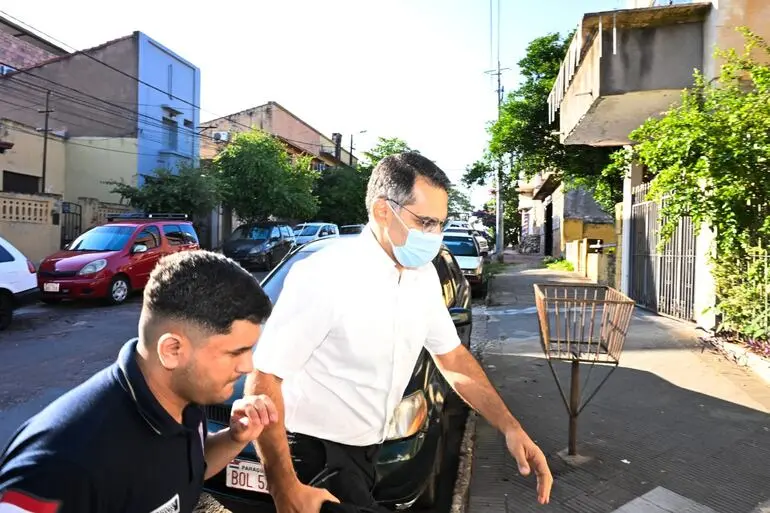
Former BCP director presents himself to the National Police in the Ueno Bank case
Marco Aurelio González presented himself shortly before 08:00 on Friday at the Organised Crime Directorate (DCCO) of the National Police, accompanied by his lawyer Arturo Daniel. According to abc.com.py, the voluntary surrender occurred hours after the Public Prosecutor's office conducted a search of his home in Luque without finding him, which resulted in him being declared a fugitive.
Following his presentation, the National Police activated the corresponding procedures to guarantee his rights and notified the Public Prosecutor's office of the situation. The authorities indicated that they had not yet been able to speak with González to establish the reasons why he was not at his residence during the operation. The Prosecutor's office is awaited to summon him for transfer to the Specialised Unit for Economic Crimes and Anti-Corruption (UDEA).
Simultaneous operation against three former BCP executives
The procedure against González formed part of a series of simultaneous search operations carried out that same Friday by the Public Prosecutor's office with the aim of capturing three former members of the Board of the Central Bank of Paraguay (BCP) as part of the investigation into the collapse of Ueno Bank and its parent company, the Vázquez Group.
The Prosecutor's office ordered the capture of Liana Caballero—who served as interim president of the BCP following the resignation of Carlos Carvallo—of Marco Aurelio González—former Attorney-General of the Republic—and of Miguel Ángel Mora. Caballero was detained at her residence in Asunción and Mora was captured at his residence in Luque. González, as already noted, was not located during the search and subsequently surrendered voluntarily.
The case is the same one in which former BCP president Carlos Carvallo, banking superintendent Holger Insfrán and former president of the Republic Santiago Peña are facing charges. Insfrán was also detained at his residence, located in the Santa Librada neighbourhood of Asunción.
Evidence of prior knowledge of insolvency
The judicial resolution ordering the captures indicates that the Public Prosecutor's office has evidence that the three former executives would have had direct and early knowledge of Ueno Bank's insolvency situation at least since December 2025, as well as of alleged irregularities in loans granted to companies linked to the business group itself.
According to the prosecutorial hypothesis, despite being aware of that situation, the then BCP executives would have omitted to implement the corrective and precautionary measures that their legal powers imposed on them. The judicial document argues that that alleged omission would have allowed the continuation of irregular operations and the massive capture of public funds under conditions of insolvency, until the financial situation of the entity became unsustainable.
The collapse of the bank and its consequences
On 3 November, the BCP announced the beginning of a resolution procedure for Ueno Bank, putting an end to its operations. The decision was based on the deterioration of solvency indicators and alleged irregularities in the granting of large loans to companies linked to the group. The measure affected the savings of hundreds of thousands of users and funds from various Paraguayan state institutions deposited in the entity.
The case also led to a political crisis which, according to the operational data, culminated in the dismissal of Santiago Peña through a political trial and his subsequent detention and charging for alleged acts of breach of trust and administration for personal benefit. Peña had been a shareholder of the business group that included Ueno Bank until March 2025, a period during which the entity recorded significant growth, captured state funds and companies linked to the group obtained public contracts.
Source: Google News PY — Crime