Murder of Dr. Roslik in dictatorship: nine military officers convicted 42 years after the crime
42 years after his death, Uruguay commemorates Dr. Vladimir Roslik, the last person murdered during the dictatorship. In December 2025, nine military officers were convicted of crimes in San Javier.
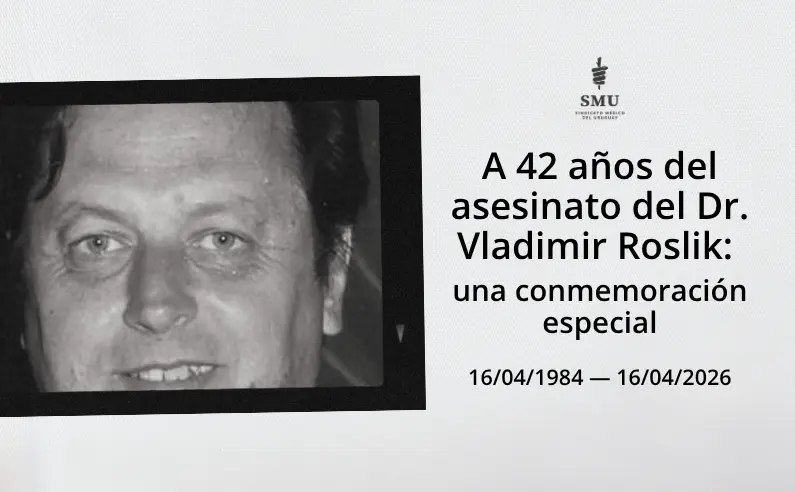
Historic conviction 42 years after the murder of physician Vladimir Roslik in San Javier
According to smu.org.uy, every 16 April the Medical Union of Uruguay remembers Dr. Vladimir Roslik, the last person killed during the Uruguayan civil-military dictatorship. This year the commemoration arrives with a different weight: on 22 December 2025, Judge Claudio de León read out a sentence lasting more than five hours at the Fray Bentos Court and convicted nine retired military officers for crimes committed in operations in 1980 and 1984 in San Javier, in Río Negro department. The highest sentences were 15 years and six months imprisonment. The magistrate apologised on behalf of the State for what occurred during the dictatorship.
Dr. Roslik's murder itself could not be tried in this case: the Supreme Court of Justice had determined that there was res judicata within the scope of Military Justice, closing off that penal avenue. Nevertheless, the conviction represents a milestone for the victims, their families and for those who for decades demanded truth and justice.
A doctor from his community
Vladimir Andrés Roslik was born on 14 May 1941 in San Javier, the small locality in Río Negro department founded in the early twentieth century by families of Russian immigrants. He studied medicine at the Patrice Lumumba University of Moscow thanks to a scholarship and returned to his town with his degree validated. It was the community itself that helped him set up his surgery, without institutional support of any kind.
On 29 April 1980, an armed forces operation "invaded" San Javier. Roslik was detained together with a group of neighbours and spent a year in Libertad Prison. During his detention, his mother died. Upon regaining his freedom in July 1981, many neighbours and friends suggested he emigrate. He always replied that he would not leave his locality.
The early morning of 15 April 1984
His son was only four months old when, in the early morning of 15 April 1984, they knocked on the Roslik door. His wife, María Cristina Zabalkin, known as Mary, recalled that moment in statements published by the weekly journal Jaque on 27 April, days after the events:
"They take over the whole house. Around the house and inside with machine guns. When I see my husband he tells me 'don't be frightened, because they are soldiers'. They enter the kitchen and already in the kitchen my husband started to cry. He asked if they would let him say goodbye to me and they took him to the bedroom. He was already handcuffed. One came with a revolver and another with a machine gun."
Vladimir was transferred to the San Javier police station and then to the Infantry Battalion No. 9 of Fray Bentos. At 6 in the morning of 16 April, Mary's father arrived at the house with the message that they had to go to Fray Bentos to collect the body.
The false autopsy and the second examination
The official version spoke of a "cardiorespiratory arrest". Military physician Eduardo Saiz signed a death certificate without a time of death, without exact date, without the signature of the attending physician and without indication of whether an autopsy had been performed.
Mary did not accept it. In the midst of dictatorship, she demanded a second autopsy. She travelled with the body to Paysandú in an ambulance after calling other doctors. The specialists found lethal organic injuries: marks of torture, the liver torn by blows and evidence of asphyxiation by "submarino". The physicians who performed the second autopsy, aware of the danger, swore not to make public statements.
When the truth reached public opinion through an investigation by the weekly journal Jaque, the Medical Union of Uruguay expelled Eduardo Saiz from its ranks, who had signed the false autopsy. It was the first time in the history of the Uruguayan medical profession that colleagues who had participated in torture or covered it up had been publicly denounced.
Four decades of judicial struggle
For more than four decades, María Cristina Zabalkin did not give up. She made the rounds of courthouses, convinced neighbours to testify, compiled evidence, written material and testimonies. In November 2025, for the first time in 41 years, Mary was able to testify before the courts, facing the accused military officers.
42 years after the crime, the SMU remembers Dr. Vladimir Roslik with the same conviction: medicine has an ethical dimension that goes beyond the profession. Remaining silent in the face of injustice is also a decision.
Sources: Medical Union of Uruguay (smu.org.uy), including institutional notes, historical statements, the essay by Dr. Andrés Banchero Ciliberti and interviews published in the SMU News Magazine.
Source: Google News UY — Crime