Organised crime in Montevideo: neighbourhoods with more homicides than New Orleans
Peñarol recorded almost 61 homicides per 100,000 inhabitants in 2022. Experts warn that the phenomenon is due to territorial disputes between criminal gangs.
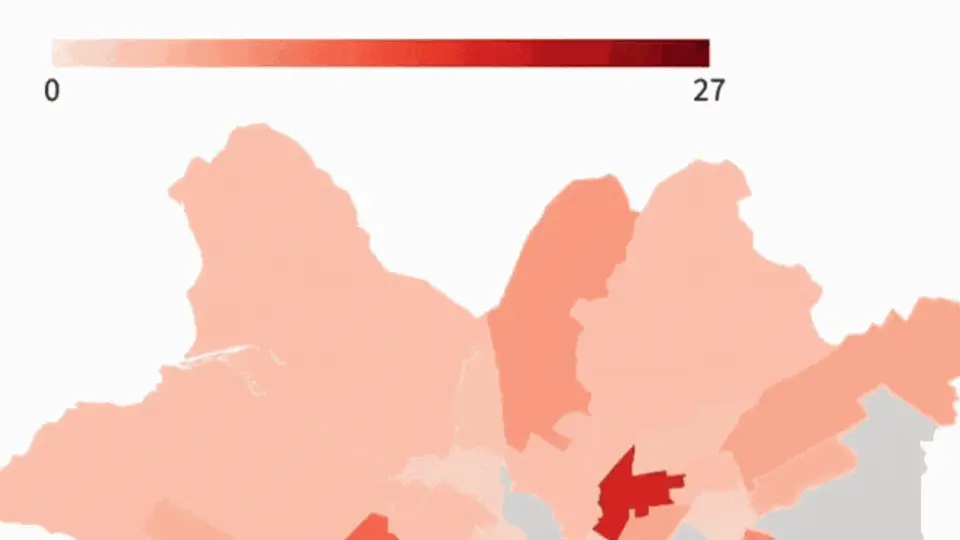
Peñarol, Casabó, Casavalle: the map of organised violence in Montevideo
According to elobservador.com.uy, the Peñarol neighbourhood recorded almost 61 homicides per 100,000 inhabitants during 2022. To put the figure in perspective: if that rate were applied to Pocitos, the most populous neighbourhood in Montevideo, there would be one death every nine days. Pocitos did not record a single homicide that year.
The previous year, the neighbourhood with the highest concentration of murders was Casabó. Before that, Casavalle. The rotation is not coincidental: criminologists and sociologists agree that the pattern responds to disputes between rival gangs for control of neighbourhood drug markets, not to an improvement or deterioration in security policy.
A pattern that does not change, only shifts
Spencer Chainey, director of the Latin America unit at the Criminology Department of University College London, analysed the situation for El Observador. "The pattern of murders in Montevideo does not change so much, but rather is associated with areas where people have conflicts with each other or between rival criminal groups," Chainey said.
The criminologist also evaluated the impact of the police plan PADO, implemented years earlier. He acknowledged that "it was truly effective, at least between 2016 and 2017, in reducing the opportunities for thieves to rob," thanks to the presence of patrols in specific places and times. However, he warned that this programme "did not transform these criminals into polite and law-abiding people" and that it also did not change the logic of homicides, which "in Montevideo, as in other port areas of the Río de la Plata Basin, are linked to organised crime and the struggle for the market".
Seventeen dead in nine months in Peñarol
Sources from the Prosecutor's Office confirmed to the Uruguayan media that the series of 17 murders recorded in Peñarol in fewer than nine months—plus four more in the neighbouring Lavalleja neighbourhood, combined for statistical purposes—responds to a specific sequence: the death of the leader of the hegemonic gang, the retaliation of the rival gang and, above all, the rise of a third group that imposed extreme violence comparable to that of Mexican cartels. The methods included dismemberment, mutilation and disappearances.
Sociologist Gustavo Leal, former director of Coexistence during the last administration of the Broad Front, noted in La Diaria that "the balance in the equation of forces in the Peñarol neighbourhood was altered following the death" of Walter Segales. Leal described a scenario in which gangs controlling between four and five drug sales outlets generate a homicide rate higher than that of cities such as New Orleans, Cali or Salvador de Bahía. His conclusion was direct: "To take credit as one's own merit in security policy for the success of a criminal gang displacing another is ridiculous".
The phenomenon is new and nobody fully understands it
Javier Donnangelo, director of the Observatory on Violence and Criminality of the Ministry of the Interior, worked under the Broad Front administration and continues in the current administration. From a technical perspective, he stated that "the phenomenon of criminal gangs is new and, as such, nobody understands it in its entirety". According to Donnangelo, "academics still do not have all the explanatory elements, and much less politicians who sometimes express opinions, genuinely believed, that are the result of deficient knowledge".
The director of the Observatory also noted that "in Uruguay insecurity became so politicised that no political actor is exempt from social pressure to provide immediate answers", whilst public opinion evaluates results in the short term.
Beyond political narratives, Donnangelo was categorical: "Behind the increase in homicides is the confrontation between gangs that are fighting over an economic territory, and proof of that is that half of the homicides are of that kind." That territoriality, he clarified, does not obey a logic of symbolic marking over a space, but rather market interests. In the case of Peñarol, the neighbourhood was the economic base of a control that extended towards the north-central part of the city.
Small gangs, local violence and hitmen for 1,500 dollars
The official described the characteristics of these criminal organisations from a Uruguayan perspective: "A gang can be made up of 15 or 20 people, mostly young males who do not know much beyond the neighbourhood boundaries, and who maintain ties of neighbourliness." It is rare, Donnangelo explained, for a gang at the far west of the city to extend to the far east. "At most there are short displacements to neighbouring areas which, once they occur, initiate new conflicts."
The murder of a rival functions as a demonstration of power. For that reason, these gangs usually act directly, although in many cases they hire hitmen. The price, according to the director of the Observatory, can reach 1,500 dollars, within a scale of payments that varies significantly.
Two governments, two narratives, one same problem
Both the authorities of the previous government and those of the current administration have tended to explain the displacement of violence as a result of their own police effectiveness. The saturation of patrols, in one case; the dismantling of gangs, in the other. The experts consulted by El Observador question both interpretations and agree that the map of crime in Montevideo reflects, above all, an economic dispute between criminal organisations on a local scale whose dynamics have not yet been fully understood by either academics or political decision-makers.
Source: Google News UY — Montevideo