590 Killed in Guyana's Bloodiest Crime Era Triggered by 2002 Camp Street Jailbreak
Stabroek News counted 590 deaths between Feb 2002 and Aug 2008, following a prison break that unleashed years of gang violence, massacres, and police confrontations across Guyana.
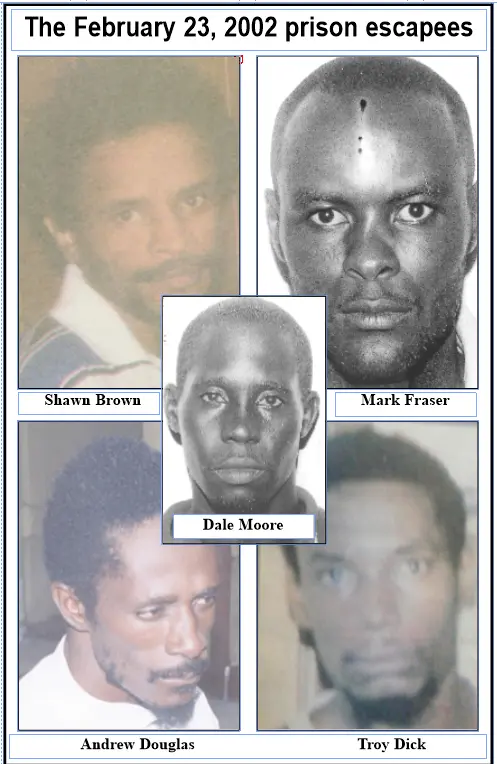
The toll of Guyana's deadliest crime wave: 590 killed over six years
Stabroek News has documented 590 deaths between February 23, 2002, and August 28, 2008 — a period bookended by one of the country's most notorious prison breaks and the killing of gang leader Rondell 'Fineman' Rawlins.
The figures, compiled from Stabroek News' own archives as part of a public service journalism project, put a number on one of the most contested and violent chapters in Guyana's modern history.
The escape that started it all
On February 23, 2002, five prisoners broke out of the Camp Street Prison in Georgetown. That jailbreak became the catalyst for a prolonged crime wave involving armed robberies, the killing of police officers, and the emergence of a parallel security operation linked to the drug trade.
It was during this period that Guyanese first learned of drug lord Roger Khan, who mobilised fighters against the escapees to protect his narcotics territory and that of other businessmen. Khan was later arrested in Suriname, transferred by US authorities from Trinidad, and flown to the United States, where he served a 10-year drug sentence. He was deported to Guyana on September 20, 2019.
The numbers
According to Stabroek News' records, between February 2002 and September 2006, 420 persons were killed — 151 by bandits, 239 during confrontations with police or in unexplained circumstances, and 30 security officers. A subsequent review identified 18 additional deaths from that period, bringing the subtotal to 438: four killed by bandits, and 14 by lawmen, under unexplained circumstances, or by vigilantes.
From October 2006 through August 28, 2008, a further 152 persons were killed — 73 by bandits, 77 during confrontations with police or in unexplained circumstances, and two law enforcement officers. Two officers killed during one of the three major massacres of that period are counted among the robbery victims.
The combined totals: 228 killed by bandits, 330 killed during confrontations with police or in unexplained circumstances, and 32 security officers dead.
Three massacres shock the nation
The bloodiest stretch of the crime wave ran from September 2006 to August 2008, during which three massacres claimed 31 lives across three separate regions of the country.
The disappearance of Tenesha Morgan — the pregnant girlfriend of Rawlins — in January 2008 was described as the trigger for that final and most gruesome phase. Rawlins reportedly contacted law enforcement and threatened widespread violence if Morgan was not returned. No explanation was ever provided for her disappearance.
On the morning of January 26, 2008, gunmen stormed the East Coast Demerara village of Lusignan, firing indiscriminately into homes and killing men, women, and children. Hours earlier, in what may have been a diversion, gunmen shot at officers manning the gate of Police Headquarters at Eve Leary, injuring two. The Ministry of Culture on Main Street was also attacked with a Molotov cocktail, and shots were fired at a restaurant on Waterloo Street.
Less than a month later, on February 17, the interior town of Bartica was targeted. Twelve persons were killed when gunmen — some in military fatigues — stormed the community, attacked the police station, killed two officers, seized weapons, and robbed a gold dealer.
The following month, Rawlins' sister, Marcyn King, was shot dead near her home.
The death of 'Fineman'
Rondell 'Fineman' Rawlins was killed on August 28, 2008, during an hours-long gun battle with law enforcement. Jermaine 'Skinny' Charles — who had escaped from the Sparendaam lock-ups months earlier after being charged with murders — and a third man died alongside him.
Police had labelled Rawlins the leader of the Agricola/Buxton criminal gang. Born in Agricola, East Bank Demerara, he had been a wanted man since 2003, when authorities published a bulletin for his arrest during the Camp Street prison escapee-led crime wave. Despite the capture or killing of several associates over the years, Rawlins remained at large.
He was accused of a range of serious crimes, including the execution-style killing of a serving government minister and participation in the three massacres. Whether he was the mastermind behind those attacks has never been conclusively established.
His death in August 2008 marked the end of the country's most violent sustained crime period — one that, by Stabroek News' count, left 590 people dead over six years.
Source: Kaieteur News