Duane Davis Convicted of First-Degree Murder in 1996 Tupac Shakur Killing
A Las Vegas jury found Duane "Keffe D" Davis guilty of first-degree murder Monday after three hours of deliberation. Davis was the only surviving occupant of the vehicle from which Tupac Shakur was shot.
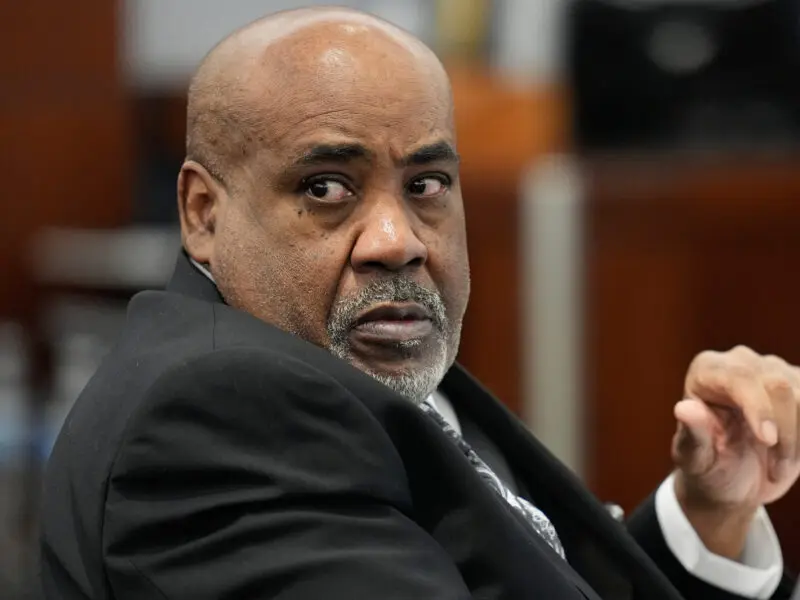
Las Vegas Jury Finds Duane Davis Guilty in Tupac Shakur's 1996 Killing
Nearly three decades after rapper Tupac Shakur was fatally shot in Las Vegas, a jury on Monday convicted Duane "Keffe D" Davis of first-degree murder, Courthouse News Service reports. Deliberations lasted just three hours following a two-week trial in Clark County District Court.
Davis, a former shot caller for the South Side Compton Crips, was accused of orchestrating the September 7, 1996 shooting as retaliation for an assault on his nephew, Orlando Anderson, earlier that same night. That assault took place at the MGM Grand, where a witness testified Shakur was among the attackers.
According to testimony heard at trial, Davis and three other men set out to find Shakur after the MGM Grand incident. About to abandon the search, the group spotted Shakur and Death Row Records CEO Marion "Suge" Knight by chance near the Las Vegas Strip. Davis was placed in the front seat of a white Cadillac, where he allegedly passed a .40-caliber Glock to the backseat. Anderson then fired the shots that struck Shakur, who died six days later.
Davis — the only person in that vehicle still alive — had pleaded not guilty. He sat with hands folded at the defense table as jurors informed Clark County Judge Carli Kierny, one by one, that they had reached a guilty verdict. He was held without bond pending sentencing.
"Excuse me. I'd like to have my stuff back," Davis said after the verdict was read, referring to personal items. "And I'd like to appeal this matter."
Prosecution: Davis Had Every Reason to Tell the Truth
Chief Clark County Deputy District Attorney Binu Palal told jurors in his closing argument that Davis' own statements — to federal authorities, to documentary filmmakers, and in his 2019 book Compton Street Legend — were more than sufficient to establish his presence and participation that night. Prosecutors said Davis spoke to federal authorities in 2008 under circumstances that gave him strong incentive to be truthful, since lying to law enforcement carried its own criminal exposure.
"Many years ago, OJ Simpson wrote the book, 'If I Did It,'" Palal said. "Duane Davis wrote the book, 'I Did It.'"
Palal also cited hotel receipts from the Excalibur and Monte Carlo placing Anderson and associates in Las Vegas that night, as well as surveillance footage of the MGM Grand attack on Anderson. James McDonald, who worked security at Knight's club, provided additional testimony about events of that evening. "That night, we know who did it," Palal said, echoing McDonald's words, pointing to Davis and Anderson.
Palal argued that gang culture drove Davis' motive. A confrontation at a California mall earlier in 1996 between the Crips and Mob Piru had escalated, ultimately spilling into Las Vegas. "And Duane Davis, in the culture of gangs, could not let that stand," Palal said.
Prosecutors ultimately opted against pursuing a gang enhancement charge.
Defense: Conflicting Statements, Corrupt Investigation
Defense attorney Michael Sanft built his case around what he characterized as Davis' unreliability as a witness against himself. Sanft argued that his client's various statements — to law enforcement, in books, and on camera — were riddled with inconsistencies and that investigators had manipulated Davis into providing certain information.
In one example Sanft cited, Davis told authorities he waited outside Club 662 for 15 minutes before the shooting; in his book, the wait stretches to 90 minutes. "Mr. Davis is not telling the truth," Sanft told the jury. "He's telling a fiction."
Sanft also contended that the investigation was tainted by corruption, that Davis' former attorney had not acted in his client's best interests, and that law enforcement had kept the case file inaccessible. He further argued prosecutors could not prove a key predicate event — the California mall altercation — ever occurred, nor could they independently confirm Davis was in Las Vegas the night of the shooting.
On the question of why Davis would fabricate such damaging admissions, Sanft offered a straightforward answer: "He wanted to protect himself, he wanted to protect his family and he wanted to make money."
"There's no proof beyond a reasonable doubt that Mr. Davis committed any crime in this case, let alone murder," Sanft said.
The jury rejected those arguments. Davis now awaits sentencing, with the conviction marking the first criminal case to reach a verdict in connection with Shakur's killing — a case that went unsolved for nearly three decades.
Source: Courthouse News Service