Federal Judge Rejects Trump's Bid to Move Hush Money Convictions Out of NY State Court
A Manhattan federal judge has denied Donald Trump's motion to transfer his hush money criminal convictions to federal court, ruling removal is unavailable after conviction and sentencing.
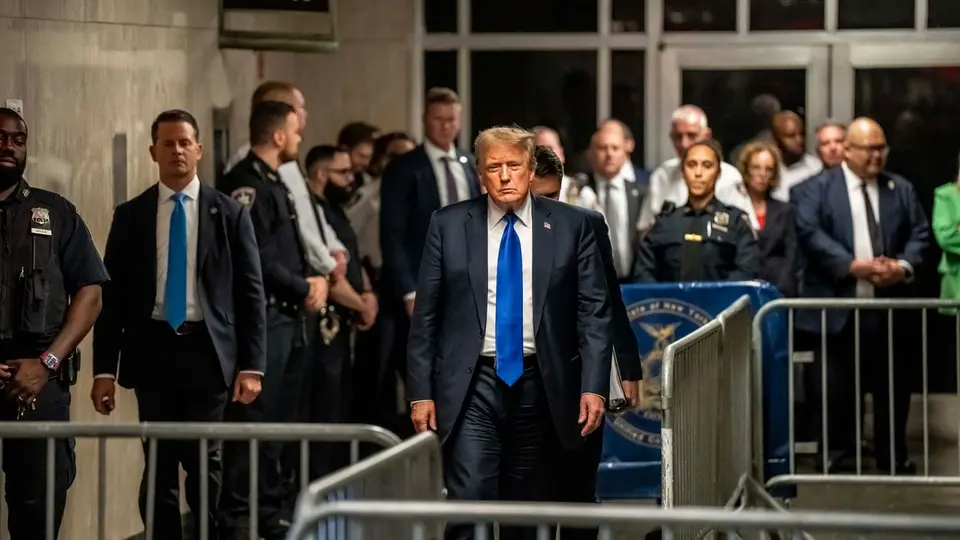
Federal Judge Blocks Trump's Attempt to Escape New York Hush Money Convictions
U.S. District Judge Alvin Hellerstein on Friday denied President Donald Trump's motion to transfer his criminal convictions in the hush money case from New York state court to Manhattan federal court, Courthouse News Service reports.
Hellerstein found that Trump had failed to show good cause to file a notice of removal, ruling that transfer to federal jurisdiction was not available at this stage of the proceedings.
"The Second Circuit asks if removal is available at this stage of a criminal case, after a federal officer defendant has been convicted, sentenced, judgment entered, and appeal noticed. I hold that it is not available," Hellerstein wrote in his ruling.
Immunity Argument Rejected Again
The judge also reaffirmed his prior decisions rejecting Trump's claims that executive immunity shielded him from prosecution, dismissing the argument that hush money payments constituted official presidential acts.
"There is no way that discussions regarding hush money payments to cover up the president's relations with Stormy Daniels could be an official act. An affair, or a cover-up of an affair, is not within the 'outer perimeter' of the president's official responsibilities," Hellerstein wrote.
A transfer to federal court would have opened a path for Trump to appeal the Manhattan District Attorney's case to the Second Circuit and ultimately to the U.S. Supreme Court. Representatives for Trump did not immediately respond to requests for comment. New York state prosecutors also declined to comment Friday afternoon.
A Long-Running Legal Battle
Hellerstein has presided over several failed attempts by Trump to move the case from New York County Supreme Court to the Southern District of New York. He denied an earlier transfer motion in 2023, before the case went to trial, rejecting the contention that the state indictment charged Trump with acts performed in his official presidential capacity.
During oral arguments in February, Hellerstein signaled he was unlikely to grant the transfer. "Here, there's nothing for me to do, and I'm not sure that saying 'here's the judgment, go appeal it' is sufficient," the Bill Clinton appointee told Trump's attorneys at the time.
A three-judge Second Circuit panel had previously returned the matter to Hellerstein, directing him in a November 2025 ruling to address whether Trump's conviction conflicted with the Supreme Court's 2024 decision establishing broad presidential immunity.
The Underlying Conviction
A jury found in 2024 that Trump had orchestrated payments through his then-personal attorney Michael Cohen, who paid $130,000 to adult film actor Stormy Daniels. Prosecutors argued Trump feared Daniels would publicly disclose details of a 2006 sexual encounter at a damaging moment during the 2016 presidential campaign.
Trump repaid Cohen by disguising the payments as standard legal fees. Witnesses testified that Trump sometimes signed those checks from the Oval Office during his first term.
Ten days before his second inauguration in January 2025, New York Supreme Court Justice Juan Merchan sentenced Trump to unconditional discharge — cementing his status as a convicted felon while sparing him from any tangible punishment such as community service or a fine.
Cohen, who had a falling out with Trump in 2018, had earlier pleaded guilty in New York federal court to eight criminal counts that implicated Trump in campaign-finance violations connected to the hush money payments.
Earlier this year, Cohen wrote in a Substack newsletter that he "felt pressured and coerced" by New York Attorney General Letitia James and Manhattan District Attorney Alvin Bragg to provide certain testimony in the case. Trump interpreted the statement as a broad repudiation of the entire prosecution, telling Cohen on his radio show — their first public exchange since their split — "They weaponized a lot of people, and I respect the fact that you recanted everything you said."
Source: Courthouse News Service