Lindsay Clancy Murder Trial: Defense Claims Psychosis, Prosecution Cites Choice
Closing arguments concluded in the Lindsay Clancy murder trial, with prosecutors arguing she knowingly killed her three children and the defense citing postpartum psychosis.
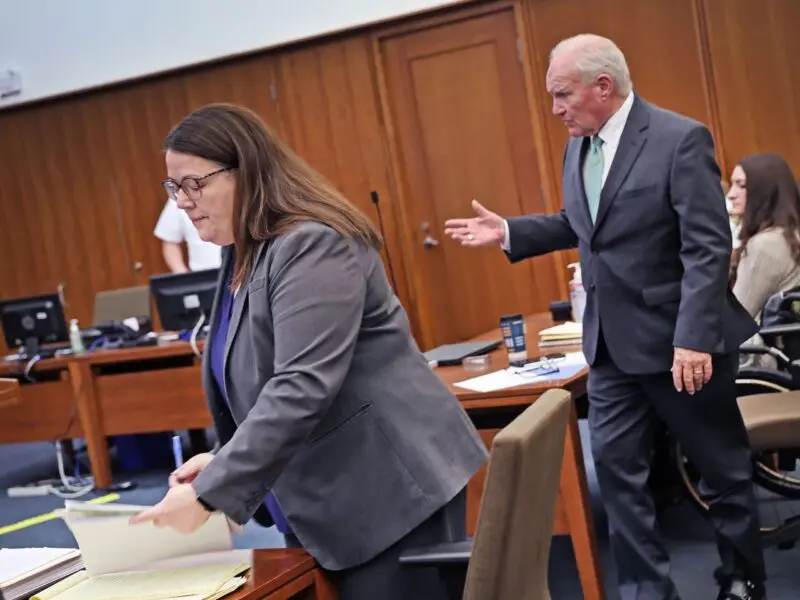
Closing Arguments Clash Over Clancy's Mental State at Time of Children's Deaths
Courthouse News Service reports that closing arguments concluded Thursday in the murder trial of Lindsay Clancy, the Massachusetts mother accused of strangling her three young children in January 2023 — with prosecutors telling jurors she made a deliberate choice and defense attorneys insisting she was gripped by a severe psychotic episode.
"It was a choice to take them with her. It was a horrible choice," prosecutor Jennifer Sprague told the jury. "It is a choice that we don't want to think about that a mother could make, because that doesn't make us feel safe or comfortable in this world. But it's a choice she made."
Clancy, now 36, has pleaded not guilty by reason of lack of criminal responsibility. She did not testify during the trial, now in its fifth week. She wiped her eyes with a tissue during closing arguments and, at one point, pressed a hand to her forehead as Sprague described the killings.
Prosecution: Planning Undermines Psychosis Defense
Sprague argued that Clancy carefully arranged for her husband to leave the house long enough for her to kill the children — a level of planning, the prosecutor said, that is inconsistent with a genuine psychotic break. Clancy strangled Cora, age 5, Dawson, age 3, and Callan, age 8 months, with exercise bands in the basement of their home south of Boston. She then jumped from a second-floor window and remains paralyzed from the waist down.
The prosecution also pointed to Clancy's decision not to tell her mental health providers about thoughts she had in December 2022 of harming her children. Sprague argued this demonstrated that Clancy understood those thoughts were wrong. The prosecutor acknowledged that Clancy had sought help for her mental health struggles, but said she did not always take medications as prescribed and did not always give her providers complete or accurate information.
Sprague pushed back against the defense's broader framing of the case. "That's a distraction to get you angry and passionate about an important issue, but an issue that's not on trial here," she said, referring to arguments centered on the state of the nation's mental healthcare system and how it treats women.
Defense: Medication and Poor Care Drove Her to the Edge
Defense attorney Kevin Reddington told jurors that Clancy had been a devoted mother before her mental health collapsed in the months following the birth of her third child. "Because of the damned medicine and the lousy medical care that she got," Reddington said, citing the mental health providers she saw and the drugs prescribed to her in the lead-up to the killings.
Reddington rejected the prosecution's characterization of Clancy's jump from the window as staged. "You know that is not what happened," he told the jury, referring to what he called the prosecution's attempt to portray it as "a fake suicide."
He held up a copy of the book Good Moms Have Scary Thoughts, found at the Clancy home, and told jurors it was a mental healthcare provider — not Clancy herself — who had given it to her. He also showed jurors a small "wish box" that Clancy and her then-husband Patrick had purchased on their honeymoon, filled over the years with handwritten slips of paper expressing hopes for healthy, successful children. Lindsay Clancy wiped away tears as Reddington described it.
"This woman lived for her kids," Reddington said.
He told the jury that after Clancy began seeing a psychiatrist, "it was not a wonderful life anymore."
Trial Background
Over more than four weeks of testimony, jurors heard conflicting assessments from medical experts about Clancy's mental state following the birth of her third child. Both her mother and sister testified that she had become anxious, paranoid, and suicidal in the period before the killings.
Clancy had sought treatment from multiple providers in the months before January 2023 and had checked herself into a psychiatric hospital. She strangled the three children less than three weeks after being discharged from that facility.
Postpartum psychosis — the condition at the center of the defense's case — is a rare mental illness associated with stress, sleep deprivation, and hormonal shifts following childbirth. Clancy's case has drawn widespread public attention to maternal mental health and sparked sharp divisions over whether she bears criminal responsibility for the deaths.
Jurors are set to begin deliberations following the conclusion of closing arguments. If convicted of murder, Clancy faces life in prison without the possibility of parole. If found not guilty by reason of lack of criminal responsibility, she could still be committed to a state psychiatric facility.
--- Editor's note: This article includes discussion of suicide. The national suicide and crisis lifeline in the U.S. is available by calling or texting 988.
Source: Courthouse News Service