Manhattan DA fights to preserve state murder charges against Luigi Mangione
New York prosecutors argue Mangione's federal guilty plea does not trigger double jeopardy. A judge is set to rule on the state indictment Dec. 10.
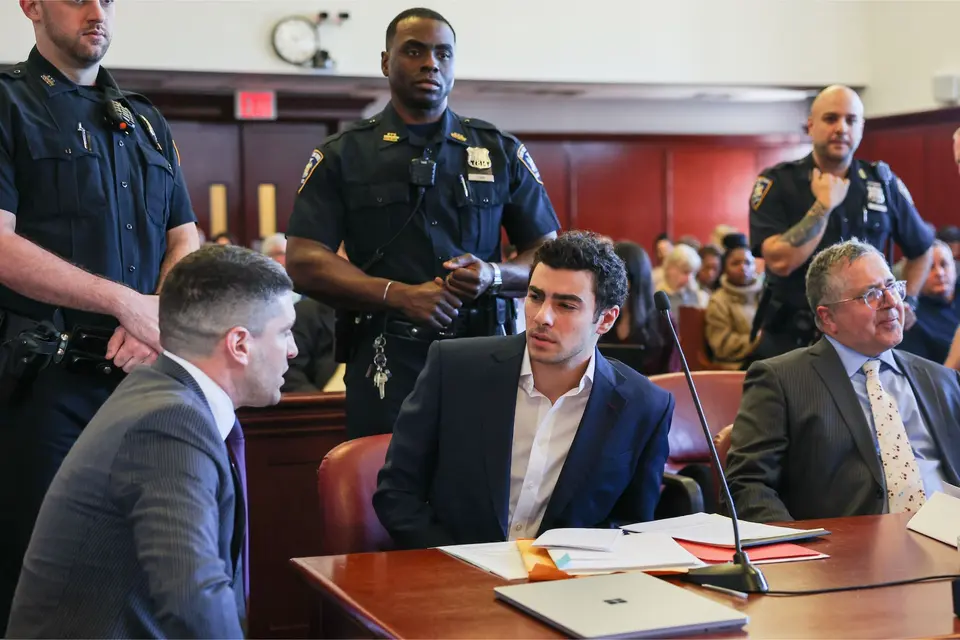
Manhattan DA: federal plea covers a "different evil" than state murder charge
The Manhattan District Attorney's Office filed a 49-page motion on Friday urging a judge to keep the state murder case against Luigi Mangione intact, according to Courthouse News Service. Mangione's defense team had moved to dismiss the parallel prosecution on double jeopardy grounds immediately after he pleaded guilty to two federal stalking charges on Aug. 14.
Prosecutors contend that the federal and state charges target fundamentally different conduct. The federal stalking counts required that the victim be placed "in reasonable fear" of death or serious bodily injury — an element absent from the New York murder charge entirely.
"No such element is required for the state murder charge, which can lead to a conviction even if the victim is totally unaware of — and thus never in fear of — the murderer's actions," the district attorney's office states in its brief.
The state also points to diverging standards of intent. Federal law, prosecutors argue, does not require an intent to kill or proximate causation — death resulting accidentally would still satisfy the provision. New York's murder charge, by contrast, demands both intent to kill and proximate causation.
"In stark contrast, defendant's New York murder charge requires both intent to kill and proximate causation," prosecutors write, calling the distinction evidence of "the different evils addressed by the two regimes."
Gun charges also at stake
Beyond the murder count, Mangione also faces weapons charges under the state indictment. Prosecutors argue those should survive as well, since he has not been separately prosecuted on federal weapons charges. An initial federal count linked to using a firearm for murder was dropped when the government pursued the death penalty — which a judge later struck down, finding Supreme Court precedent made capital punishment unlawful in the case.
The district attorney's office argues that a dropped charge alone is insufficient to invoke double jeopardy protection.
"A mere charge is thus not enough to trigger double jeopardy; instead, a case must proceed to a guilty plea," the filing states. "The defendant must be presently facing a charge on an offense at the time of the guilty plea for jeopardy to attach to that offense."
The federal plea and what Mangione said in court
On Aug. 14, Mangione admitted in federal court to shooting and killing UnitedHealthcare CEO Brian Thompson on a Midtown Manhattan sidewalk on Dec. 4, 2024. Reading from a written statement at the defense table, he said he was motivated by "years of enduring severe pain from a broken back and navigating the obstacles of the health insurance system."
"On the morning of Dec. 4, 2024, I shot Mr. Thompson in Manhattan and he died," Mangione told the court.
Thompson was 50 years old at the time of the shooting.
Defense calls it a case of overcharging
Mangione's lawyers, filing their dismissal motion directly after the plea hearing, characterized their client as "a pawn in parallel prosecutions" by both the Manhattan DA and the U.S. Department of Justice.
"Both have sensationalized the case and misapplied statutes in an effort to overcharge him," the defense filing states.
State prosecutors had anticipated this scenario. Over the summer, they told a Manhattan judge they held "primary jurisdiction" over the case because state authorities had Mangione in custody before federal authorities did.
Key dates ahead
New York Supreme Court Justice Gregory Carro is scheduled to rule on the motion to dismiss the state indictment on Dec. 10. Eight days later, on Dec. 18, Mangione is set to be sentenced in federal court, where he could face life in prison.
Source: Courthouse News Service