Palisades Fire arson retrial: ex-Uber driver Rinderknecht faces jury again in LA
A second jury is weighing arson charges against Jonathan Rinderknecht, 30, whose first trial ended in a 10-2 mistrial. The Palisades Fire killed 12 and destroyed thousands of homes.
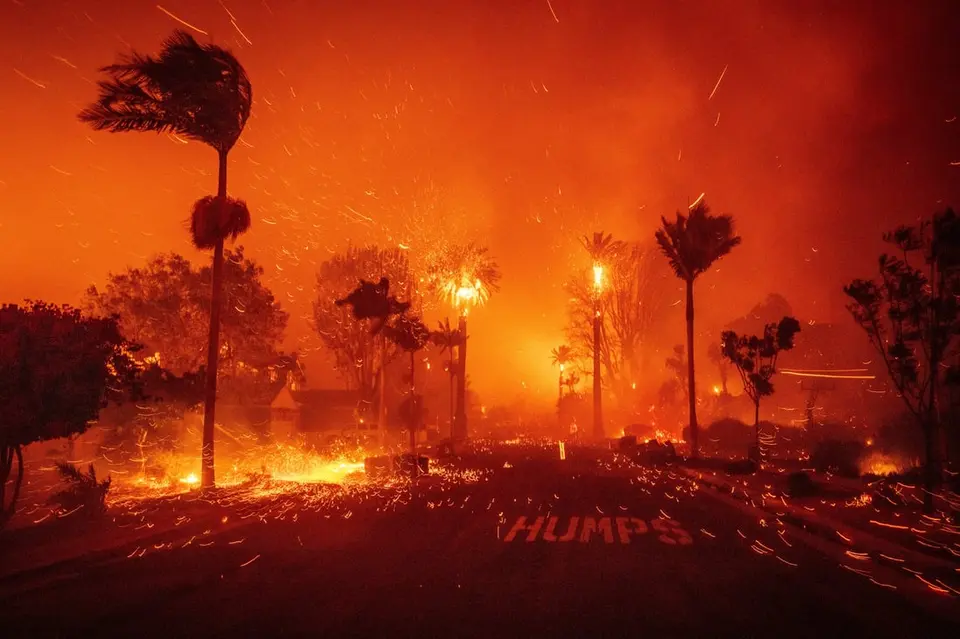
Second jury to decide fate of ex-Uber driver accused of sparking the Palisades Fire
Federal prosecutors on Wednesday asked a Los Angeles jury to convict Jonathan Rinderknecht, 30, of starting a brush fire in the early hours of New Year's Day 2025 — a blaze that prosecutors say eventually erupted into the Palisades Fire, one of the most destructive in Los Angeles history. Courthouse News Service reports that this is the second time Rinderknecht has stood trial on the charges; the first ended in a mistrial after jurors split 10-2 in favor of acquittal.
U.S. District Judge Anne Hwang, a Joe Biden appointee, declared the mistrial in June following that divided verdict. She instructed the new panel of jurors not to factor the Los Angeles Fire Department's response into their deliberations.
What prosecutors say happened on New Year's Eve
Assistant U.S. Attorney Mark Williams told the jury in his closing statement that Rinderknecht was seething with anger on the night of December 31, 2024. He had just dropped off an Uber passenger in Pacific Palisades — close to a neighborhood where he had once lived with a former partner — when, prosecutors allege, he parked near a trailhead and hiked alone into the dark hills above the houses.
Surveillance footage from nearby homes, cellphone location data, and Rinderknecht's own statements to investigators place him at the so-called Hidden Buddha clearing shortly after midnight, Williams said. Wildfire-detection cameras near that clearing recorded the first signs of a brush fire just after 12 a.m.
"We'll never know all the reasons why he started the fire," Williams told the jury, "but you've seen some of them."
Prosecutors say Rinderknecht used a large grill lighter — later recovered from the glove compartment of his car — to ignite the shrubs. After the flames began to spread, he allegedly remained in the clearing and called 911, a move Williams described as a calculated attempt to construct an alibi. Investigators also say Rinderknecht queried ChatGPT to find out whether a person could be held legally responsible for a fire started by a cigarette — another step, the government argues, toward establishing a cover story.
Three weeks after the fire, investigators brought Rinderknecht back to the clearing. He told them he had gone there alone to watch the New Year's fireworks, but that there were none, and that he was the only person present.
Two arson counts, one catastrophic outcome
Rinderknecht faces two counts of arson: one for the January 1 Lachman Fire, which prosecutors say he ignited, and a second for the January 7 Palisades Fire. That second blaze broke out when powerful Santa Ana winds swept through Southern California and reignited embers that had been smoldering in tree roots for six days.
The Palisades Fire destroyed thousands of homes in the affluent coastal enclave above the Pacific Ocean and in neighboring Malibu. Twelve people died before the fire was fully contained on January 31, 2025.
Prosecutors also pointed to a string of angry text messages Rinderknecht sent to a girlfriend who had told him the night before that she needed space, and to testimony from Uber passengers who rode with him on New Year's Eve and reportedly had to endure his furious outbursts during the trips.
Defense: too many gaps for a conviction
Defense attorney Steven Haney, reprising arguments he made at the first trial, told the jury that the government's evidence was riddled with gaps too significant to support a guilty verdict beyond a reasonable doubt.
Haney argued that fireworks could not be excluded as the cause of ignition. Several neighbors testified they heard fireworks that night, and the wildfire-detection cameras capture only still images at one-minute intervals — potentially missing any fireworks activity near the clearing. He also noted that the Lachman Fire scene was not formally preserved until more than ten days after the blaze, leaving open questions about what evidence may have been lost or degraded in that time.
"The government has never been able to tell you when the fire started," Haney said. "Are you convinced beyond a reasonable doubt that the fire wasn't smoldering earlier from fireworks?"
Prosecution's rebuttal: the lies are telling
Assistant U.S. Attorney Danbee Kim dismissed the defense's arguments in her rebuttal as speculation and distraction. She pointed to Rinderknecht's own statements to investigators in early 2025, which she said made clear he was the sole person at the clearing around midnight and that no fireworks were nearby.
Kim pressed the jury on a specific inconsistency: Rinderknecht told investigators he had already walked back down the hill to his car when he first spotted the fire, but his cellphone data shows he was still at the top of the hill — at the clearing — when he placed his 911 call.
"He lied and lied and lied again about where he was when he first saw the fire," Kim told the jury. "These lies are telling — they are not mistakes. Because he knew that where he was when the fire started was incriminating."
The case is now in the hands of the jury for a second time.
Source: Courthouse News Service