Mexican cartels in Argentina: Sinaloa exports cocaine and Jalisco tests synthetic drugs
Two court cases reveal differentiated drug trafficking routes by Mexican cartels on Argentine soil: Sinaloa through the north and Jalisco through the ports.
Sinaloa and Jalisco consolidate distinct routes in Argentina: cocaine to the north, synthetics through the ports
According to airedesantafe.com.ar, on the same day the Argentine Government added the Sinaloa Cartel to its list of terrorist organisations, a court in Salta sentenced two Bolivian pilots for transporting 364 kilogrammes of cocaine linked to that organisation. Judge Gabriela Catalano, of the Federal Criminal Oral Court No. 2 of Salta, imposed 10 years' imprisonment on Juan Pablo Quinteros Peredo and Henry Álvaro Mercado Cuajera.
The small aircraft carrying the drug crashed in November 2025 in Rosario de la Frontera, in the province of Salta. It attempted to land at the El Cóndor farm, collided with a curtain of churqui trees and struck the car of three men who were waiting for the cargo. The cabin contained 136 kilogrammes; another 228 kilogrammes were found buried in a nearby plot with a purity of 74%.
The aircraft had departed from San Borja, and the cocaine was loaded during a stop in Wernes, both towns in Bolivia. According to the investigation, the drug belonged to a branch of the Sinaloa Cartel established in Bolivia, which produced there and dispatched it to Europe via Argentine ports.
The "PRADA" seal as the cartel's fingerprint
The Mexican connection came from the packaging. The bricks bore the "PRADA" seal, which according to official sources is the brand with which Sinaloa identifies its cocaine. The same logo had appeared on a 1.6-tonne shipment seized in July 2022 in Tepito, Mexico City, which Mexican authorities attributed to that organisation.
Investigators argue that the structure sought to consolidate an air and land bridge to move cocaine from the Bolivian Chapare region and the Peruvian Vraem to Argentine ports, with Europe and Asia as final destinations. From the Chapare to Salta is 907 kilometres, and from there the drug descends to the ports of the Paraná.
The designation of Sinaloa as a terrorist organisation came through Joint Resolution 5/2026 of the Ministries of National Security and Foreign Relations, which also added La Nueva Familia Michoacana to the Registry of Terrorist Entities (RePET). The Jalisco New Generation Cartel (CJNG) had inaugurated that list in March.
Jalisco tested the synthetic drugs route via Zárate
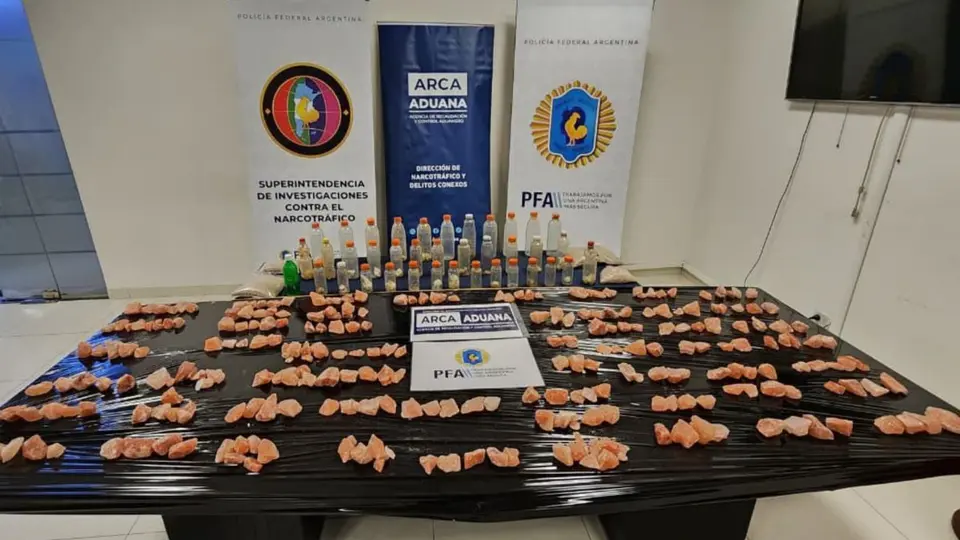
The second case runs in the opposite direction. An Opel Combo loaded in Antwerp arrived at Zárate in October 2025 and remained in the customs zone for nearly a year. Inside were 52 kilogrammes of MDMA crystals, enough to manufacture approximately one million ecstasy tablets. The investigation began following a warning from the DEA, which alerted authorities to a Mexican organisation planning to bring 300 kilogrammes of methamphetamine by sea.
The structure deployed by the CJNG was small. At the top is a Mexican from Zapopan nicknamed "Good-Looking", who remains at large. Luis Enrique Corona Ortiz, detained in Palermo, would be a member of the cartel. The local contact was a resident of Salta who had worked as a sushi chef in Playa del Carmen. The drivers and workers were Venezuelan.
Money circulated through hawala and there was an attempt to pay port costs with cryptocurrencies. In conversations with an informant, "Good-Looking" spoke of bringing methamphetamine hidden in a container of surgical medical supplies. That communication suggests that Zárate functioned as a route trial.
The last person detained in that case closes the regional circle: Venezuelan Alex David Coronil Polanco was detained by Interpol in Santa Cruz de la Sierra and handed over at the Salvador Mazza–Yacuiba border crossing.
A reverse route: MDMA from Europe to Latin America
Behind the MDMA found in Zárate lies a mechanism that exceeds Mexican cartels. The European Union's drugs agency warned in its 2025 report of the reverse route from Europe to Latin America, with evidence of MDMA-for-cocaine exchanges.
In July, police from Spain and the Netherlands seized 947 kilogrammes of MDMA hidden in a crane leaving Antwerp for Ghana. According to a source in the Argentine federal judiciary, the final destination was Buenos Aires. In Misiones, prosecutors Silvina Gutiérrez and Martín Uriona described a network that charged in ecstasy for the cocaine their couriers delivered in Europe.
Bolivia, the board that changed in 2026
The two court cases show that Mexican presence in Argentina is not homogeneous. Sinaloa appears in the cocaine export corridor; Jalisco, by contrast, tested the entry of synthetic drugs. Both routes converge in Bolivia.
Sinaloa and Jalisco are believed to have set up near the Argentine border with the aim of purchasing most of the production from Bolivian clans, according to investigators. The regional situation also changed with the capture of Sebastián Marset on 13 March in Santa Cruz de la Sierra. The DEA escorted him to the United States, where he faces charges for cocaine trafficking and money laundering.
The capture occurred as Bolivia resumed cooperation with Washington after decades of hostility. In May, the government of Rodrigo Paz announced that the DEA would have an office in La Paz dedicated to intelligence sharing, nearly 18 years after its expulsion, without participating in operations or deploying in the Chapare.
Source: Google News AR — Crime