Life sentence for the triple lesbian killing in Barracas, Buenos Aires
Justo Fernando Barrientos was sentenced to life imprisonment for the fire that killed three lesbians in Barracas in May 2024. The crime was recognised as aggravated homicide motivated by hatred based on sexual orientation.
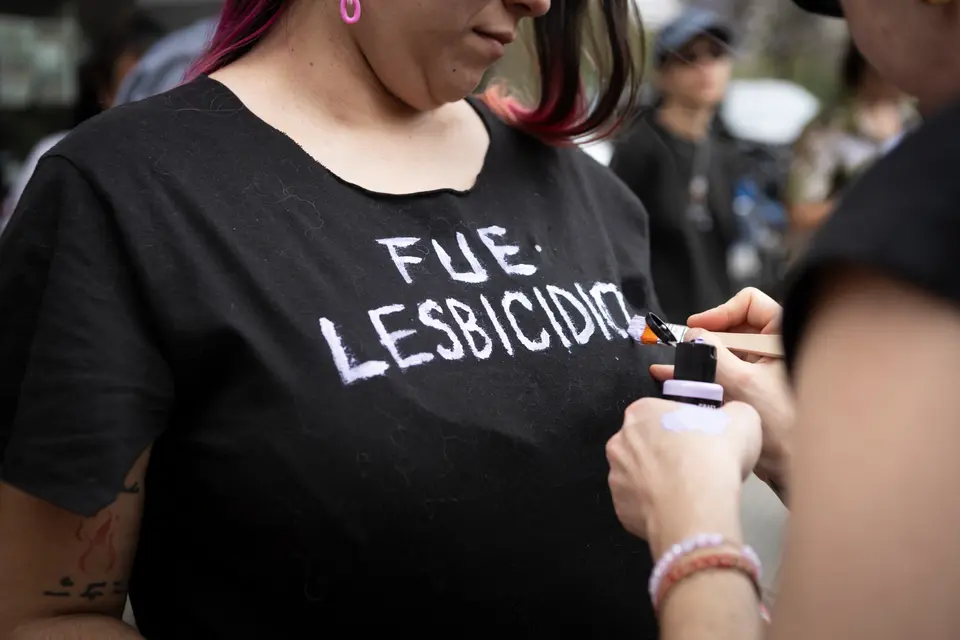
Life sentence for the triple lesbian killing in Barracas: a historic conviction with pending demands
Hundreds of people gathered in torrential rain outside the Fifth Criminal and Correctional Oral Court in Buenos Aires to hear the life sentence handed down against Justo Fernando Barrientos, the sole defendant in the fire that killed Pamela Cobbas, Roxana Figueroa and Andrea Amarante in May 2024. Sofía Castro Riglos, the only survivor, was not present in the courtroom. According to latfem.org, a prior call for people to attend the sentencing had circulated on social media under the slogan: "Today hug your closest lesbian".
The court classified the crime as "aggravated homicide with cruelty and treachery motivated by hatred of the victims' sexual orientation and by the use of a means capable of causing danger to the common good". The victims lived together in room 14 of a family hotel located at Olavarría 1621, in the Buenos Aires neighbourhood of Barracas. The room measured 12 square metres.
Over 19 days of hearings, the trial attempted to reconstruct what happened in the early hours of 6 May 2024. Barrientos lived in room 12 on the same floor. The prosecution's arguments described daily harassment prior to the attack.
A partial victory: recognition of hatred, but without reparation
Sofía Castro Riglos's legal representative, lawyer Luciana Sánchez, celebrated the recognition of the discriminatory motive but criticised the absence of reparatory measures. "We very much regret that reparations were not awarded either for Sofía or for the community," Sánchez told latfem.org. "We understand that the Court adhered to a classical interpretation of the criminal process in which victims are required to pursue separate proceedings for reparatory measures."
The Court had rejected the reparatory measures requested by Sofía's legal team, who was also not present in the courtroom during the reading of the verdict. "For us the sentence is not reparation," Sánchez added. "We understand that there must be a sentence proportional to the damage caused, but without reparation either for Sofía or for the rest of the community, we are left wanting more."
Inside the courtroom—which can barely fit 20 people—those present held up signs reading "it was femicide" and the names of Pamela, Roxana and Andrea. In the courthouse corridors, the demonstration was led by the Coordinator Lesbicides Never Again, which maintained the mobilisation throughout all the trial hearings.
The grounds and the category of lesbian killing
The full grounds will be read by the court on 19 February. At that time it is expected that the category of lesbian killing will be explicitly stated, a legal recognition that has run through the entire proceedings and which seeks to identify structural discrimination against lesbian people as a central element of the crime.
From the perspective of the legal representatives, the case was named as a lesbian killing precisely to prevent an individual focus from obscuring the structural dimension. "There is social complicity and in this case state action that enables this violence," Sánchez stated in her arguments. The lawyer drew a connecting thread between the attack in the hotel, previous assaults against the trans travesti community in Palermo and public statements by figures such as Javier Milei, Manuel Adorni and Agustín Laje. "It is the State, through its policies, that not only tolerates violence but incites it, and this should be taken very seriously," she concluded.
The public debate sparked by the case links official discourses against the LGBTIQ+ community with the dismantling of public policies that guarantee rights for women, lesbians, transvestites and trans people, a connection that activists point to as having been reinforced since 2023.
Who the victims were
Pamela Cobbas and Roxana Figueroa had been a couple for at least six years and had lived in the Barracas hotel since 2022. Andrea Amarante and Sofía Castro Riglos had met in 2022; at the end of 2023 they arrived from Neuquén, where they had lived on the streets. In the temporary shelters they were not allowed to stay together nor were their couple relationship recognised; on occasions a subsidy would be granted to one but not the other.
In Buenos Aires they met Pamela and Roxana, and the four of them moved into room 14 of the hotel. "They were not just visiting," Sánchez emphasised in her arguments: they were "building a family". Photographs of the remains of the room show the kettle, the mate, the television and the small table where they ate. "The traces of that lesbian life that was brutally interrupted," the lawyer said.
The recognition of hatred based on sexual orientation as an aggravating factor was valued by LGBTIQ+ organisations that accompanied the process for two and a half years as a victory of persistent and sustained activism that fought to ensure the crime was not treated as an isolated incident but as part of a structure of discrimination. The cry of "reparation" echoed among those who had waited since early morning outside the Courts building, on a day that mixed celebration and tears.
Source: Google News AR — Crime