Bolivia's attorney general arrested for leading criminal network protecting drug trafficking terrorism
Roger Mariaca, Bolivia's attorney general, was arrested in Santa Cruz accused of heading a criminal organisation that protected drug trafficking. The US had revoked his visa days earlier.
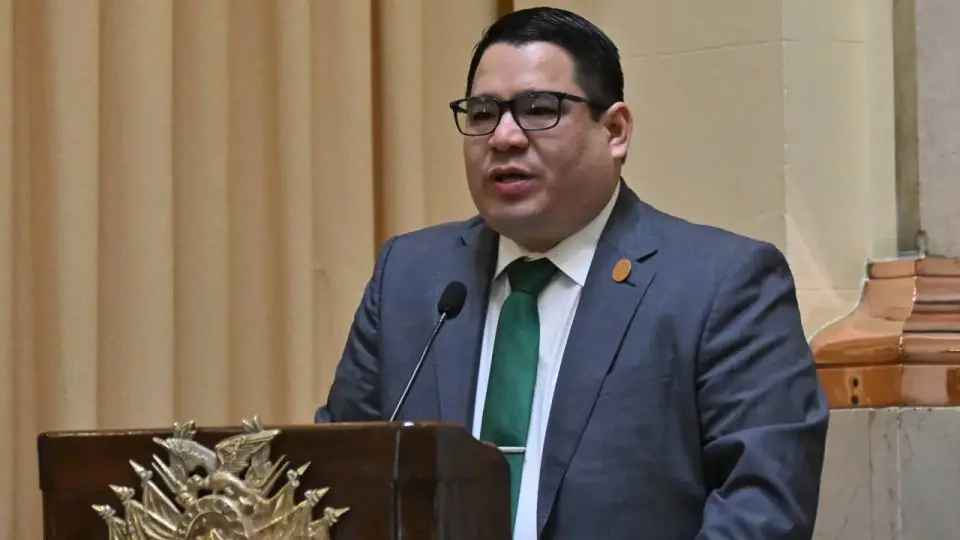
Bolivian government arrests attorney general over narcoterrorism links
The Bolivian Government detained the State's attorney general, Roger Mariaca, in the eastern region of Santa Cruz during the night of Wednesday 30 September and the early morning of 1 October, according to noticiascaracol.com. The authorities accuse him of heading a "criminal organisation" entrenched in the Public Ministry that, according to the Executive, served to protect "narcoterrorism" in the country.
The Minister of Government (Interior), Marco Antonio Oviedo, confirmed the arrests at a press conference in La Paz, accompanied by the Ministers of Defence, Ernesto Justiniano, and of the Presidency, Fernando Aramayo, as well as senior police officials. "A criminal organisation entrenched in the Justice system and in the administration of the Public Ministry, headed by Roger Mariaca, has been dismantled," Oviedo declared.
14 detained, four holding high-ranking posts at the Attorney General's office
In total, operations carried out in recent hours resulted in the detention of 14 people. Four of them held hierarchical positions at the General Attorney's office and at the departmental attorney's offices in Santa Cruz and La Paz. Among those arrested are the departmental attorney for Santa Cruz, Alberto Zeballos; a superior attorney; a police major; four people intercepted at the condominium where Mariaca resided, where "vast sums of money" were found; and six Public Ministry officials accused of attempting to remove documentation from the attorney general's residence.
According to local media, the attorneys detained in Santa Cruz were transferred to La Paz and remain in facilities of the anti-drug force in the city of El Alto.
The Marset case as the connecting thread
Oviedo directly linked Mariaca to the case of Uruguayan drug trafficker Sebastián Marset, captured in Bolivia in March 2026 and extradited to the United States, where he remains detained. The minister specified that Marset was arrested for the first time in 2023, when Mariaca was serving as departmental attorney for Santa Cruz, and that on that occasion the Uruguayan was quickly released. "That is the type and model of narcoterrorism that took over the Public Ministry in Bolivia," Oviedo stated.
The Government formally accuses Mariaca of the offences of criminal organisation, money laundering and illicit trafficking in controlled substances. Oviedo stressed that the attorney was arrested "because the crime committed by this narco-structure in the Attorney General's office has been continuous and permanent" and that the organisation "protected, participated in and enriched itself from the trafficking of controlled substances".
Visa revoked by Washington days earlier
The arrests come after the US Government announced on Monday the revocation of visas for high-ranking officials from Bolivia, Colombia and Peru, whom it accuses of being "corrupt" and of "undermining democratically elected governments". Bolivia tops the list of countries with most sanctioned citizens published by the State Department, among them Mariaca and Zeballos.
Secretary of State Marco Rubio wrote on X that "the Trump Administration strongly supports the president and the democratically elected Government of Bolivia in their bold and decisive actions to combat drug trafficking, systemic corruption and transnational organised crime". Rubio added that "Bolivia's actions demonstrate the kind of leadership needed to achieve a safer, stronger and more prosperous hemisphere" and recalled that last week, at the Americas Shield meeting, "the United States reaffirmed its commitment to safeguarding democratic governance against the influence of armed narcoterrorist networks".
Mariaca rejects the charges
Mariaca himself rejected the accusations against him and linked the US decision to revoke his visa with the "implications" that some Public Ministry investigations would have had, both inside and outside the country. Among these he cited the criminal proceedings against Argentine political consultant Fernando Cerimedo, accused among other things of alleged attempted femicide against his former partner.
The Government also confirmed that it is seeking former Minister of Government and former presidential candidate of the Movement Towards Socialism (MAS) Eduardo del Castillo, although Oviedo denied that he had been arrested at the time of the press conference.
Dispute over interim leadership of the Attorney General's office
Mariaca's arrest immediately opened an institutional controversy over who should assume leadership of the Public Ministry. Superior Attorney Luis Montaño appointed himself interim attorney general "to avoid a legal vacuum and continue with institutional order," according to a statement he made at a press conference, specifying that he would remain in office until the Legislature elected the new head.
The General Attorney's office supported this decision in a statement, arguing that current regulations stipulate that leadership should fall to the superior attorney "with the greatest seniority", a condition met by Montaño.
However, the Government rejected the appointment. Oviedo pointed out that Montaño "cannot appoint himself" interim attorney general and that it is the responsibility of the Legislative Assembly—the body from which the original appointment originates—to resolve the situation in a session called for Friday. The presidential spokesman, José Luis Gálvez, was more forceful and accused Montaño of "usurpation of functions", also warning that he could attempt to remove the attorneys handling the cases of those detained to obstruct the investigations, which could result in his own arrest.
Source: Google News BO — Crime