Prosecutor Mariaca under police investigation for 10 months with trail of more money in Bolivia
Police have been investigating prosecutor Mariaca for 10 months on drug trafficking charges. After seizing more than Bs 4 million, authorities are searching for additional resources in properties linked to the case.
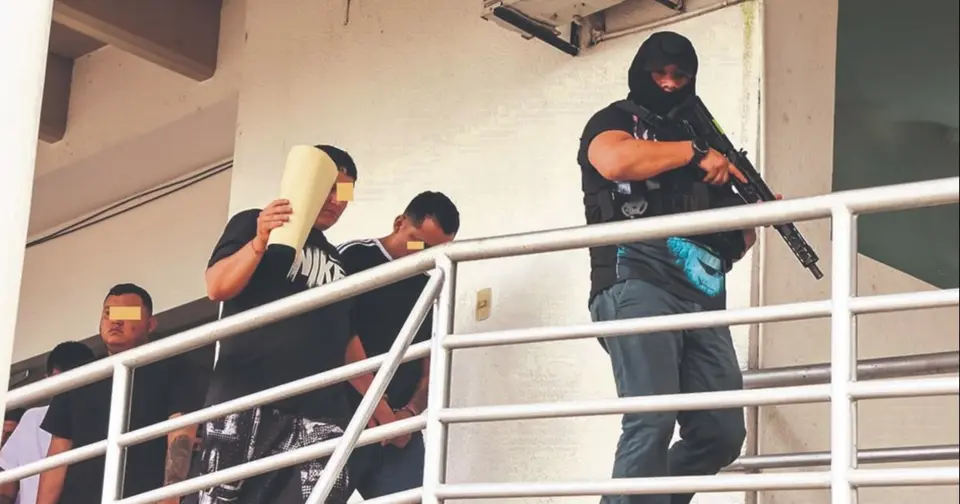
Police follow the money trail in the Mariaca case after 10 months of investigation
The discovery of more than Bs 4 million in cash—distributed between Santa Cruz and Sucre—could represent only a fraction of the resources that Bolivian authorities are seeking as part of the investigation into State prosecutor general, Róger Mariaca. According to El Deber, Government Minister Marco Antonio Oviedo revealed that Mariaca had been under investigation for ten months.
"In this case, the State prosecutor general does not have privilege of immunity for committing drug trafficking offences," Oviedo stressed, and he also asserted that there is evidence of his participation as the head of a criminal organisation, not merely as a member of it.
Arrest and associated captures
Mariaca was arrested on 28 September at Viru Viru airport in Santa Cruz by agents from a specialised intelligence unit of the Bolivian Police. On the same day, Santa Cruz prosecutor Alberto Zeballos, considered to be part of Mariaca's inner circle, was captured.
Following the operation, 12 more people were detained: police officers, prosecutors and Public Ministry officials linked to an ambulance in which the first cache of banknotes was found. That vehicle was intercepted on 28 September with Bs 3,532,100 and $us 10,000, an amount that the Public Ministry confirmed officially. In Sucre, a parallel operation reported more than Bs 1 million at the residence of the aide-de-camp of the investigated prosecutor general.
Properties under surveillance, raids pending
Defence Minister Ernesto Justiniano indicated that police officers were already deployed outside several properties linked to the detainees, but that they were unable to enter due to the lack of prosecutorial proceedings and judicial orders, delayed by the institutional impact of the case.
"We have a huge number of police officers through the Ministry of Government at different homes of all the people who have been arrested, but they have not been able to enter," Justiniano stated. Among the properties mentioned were those related to former Government Minister Eduardo Del Castillo, who fled after the 28 September operation. "We knew there was money in that house and we know there is more money," the minister insisted.
On Monday, José Armando Urioste will assume office as interim prosecutor, and the Government hopes that with his appointment all investigative actions will be reactivated.
Links to the political crisis and blockade financing
Minister Oviedo broadened the scope of the investigation by indicating that the organisation led by Mariaca would have intervened in the 53-day crisis that put the Rodrigo Paz government in jeopardy. He also connected that hypothesis to more than Bs 8 million detected in investigations into blockade financing, in addition to the money seized this week.
Presidential spokesman José Luis Gálvez went further by alleging that drug trafficking financed, through bribes, political decisions, including Mariaca's election in 2024, during the final term of the MAS in power.
Mariaca's position and his legal defence
Mariaca initially remained silent, but later asserted that he would demonstrate the legal origin of the resources, according to police sources consulted by El Deber. His legal team filed a petition for release that was unsuccessful. At the time of his arrest, a high-end mobile telephone and a Swiss watch, among other valuable belongings, were seized from him.
The United States designation
Just two days before his arrest, the United States had designated Mariaca under Section 7031(c) of the State Department Appropriations Act, for his involvement in significant corruption. Washington accuses him of soliciting and accepting bribes to facilitate drug trafficking and help criminals evade justice.
Robert Evan Ellis, researcher at the Institute for Strategic Studies of the US Army War College and former State Department official, explained that the information used for an administrative decision can, in certain cases, feed into a criminal investigation or even an extradition request. However, Ellis clarified that he has no direct knowledge of a criminal proceeding against Mariaca being underway.
Regarding the possible exchange of information between Washington and La Paz, Ellis specified that there is no fixed diplomatic timeframe for responding. "There is always speed in communicating when possible," he stated, although he indicated that before that, consideration must be given to who possesses the information, what can be delivered and who will receive it in Bolivia.
The United States disclosed the visa revocation of 13 citizens, including Mariaca. Of that list, nine are justice operators; their cases were consulted through the Bolivian Ministry of Foreign Affairs. Ellis warned that Washington may withhold elements if their disclosure could prejudice a possible legal proceeding: "We have to evaluate what we can communicate with you whilst respecting your process, but without putting our sources, methods and processes at risk."
Source: El Deber