Shots in Aarau: How a police manhunt following a homicide unfolds
After fatal shots fired at a rave in Aarau, a 43-year-old was arrested. Violence prevention expert Thomas Herzing explains how large-scale manhunts operate.
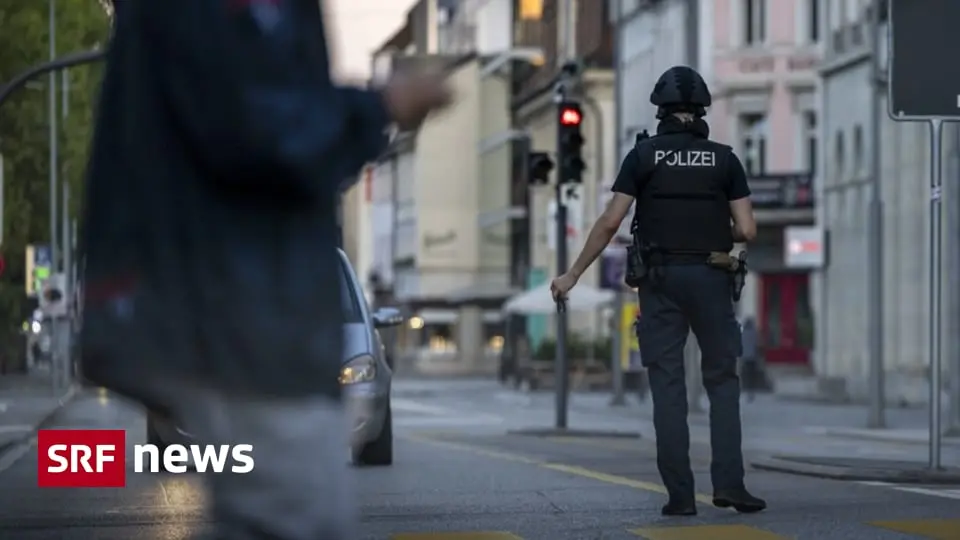
Fatal shots in Aarau: An expert explains the manhunt operation
Fatal shots were fired at a rave event in Aarau on Sunday morning. Aargau police subsequently launched a large-scale manhunt and arrested a 43-year-old suspect. Investigations are ongoing. SRF has consulted Thomas Herzing, a specialist in violence prevention with over 30 years of experience with the police, criminal investigation department, and the Bavarian State Criminal Police Office (LKA), to explain how such manhunts work in practice.
Hazard mitigation before perpetrator pursuit
Herzing explains that in an initial phase, organising incoming information takes priority. The primary concern is to quickly contain the danger to the public – hazard mitigation therefore comes before the actual pursuit of the perpetrator. This also includes securing the provision of medical care for the injured by paramedics and emergency services. In parallel, the criminal investigation department is deployed, which initiates the first forensic and tactical criminal measures and attempts to classify the act.
Evidence as puzzle pieces
According to Herzing, spent cartridges, witness statements, and video recordings are the central building blocks that together create an overall picture. He emphasises that evidence material available to the public should be handed over to police as early as possible and without interpretation. Personal conclusions or public distribution of evidence material could significantly hamper investigative work.
Witness statements: valuable but error-prone
The public's cooperation is very important, according to Herzing, but limitations must be observed. People are subject to perceptual errors, which increase with greater time elapsed since the crime. Media reports can also influence the memories of witnesses. Herzing cites a personal example: as a civilian, he once described a getaway car as red – in fact it was green. Witness statements are therefore fundamentally significant, but should ideally be taken as soon as possible after the event.
Social media: help and risk combined
Police also use social media to obtain information. However, Herzing warns of countereffects: those who seek maximum attention for their own observations on platforms like TikTok risk making investigatively relevant details public. This can trigger further speculation and slow down police work. "Information is not yet insight," Herzing emphasises. Every lead must first be verified for its reliability before it becomes usable investigative material. Since the police must follow up on every lead, a flood of unverified information can delay the process.
Speed and thoroughness must be balanced
A large-scale manhunt does not necessarily mean that a person can be apprehended within a few hours, says Herzing. Speed does play an important role, but all findings must be verified for their reliability and brought together. An incorrect conclusion could significantly impair the entire investigative course. For the public, 24 hours may seem like a long time – for investigative work in complex cases, that is a very short timespan, according to the expert.
The interview was conducted by Susanne Stöckl for SRF.
Source: SRF