Dominican authorities recover drugs from speedboat attacked by US forces
Anti-narcotics officials from the Dominican Republic extracted hundreds of packages of cocaine following an aerial operation by the US Navy against a speedboat in the Caribbean.
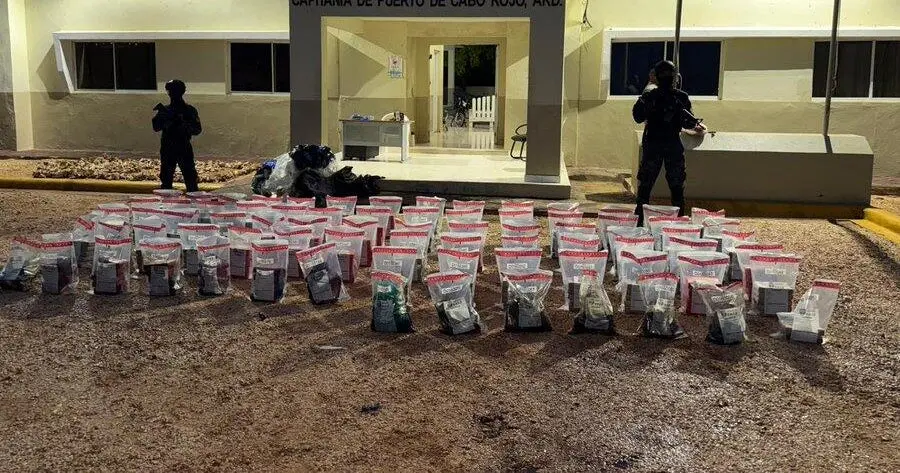
Dominican authorities recover drugs from speedboat attacked by US forces
The government of the Dominican Republic announced on Sunday that its teams succeeded in recovering part of the illicit cargo being transported by a high-speed speedboat, which was neutralised days earlier by means of an aerial attack carried out by American warships. The authorities described the event as a historic precedent in the Caribbean region.
At a press conference, representatives of the DNCD—the country's leading authority on narcotics—confirmed that they recovered 377 packages containing cocaine. It is estimated that the vessel was carrying approximately one tonne of the substance, equivalent to more than two thousand two hundred pounds. The seizure was finalised after American military aircraft struck the vessel, described by authorities as belonging to narco-terrorism networks.
A spokesman for the United States diplomatic mission in Dominican territory clarified that this incident coincides with the bombing that President Donald Trump publicly revealed the Friday before, without initially specifying where it had occurred. The Republican leader had stated that three men linked to drug trafficking were killed in that operation.
The vessel was disabled some 80 nautical miles south of Isla Beata, an area that forms part of Dominican island territory. According to official information, the Caribbean country's Navy actively participated alongside northern forces in locating the speedboat, whose crew intended to land on Dominican shores and use that territory as a transit point towards US markets.
Images released by the DNCD show uniformed personnel handling rectangular packages; on some the inscription "MEN" is visible stamped on the wrapping material.
"For the first time in history, our nation and the United States are carrying out a combined action against narco-terrorism in the Caribbean," emphasised the institution in its bulletin.
The military deployment in the zone dates back to August, when the Trump administration sent eight combat vessels and a submarine to the southern Caribbean with the stated purpose of combating drug trafficking. Since then, according to the Presidential Palace, the fleet has eliminated at least three drug-laden speedboats, resulting in more than twelve people dead on board.
These actions have generated criticism from human rights advocacy groups, who consider the attacks to constitute homicides outside the legal framework. The controversy escalated when a pair of Democratic Party legislators pushed a motion in Congress to stop further bombings of this kind.
The US federal executive maintains that two of the intercepted vessels set sail from Venezuelan ports. The government of Nicolás Maduro, usually indicated by Washington as responsible for illicit activities and head of a criminal organisation nicknamed the Cartel of the Suns, firmly rejected such accusations. The Venezuelan leader characterised the presence of warships in the zone as an "absolutely criminal and bloody threat".
Tensions in the region have increased during the current month. In two separate episodes, military aircraft from the South American country approached US vessels dangerously, manoeuvres which the Pentagon interpreted as deliberate provocations. Additionally, Caracas reported that a fishing vessel was intercepted by American forces within its exclusive economic zone, with nine crew members temporarily detained.
As part of the operational reinforcement, the US Navy has relocated multiple naval units to the vicinity of Venezuela. In parallel, a squadron of ten F-35 combat aircraft arrived this month in Puerto Rico to participate in anti-narcotics interdiction operations.
_Information published by: CBS News_
Source: Google News DM — Crime