Dominican Republic recovers tonne of cocaine following joint naval operation with US
Dominican anti-drugs agents seized 1,000 kilograms of cocaine from a vessel intercepted in Caribbean waters during a binational mission with US forces.
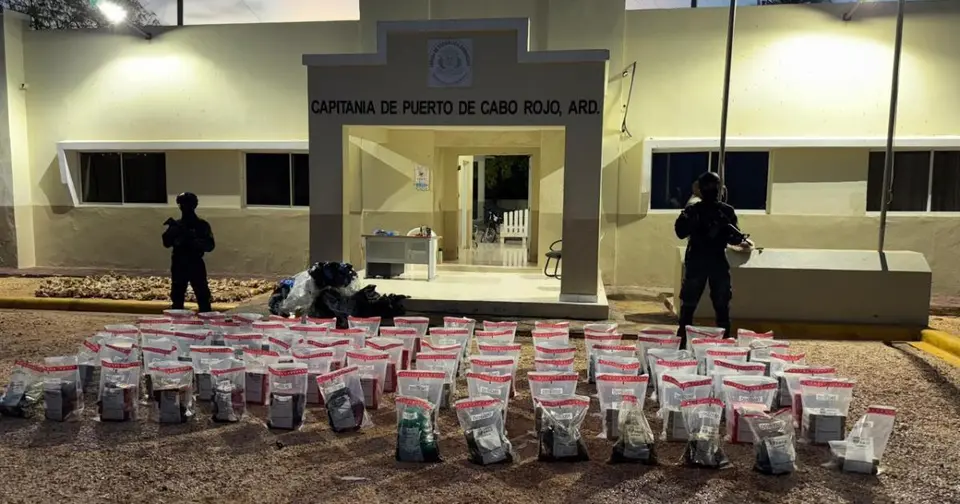
Dominican Republic recovers tonne of cocaine following joint naval operation with US
Operatives from the Dominican Republic managed to seize hundreds of packages containing cocaine from a speedboat that had been attacked and sunk by US Navy ships, in a context of growing anti-narcotics military activity in the Caribbean region.
Through a message published on X on Sunday, the National Drug Control Directorate (DNCD)—the governing body responsible for combating drug trafficking in the country—confirmed that the seizure took place as part of a binational mission. According to the agency, 1,000 kilograms of cocaine were removed from illicit circulation, packaged in 377 wrappings.
The vessel transporting the substance was destroyed approximately 80 nautical miles—equivalent to 150 kilometres—south of Isla Beata, located off the south coast of Dominican territory.
The DNCD released audiovisual records of the operation, in which security personnel can be seen boarding the vessel and examining the packages that allegedly contained the drug.
The agency highlighted that this is the first occasion on which both nations have executed a coordinated action of this type against narco-terrorism in the Caribbean region.
The seizure coincides with growing momentum from Washington to strengthen its presence in the Caribbean for anti-drugs purposes, according to spokespeople for the Donald Trump government. At the beginning of September, the United States began deploying eight warships, unmanned aircraft and an attack submarine to the southern part of the region.
The US administration has carried out several recent attacks against vessels that, according to its own statements, belong to organisations engaged in smuggling prohibited substances destined for its territory. The latest of these operations, ordered directly by Trump, resulted in the deaths of at least three occupants of a vessel.
In a post on his Truth Social network, the leader specified that the "lethal kinetic strike" was executed within the scope of responsibility of Southern Command, a military jurisdiction that includes 31 states of South America, Central America and the Caribbean.
Trump argued that intelligence services had verified that the vessel was travelling along a customary narcotics trafficking route carrying illicit cargo destined to "poison" the US population.
The incident took place in parallel with the deployment of US warships in international waters near Venezuela, supported by F-35 fighter jets transferred to Puerto Rico as part of the same campaign.
Various human rights organisations have questioned these actions. Sarah Yager, Human Rights Watch representative in Washington, noted that US authorities lack the power to extrajudicially execute people merely accused of trafficking drugs.
Meanwhile, Democratic legislators Tim Kaine and Adam Schiff introduced a resolution intended to prevent the use of armed force against non-state actors without prior authorisation from Congress.
The growing militarisation of the southern Caribbean has generated new friction with Venezuela, which interprets the US naval presence as provocation. Venezuelan Defence Minister Vladimir Padrino López denounced that the United States is waging an "undeclared war" and that those affected by the bombardments have been "executed without the right to a defence".
The Caracas government also denounced the "illegal and hostile" boarding of a tuna vessel by a US destroyer in mid-September, when the vessel was in Venezuelan territorial waters with valid fishing permission. In response, Venezuela conducted three-day naval manoeuvres off the island of La Orchila.
Venezuelan President Nicolás Maduro has warned that Trump seeks to overthrow him, although the White House has ruled out any such intervention. Maduro, for his part, has called on the population to join militia training to "defend the homeland" and announced that the armed forces will provide weapon training to residents of popular areas.
Henrique Capriles, an opposition figure and former presidential aspirant in Venezuela, stated on Friday that he would not support a potential US military invasion.
Information from Al Jazeera
Source: Google News DM — Crime