Security crisis in Ecuador: homicides, drug trafficking and Noboa's plan
Ecuador faces an unprecedented wave of violence linked to drug trafficking, with homicides rising by 528%. President-elect Daniel Noboa promises a hardline approach and prison reforms.
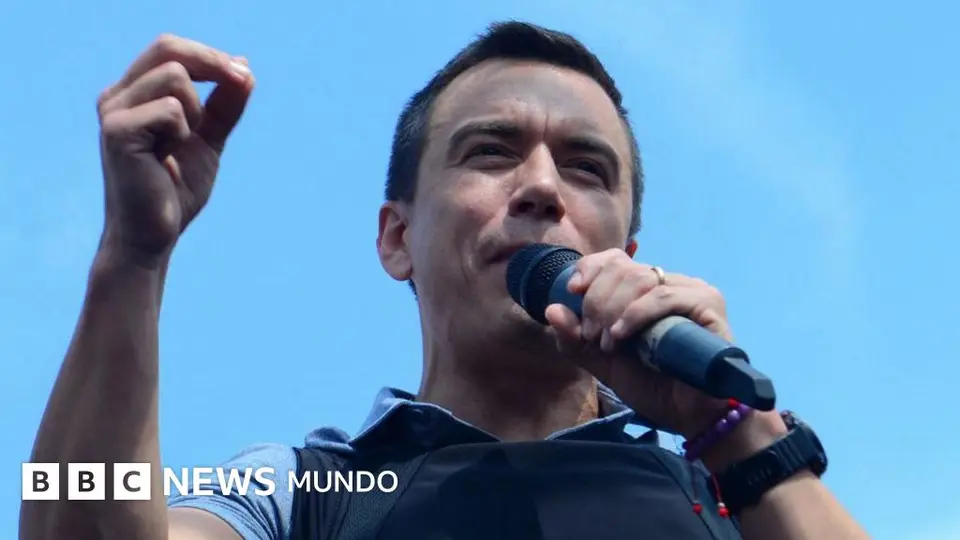
Violence and drug trafficking mark Noboa's arrival at Ecuador's presidency
Hardline measures, deep prison reforms and investment in technology to combat organised crime. This is, according to bbc.com, the plan that Ecuador's president-elect, Daniel Noboa, proposes to confront the security crisis shaking the country.
The challenge is no small matter: Noboa will only hold office until May 2025 and must govern with a fragmented National Assembly, with a significant number of seats in the hands of the correísmo faction.
Noboa won in a second round against correísta candidate Luisa González following an atypical electoral process: the outgoing president, Guillermo Lasso, decreed in May the dissolution of the National Assembly through the constitutional mechanism known as "crossfire death", which resulted in early elections. Lasso faced possible removal from office due to alleged embezzlement of public funds, accusations which he denies. Noboa will complete the term that remained for Lasso, who has held the presidency since May 2021.
A campaign marked by murders
Violence tainted the electoral campaign from beginning to end. Presidential candidate Fernando Villavicencio was shot during a rally in August, in what was perhaps the most serious episode in a series of attacks against political figures. A trade union leader, journalist and deputy, Villavicencio had launched his candidacy for the Construye movement and was known for denouncing the infiltration of drug trafficking into official government bodies.
Manta's mayor, Agustín Intriago, was shot dead in July while visiting a public works site. Sportswoman Ariana Estefanía Chancay died in the same attack, having approached the official to request assistance. That same month, deputy candidate Rinder Sánchez was shot when four men allegedly attempted to steal his vehicle. In February, two mayoral candidates died in separate attacks.
Prisons, another front of the crisis
On 22 July, inmates at the Guayas No. 1 Centre for Deprivation of Liberty, located in Guayaquil—the country's second most populous city and home to the main Ecuadorian port—clashed with each other in a burst of violence that left 31 dead, according to figures from the Public Prosecutor's Office. Authorities deployed 2,700 police and military personnel to restore order. During the operations, the Armed Forces seized long-range rifles, grenade launchers, ammunition and explosives.
Hours after the riot, prisoners from 13 of the country's 35 prisons began a hunger strike and detained approximately 100 custodians. President Lasso responded by imposing states of exception in different areas of the territory. Many analysts question the effectiveness of that measure in the face of recurring violence in prisons, which has left more than 400 dead since 2021, according to Human Rights Watch.
At the same time, several cities and localities recorded attacks and bombings against commercial establishments and vehicles.
The drug trafficking route
The provinces of Esmeraldas, Guayaquil and Manta, on the western coast, have concentrated the main focal points of recent violence. The country's most important ports are located there, strategic infrastructure for criminal organisations, especially drug traffickers.
Ecuador's own National Police acknowledged in a report published in July that "the main problem for Ecuador in relation to the geopolitics of drug trafficking is given by its territorial location next to Colombia and Peru, the world's principal cocaine producers, as well as by the weakness in integrated border controls that facilitate the entry of drugs". The same document admitted that scarce state control over maritime and air territory facilitates the departure of aircraft and vessels with barely any inspection.
Since 2019, drugs seized in the country have nearly tripled: from 79.5 tonnes to 201 tonnes, according to the same police report. This context led to the consolidation of national criminal organisations and the establishment of international gangs in Ecuadorian territory.
Sustained rise in homicides
The Ecuadorian Observatory of Organised Crime noted that in the first half of 2023 the number of intentional homicides increased 528% compared with the same period in 2019. "By the end of 2023, the country could reach a homicide rate per 100,000 inhabitants of more than 35", the body warned in its most recent report.
Authorities maintain that the vast majority of murders are linked to drug trafficking. The Interior Minister, Juan Zapata, however rejected the notion that the entire country is under the control of organised crime. "Violent deaths are geolocalised. Ecuador has 24 provinces. The problem is in five, which are the drug route", he declared.
Ecuadorian journalist Carolina Mella, resident in Guayaquil, disagrees with that interpretation. "Violence has begun to spread throughout the country. On the coast it is because drug trafficking needs the ports, but in the highlands it is because storage points operate there, even in Quito", she explained.
The outgoing government attributes the rise of violence not only to criminal organisations, but also to structural factors that the new president will have to address in a term of limited duration and with a parliament of variable configuration.
Source: Google News EC — Crime