Eiffel Tower closed: 575,000 protesters in France, 448 arrests
During nationwide protests in France, the Eiffel Tower remained closed all day. 448 people were arrested, 53 police officers injured.
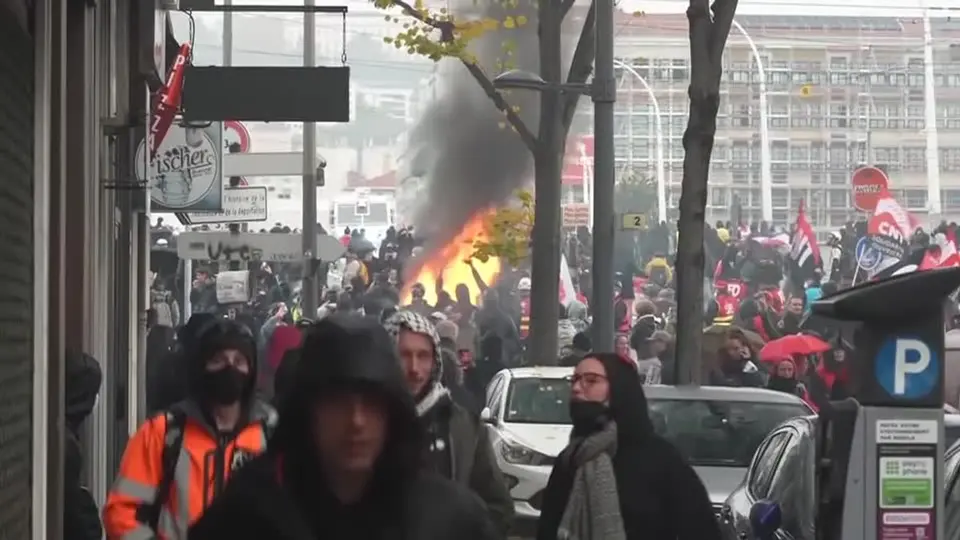
Strike and protests paralyse France – Eiffel Tower remains closed
According to t-online.de, on Thursday in France 575,000 people took to the streets, according to the Interior Ministry, to demonstrate for higher wages and better conditions at schools and universities. The CGT trade union put the number of participants at 1.6 million. In Paris, the Eiffel Tower remained closed to visitors for the entire day because of the protests. During clashes on the margins of the demonstrations, 448 people were arrested nationwide, and 53 police officers were injured.
Prime Minister Sébastien Lecornu announced a "social conference" for Monday. In the public service, approximately ten per cent of employees ceased work, and numerous regional trains were cancelled. Several trade unions had already called for the protest day in early October. Student associations and the Yellow Vests movement joined in.
Presidential candidates on the streets
In Paris, several presidential candidates participated in the demonstration, including left-wing populist Jean-Luc Mélenchon and Green politician Marine Tondelier. Social Democrat Raphaël Glucksmann was booed and left the rally early.
Blockades and tear gas outside schools
In the morning, pupils and students once again erected blockades made of waste bins and barrier fencing in front of numerous schools. Police deployed tear gas in many cases. In Toulouse, unidentified individuals wearing face masks entered a school and started a fire there, which was quickly extinguished. According to trade union figures, nearly one thousand of the total 3,700 secondary schools nationwide were affected by blockades. The government reported 81 blocked schools and a strike participation rate of 16 per cent among teachers. Every third university was also affected by protest action.
France's secondary school pupils have been protesting since mid-September against teacher shortages, excessively long school days, school buildings in poor condition, and the opaque allocation of university places. The government promised a new application procedure and more teaching positions – the student associations called this insufficient.
15-year-old pupil Luce from Strasbourg said: "We continue to protest because we are still not being listened to." With regard to school days that are long by international standards, she added: "In other countries, school days are much shorter, and that works too." 17-year-old Luna complained that the heating did not work in her school.
Trade unions against government spending cuts
The trade unions are mainly directed against the government's spending cuts and are demanding higher wages. CFDT union leader Marylise Léon told broadcaster BFM: "We want to be able to live decently from our work."
Clashes in Lyon, Rennes and Paris
Clashes occurred in several cities. In Lyon, at least one vehicle was set on fire, and police deployed tear gas. An AFP photographer with clearly visible press credentials received five baton blows during a police operation. There were also clashes in Rennes. The Interior Ministry recorded 86 operations nationwide due to fires.
In many places, however, there was a festive atmosphere. In Lyon, participants dressed up as superheroes on a pony or as a dancing pig. On Paris's Place de la République, dozens of musicians from the Orchestre du Nouveau Monde performed revolutionary songs and got the crowd singing along.
Interior Minister defends police strategy
Interior Minister Laurent Nuñez recently acknowledged that security forces had been overwhelmed on 17 October, the day of the most consequential clashes so far. There had been a "previously unprecedented mix" of various groups, including trade unions, Yellow Vests, left-wing radical vandals, criminals and young looters.
The minister nonetheless rejected any change in strategy or reduced arming of security forces: "Security forces must be able to defend themselves if they are attacked." On 17 October alone, 22,000 tear gas canisters were deployed, the use of which resulted in numerous people being seriously injured. The police inspectorate is currently investigating 83 cases of alleged unlawful police violence.
Further actions announced
The protest movement intends to continue its actions. The student organisation Unef called for new rallies on 7 November. The Yellow Vests also announced further actions. The protests, which have been ongoing for weeks, are shaping the presidential election campaign, in which incumbent Emmanuel Macron has only 13 per cent approval in polls and is not permitted to run again.
Source: Google News LU DE