Racist shooting in Trappes: one dead and five injured ahead of fresh protests
An individual opened fire on people of African and Maghrebi origin in the French town located near Paris. The attacker was arrested and the prosecutor's office is investigating the incident as racist terrorism.
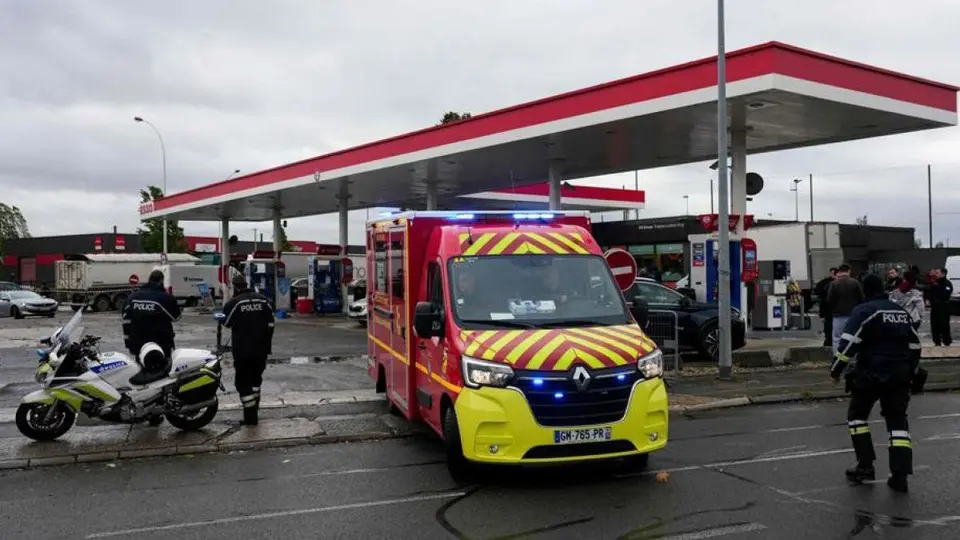
Terrorist attack in France leaves one dead
A racist attack has shaken France at a moment of extreme social tension. According to La Vanguardia, one person died and five others were injured in shots fired by an individual from his vehicle in Trappes, a town located approximately 30 kilometres west of Paris. The alleged attacker, Kevin T., a 39-year-old resident with a criminal record for common offences, was arrested immediately.
The victim is a 26-year-old man. Among the injured is a 12-year-old girl who received eight bullet impacts; three of the injured sustained serious injuries. The Counter-Terrorism Prosecutor's Office stated in a communiqué that it is investigating a murder linked to terrorism, as there are indications that the perpetrator selected his targets based on "the true or supposed belonging to a purported race, ethnicity, nation or particular religion".
The attacker used an old submachine gun from the Second World War era. Witnesses reported that he fired bursts in at least three locations: in front of a petrol station, a health centre and a play area. Investigators identified that three of the injured had "African appearance".
At the time of his arrest, Kevin T. was carrying the semi-automatic weapon, tear-gas grenades and a white powder allegedly cocaine. The Counter-Terrorism Prosecutor's Office stated that the attacker had prepared a booby-trap device at his residence, presumably to detonate when law enforcement arrived. A subsequent search of his home found three gas canisters.
Government and local authorities' reactions
President Emmanuel Macron expressed his "profound emotion" at the events and travelled to Trappes that evening. After visiting the Town Hall and speaking with the prosecutor of the Republic, Macron deplored that people had been attacked because of the colour of their skin. "This is a turning point. This is not France. The Republic will not yield," said the head of state, lamenting that in recent years "racist discourse has become entrenched".
Prime Minister Sébastien Lecornu reacted immediately via social media, promising the mobilisation of all state resources. Interior Minister Laurent Nuñez announced that 70,000 officers would be deployed across the entire territory, with forceful means including 15 vehicles equipped with water cannons, in anticipation of the protest scheduled for Saturday.
The mayor of Trappes, Ali Rabeh, of Moroccan descent, provided an in-depth analysis of the context of the attack. Rabeh emphasised that "discourses that arm ideologically those capable of taking action are criminal and must be condemned as such", implicitly referring to political leaders and presidential candidates who accuse the Arab-Muslim community of the country's problems. According to the mayor, these discourses "cause deaths". He urged "collective responsibility", "de-escalation" and "republican harmony".
Diverging political positions
Marine Le Pen, far-right presidential candidate, described the attack as a "barbaric act" whose perpetrators must be "severely punished". However, she avoided exploring the ideological motivations.
Manuel Bompard, national coordinator of La France Insoumise (radical left), emphasised that the attacker fired "based on skin colour". The presidential candidates of the Greens, Marine Tondelier, and of the Communist Party, Fabien Roussel, pointed to the far right for the climate they generate. Tondelier referred to "the release of racist speech more uninhibited than ever" since the disturbances of 17 October, pointing to the designation of scapegoats by the right and far right. Roussel lashed out against "the hatred that the far right spreads".
Context of the town and reinforced surveillance
Trappes is a multiethnic city of approximately 35,000 inhabitants, with a strong working-class and left-wing tradition, which contrasts with nearby Versailles, which has a middle-class and right-wing profile. In recent years, it has made news as a focus of Islamism and a departure point for jihadists to Syria and Iraq. In the first round of the 2022 presidential elections, Jean-Luc Mélenchon of La France Insoumise obtained 60.6% of the votes.
The attack occurred on the eve of a day of trade-union protest and the yellow vests movement. French police have stepped up alerts to prevent disturbances. Calls from far-left groups have been detected on social media to attack public buildings and commit looting. Minister Nuñez insisted that "we will be absolutely inflexible" and stressed that "there will be zero tolerance". Instructions to police emphasise acting "with great mobility, responsiveness and firmness".
There will be special surveillance in Orléans, where a National Rally congress was scheduled. The prefecture banned the protest demonstration against the far right, but maintains the trade-union call as part of the broader social mobilisation.
Source: La Vanguardia