Haiti inaugurates two judicial units specialised in gang crime, corruption and sexual violence
Port-au-Prince launched on 27 May two units of 25 magistrates to prosecute mass crimes, sexual violence and financial fraud related to gangs. Human rights activists warn of the risks of ineffectiveness.
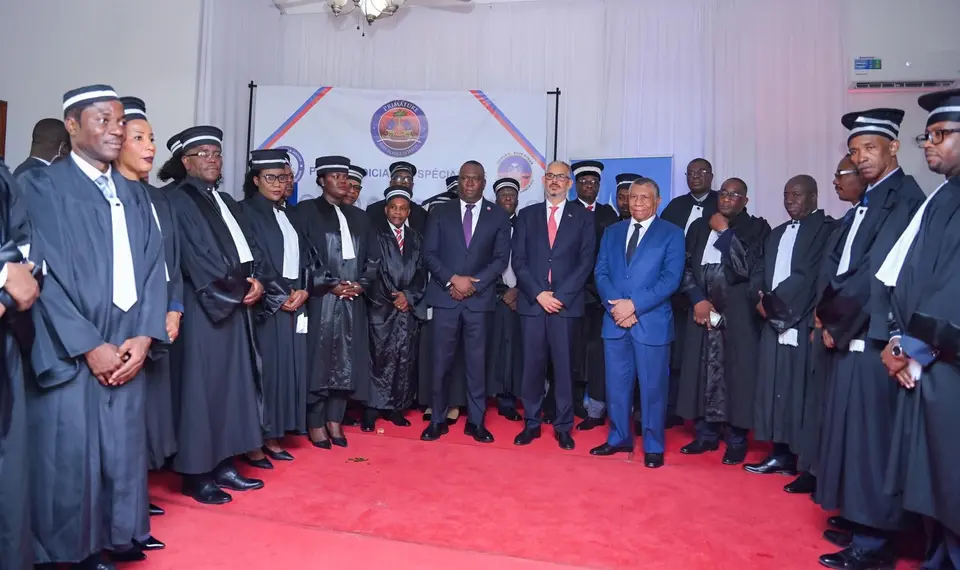
Two new specialised judicial structures inaugurated in Delmas
Haiti officially launched on Wednesday 27 May two judicial units specialised in Port-au-Prince, charged with investigating and prosecuting the perpetrators of mass atrocities, sexual violence, corruption, financial crimes and electoral fraud related to gangs and organised crime, reports haitiantimes.com.
The units, comprising a total of 25 magistrates, were inaugurated at a ceremony held in Delmas, in the presence of magistrates, representatives of the Haitian government and foreign diplomats. The initiative is based on a decree adopted on 16 April 2025 under the former Presidential Transitional Council (CPT).
"A historic first," according to the CSPJ
Jean Joseph Lebrun, president of Haiti's Supreme Council of the Judiciary (CSPJ), described the launch of these structures as an unprecedented event in the country's judicial history.
"This marks a historic first in the judicial annals of our dear Haiti, conceived to respond to the complex challenges that our society is facing," he declared at the ceremony.
Lebrun also urged judges assigned to the new units to resist political, economic and criminal pressures in the context of sensitive investigations. "These units are designed to ensure that no one can escape justice through influence, money or political protection," he added.
A judicial system under chronic pressure
This launch comes in a context of persistent criticism of the Haitian judicial system: structural malfunctions, political interference, corruption and inability to handle major crimes are regularly denounced. The courts in Port-au-Prince have suspended their activities on several occasions due to gang violence, and many investigations into massacres, abductions and sexual violence have stalled for years.
Human rights organisations maintain that this institutional weakness sustains a climate of widespread impunity, allowing armed groups, political networks and financial actors to operate without fear of prosecution. Many victims of gang attacks or sexual violence have never had access to legal protection.
Two distinct mandates
Prime Minister Alix Didier Fils-Aimé clarified the division of responsibilities between the two units at the ceremony. The first will focus on mass crimes and sexual violence, increasingly used by organised gangs as instruments of terror against civilian populations. The second will deal with financial crimes: corruption, money laundering, illicit enrichment and electoral offences that authorities present as factors of instability undermining state institutions.
"This act goes well beyond administrative formalities; it marks a decisive turning point where the State reaffirms its duty to guarantee justice, peace and dignity to every citizen," Fils-Aimé declared. "The specialised judicial units launched today bear witness to a firm political will to make law prevail over weapons, justice over impunity and the nation over barbarism."
Extended scope of authority
Under the April 2025 decree, prosecutors assigned to the units will be appointed by the Prime Minister on the recommendation of the Minister of Justice. Investigating judges and trial judges will be designated by the CSPJ. The authorities indicate that magistrates have been selected on the basis of their integrity, competence and independence.
The two structures will have jurisdiction to deal with cases of embezzlement, fraud, money laundering, unlawful appropriation of public funds and unjustified enrichment. They will also be authorised to investigate massacres, abductions, sexual violence used as a weapon of terror, human trafficking, arms trafficking and organ trafficking, the financing of terrorism and the exploitation of children.
The decree furthermore requires courts and prosecutors throughout the country to transfer to the specialised units any case involving crimes related to sexual violence, corruption, organised crime or individuals benefiting from legal immunity.
Persistent reservations from human rights organisations
Despite the widely shared recognition of the need for more robust judicial mechanisms, several Haitian human rights organisations point to significant gaps in the reform. They warn against the risk that prevailing insecurity, the weakness of the existing legal framework and political interference may limit the practical effectiveness of these new structures.
The authorities, for their part, believe that these units could help correct some of the structural failings of the system, provided that magistrates have sufficient security, resources and operational independence. They describe these structures as a potentially decisive tool for restoring public confidence in Haiti's state institutions.
Source: Google News HT — Port-au-Prince