Shooters from Lisbon's Lower Town in house arrest after attack that wounded Swedish tourist
Wilson, Arnaldo and Fábio, responsible for the shooting in Lisbon's Lower Town on 10 August, are in house arrest. The Public Prosecution Service appealed, demanding effective imprisonment.
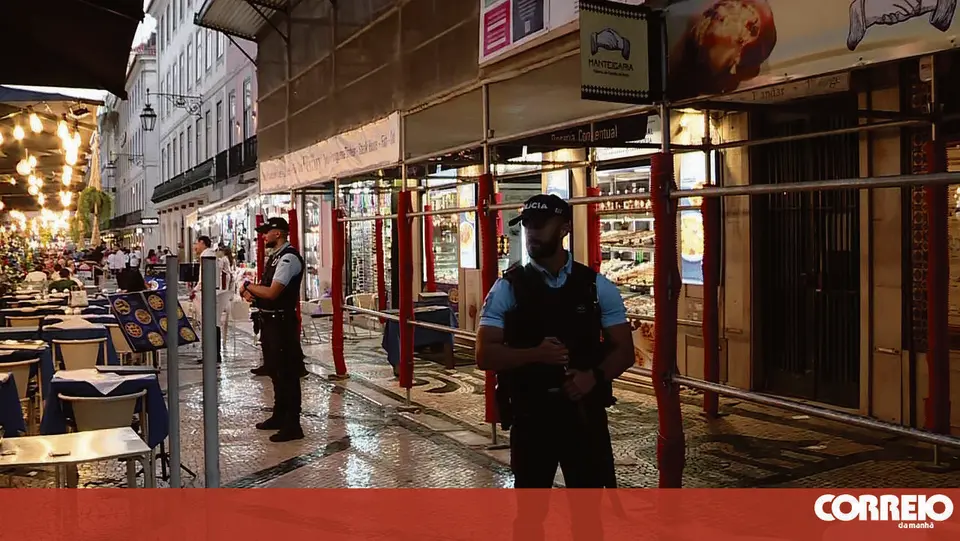
Judge maintains house arrest for trio who fired in Lisbon's Lower Town
The three men responsible for the shooting in Lisbon's Lower Town that seriously wounded a Swedish tourist have returned home with electronic bracelets, contradicting the position of the Public Prosecution Service, which demanded preventive detention. The case is reported by Correio da Manhã.
Wilson, Arnaldo and Fábio are identified as perpetrators of the settling of scores that culminated in a shooting attack on Rua Augusta itself, on 10 August. The target was a man from a rival family who usually sells sunglasses on that street in the city centre. A Swedish tourist was hit by a stray bullet and suffered serious injury.
The crime had been announced on social media three days before the attack — which was initially planned to be fatal — without the police authorities detecting the warning. The weapon used, a 6.35 mm calibre pistol, has not been found. The three defendants were also carrying cobblestones in their hands during the action.
When the Judicial Police went looking for the three men, none of them was at home. The inspectors were met with a wall of silence from family members. By late afternoon that same day, the three turned themselves in voluntarily to the Judicial Police.
Brought before the criminal instruction judge in September, Wilson, Arnaldo and Fábio were placed under house arrest with electronic surveillance. The Public Prosecution Service prosecutor appealed immediately and attempted to prevent the defendants from returning home. Last week, the three men left prison and are with their respective families.
In the decision, the judge acknowledged the seriousness of the facts, but held that remaining in a dwelling with electronic surveillance is sufficient to contain the identified risks. "Although without downplaying its high degree of unlawfulness and the intensity of the wrongful intent and, consequently, the high foreseeability that an effective prison sentence will be imposed on them, it was nonetheless considered that the obligation to remain in the dwelling, with their confinement to the aforementioned residences, is capable of adequately containing the stated dangers — namely, the continuation of criminal activity and the disruption of the inquiry and public order and tranquillity — provided that such obligation to remain in the dwelling is accompanied by effective electronic surveillance", wrote the magistrate.
Prosecutor Ana Fernandes da Silva had warned, in the appeal, that only incarceration in a prison establishment could prevent new crimes. The judge did not accept the argument and maintained the measure of constraint.
In the decision, the magistrate acknowledged the reservations of the Public Prosecution Service: "We do not downplay the reservations noted by the Public Prosecution Service, regarding the possible incapacity of the defendants, as a result of their respective personalities, to comply with the obligations arising from such a measure, seeking, fundamentally, to interfere with and/or condition the evidence and to persist in criminal activity. However, beyond the fact that this circumstance was duly weighed when fixing their coercive status, it is a risk inherent to the aforementioned obligation to remain in the dwelling, which, in our view, is mitigated both by electronic surveillance and by the prohibition of contacts and always without forgetting the possibility, in case of breach, of a new aggravation of the coercive measure."
Pedro Pestana is one of the defence lawyers appointed in the case. The inquiry continues with the murder weapon still to be located.
Source: Correio da Manhã