Life sentence and committal: Vienna man convicted of murder of ex-girlfriend Jennifer S.
A 33-year-old Vienna man was sentenced to life imprisonment on Thursday at the Vienna Regional Court for the murder of Jennifer S. in 2018. The court also ordered his committal to a forensic therapeutic centre.
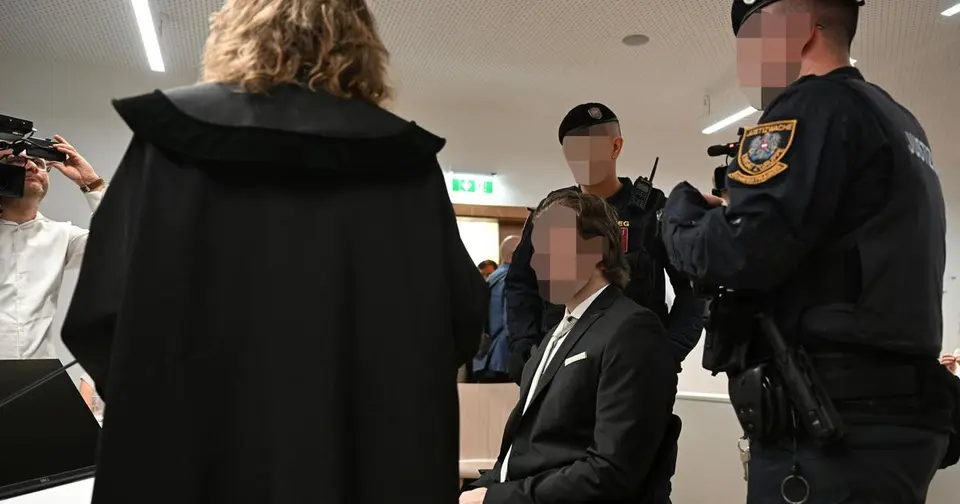
Murder verdict after almost eight years: life sentence for Jennifer S.'s killer
As Google News AT — Crime (de) reports, the murder trial against a 33-year-old man came to an end on Thursday at the Vienna Regional Court with considerable public interest. The court convicted him of the murder of his ex-girlfriend Jennifer S. and sentenced him to a life sentence. Additionally, he was committed to a forensic therapeutic centre in accordance with Section 21, Paragraph 2 of the Austrian Criminal Code. The verdict is not final.
Jennifer S. was killed in her flat in Vienna-Brigittenau on 21 January 2018. The defendant initially buried her body near Großweikersdorf in Tulln district, but later moved the remains to the area of the Allentsteig military training ground in Zwettl district. The crime remained undiscovered for almost eight years.
Confession in court
The 33-year-old had already confessed in December of the previous year and led police to the buried remains. In court, he pleaded fully guilty. "I confess fully guilty to murder," he stated at the beginning of his examination. He had strangled Jennifer S. because he "could not bear" that she no longer wanted to be in his life.
The prosecutor described the background of the crime to the jury: on that morning, Jennifer S. had "definitively broken up with him". The two had been in a relationship for around a year and a half, during which time, according to the indictment, the defendant had exercised "absolute control" over the woman, but had claimed freedom for himself — including contact with other women via social networks. "He strangled her in cold blood," said the prosecutor. "He could not accept her decision to leave him."
Emotional appearance of the defendant
The defendant described the escalation in the flat: Jennifer S. had become "physically aggressive" and told him to get out. "It was as if the floor beneath my feet was torn away," he said. The man, who was 1.96 metres tall and weighed around 90 kilogrammes, brought the woman, who was physically far inferior to him, to the ground and killed her with a forearm hold.
When presiding judge Petra Poschalko asked what he had felt immediately afterwards, the defendant answered: "Fear. That I would be caught." After the act, he undressed the dead woman, placed her in a box and transported her away. "At first I didn't know where I was driving to," he said. "I was without a plan, without anything."
The judge confronted him with his own account: "So you made her disappear." The defendant admitted that he had "repressed" the act for years and had "distracted myself with work or other diversions".
Back in the sights of investigators
From the outset, the 33-year-old was in the focus of the authorities in connection with Jennifer S.'s disappearance. However, investigations on suspicion of unlawful confinement were discontinued in April 2019 because nothing could initially be proven against him.
The criminal prosecution authorities refocused on him because in 2025 he described in detail in a chat how to dispose of a corpse without leaving suspicious traces. This had "put him under pressure," he admitted in court. He "could not bear the burden".
Eight years of uncertainty for the family
The lawyer representing the mother of the deceased, Andreas Schweitzer, described the family's years of suffering. "For eight years the mother searched for her daughter — with police units, with excavations that she financed herself." The disappearance had psychologically "destroyed" Jennifer S.'s sister, nephew and niece as well.
Schweitzer criticised that too little was said about the victim in the trial: "It was only about the defendant." Jennifer S. had been "successful in her studies" and "a person who loved life".
The prosecutor emphasised: "For eight years her family did not know what had happened to her." The relatives had on the one hand harboured hope for a reunion, and on the other hand "feared the worst, a crime".
The defendant apologised to the relatives: "You suffered for eight years because I was unable to take responsibility." He hoped "that I will be helped". The judge replied dryly to this: "There's nothing more that can be done for the victim. That's the sad thing about it."
Defence and verdict
Defence counsel Astrid Wagner emphasised that her client was "not a cold-blooded killer" and was "relieved that it has been cleared up". He "could not come to terms with her wish to separate".
The prosecution had explicitly called for the maximum sentence — for a crime that remained undiscovered for almost eight years. The court followed this request. The remains were identified on the basis of the skull bone, which could be attributed to the missing Jennifer S.
Source: Google News AT — Crime (de)