Operation in Santa Cruz exposes alleged judicial leaks that may have protected PCC
An international operation in Santa Cruz de la Sierra to capture two PCC leaders uncovered alleged judicial leaks and institutional obstacles. Brazilian police chief Fábio Pinheiro Lopes revealed the details to SBT News.
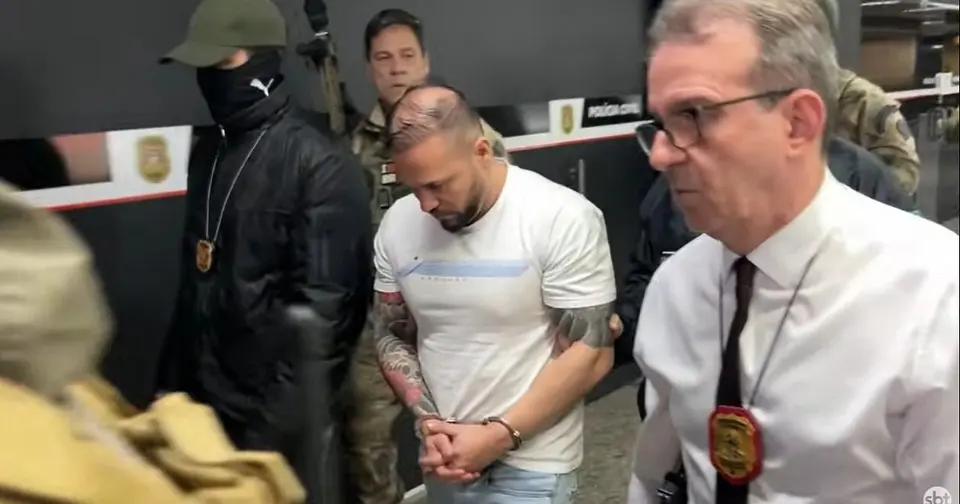
Capture of two PCC leaders in Santa Cruz reveals alleged leaks and institutional protection
An international operation carried out in Santa Cruz de la Sierra led to the arrest of two alleged leaders of Primeiro Comando da Capital (PCC), but exposed possible leaks of confidential information, judicial restrictions that may have limited intervention, and suspicions of institutional protection of organised crime in Bolivia, according to El Deber.
The revelations were made by Fábio Pinheiro Lopes, head of the Strategic Police Operations Division (DOPE) of the Civil Police of São Paulo, in an interview with the True Crime programme on SBT News, broadcast on 10 October. According to his account, cooperation between Brazilian officers, the Special Force to Combat Drug Trafficking (Felcn) and an agent from the United States Drug Enforcement Administration (DEA) made it possible to capture Roberto Prieto Filho, alias 'Betinho da Baixada', and Márcio Barbosa da Silva, known as 'Beiço de Mula'.
Lopes maintained that Betinho was the main target of the operation and that the encounter with Beiço de Mula was a coincidence that investigators took advantage of. The police chief described the mission as an unprecedented experience of joint work outside Brazilian territory.
Early alert before the search
One of the most sensitive episodes described by Lopes concerns an alleged advance warning that Betinho received before the search of his flat, located on the 13th floor of a building in Santa Cruz, and another property linked to his security on the 14th floor.
According to the police chief's account, Felcn processed requests around 10:00 to carry out the proceedings. However, the suspect allegedly received an alert around 11:00, before the intervention took place.
Lopes stated that Betinho subsequently acknowledged to Brazilian investigators that he had been warned about the procedure. According to that version, the information allowed him to order his associates to clean the flat, remove weapons and move vehicles to another condominium.
The allegation raises questions about the handling of confidential information and the possibility that people linked to the judicial proceedings had alerted the suspect. The identity of those who allegedly provided the warning and the existence of any leak must be established through documented investigation.
Judicial restrictions complicated the intervention
Lopes also questioned the conditions imposed for carrying out the searches. According to his testimony, officers had limitations on entering certain properties by force, breaking locks or intervening with vehicles, which would have reduced the scope of action during the operation.
Faced with these obstacles, investigators chose to maintain surveillance and track the suspects' movements until they found an opportunity to intercept them. Around 13:00, a pick-up truck left the car park of the building and headed to a restaurant. Two men got out and entered the premises, whilst the vehicle continued circulating in the area.
To verify the identity of one of them, a Felcn officer posed as a customer and took discreet photographs. The images were sent to Lopes, who identified Betinho, according to his own account.
Officers waited for the suspect to leave the restaurant and intercepted him on a public street. The capture was accomplished through surveillance and intelligence work, despite the difficulties described.
A suspicious vehicle and weapons that could not be verified
Another point raised by Lopes was the case of a white Honda that, according to investigators, was connected to Betinho's security circle. Police suspected that the vehicle might contain AK-47 rifles, but were unable to open it or break its windows due to the restrictions in place for its intervention.
The limitations were related to the ownership of the vehicle and the procedures required to inspect it. The police chief questioned whether, given suspicions of the presence of weapons, investigators were unable to immediately verify the contents of the vehicle.
To clarify this episode, it will be necessary to know the full text of the court orders, the conditions they established and the actions that were ultimately authorised. It is also necessary to establish where and under what circumstances the weapons mentioned in the account were found.
Santa Cruz as a haven for Brazilian organised crime
During the interview, Lopes described Santa Cruz as a city with high-level residential sectors where, in his assessment, members of Brazilian criminal organisations took refuge.
The police chief maintained that investigators found difficulties in accessing certain condominiums and mentioned alleged connections between PCC members and people in the Bolivian institutional sphere. He also made reference to suspicions concerning members of Comando Vermelho and other criminal organisations.
These assertions open a line of investigation into the possible use of property, private security and high-end vehicles to facilitate the concealment of persons sought by justice. However, restrictions on entering a property do not by themselves demonstrate the existence of criminal protection: it is necessary to establish whether the decisions were legally grounded or whether they were deliberately used to favour the suspects.
Alleged irregularities in judicial order records
Another aspect raised by Lopes concerns alleged irregularities in the records of arrest warrants. According to statements broadcast by SBT News, at least one of these warrants allegedly presented inconsistencies that investigators flagged as an indication of possible manipulation of the Bolivian judicial system for the benefit of the captured suspects.
Source: El Deber