Argentine Cameraman Filmed His Own Murder During the 1973 Tanquetazo in Santiago
Leonardo Henrichsen, an Argentine cameraman for Swedish broadcaster SVT, was shot dead by a soldier whilst filming the attempted coup of 29 June 1973 in Chile.
The Argentine Who Did Not Lower the Camera
According to infobae.com, on the morning of 29 June 1973, Argentine cameraman Leonardo Henrichsen ran out of the Hotel Crillón in central Santiago de Chile, camera in hand, towards the sound of tanks. A few hours later, his own camera would record the moment a soldier shot him.
Henrichsen was 33 years old, had three children and had covered fourteen coups d'état throughout his career. He was born in Buenos Aires in 1940, the son of a Swede and an Argentine woman of English ancestry. He trained at Sucesos Argentinos, the country's first cinematographic news programme, alongside photojournalist Tadeo Bortnowski, a veteran correspondent of the Second World War. He later worked at Canal 7, covered the coup against Juan Bosch in the Dominican Republic in 1963 and the Cordobazo in 1969 with such precision that Swedish public broadcaster SVT hired him.
He arrived in Santiago in 1972 to cover the truck drivers' strike that had put the government of Salvador Allende in check. He stayed because the political climate made it evident that something more serious was about to happen.
Chile on the Brink of the Abyss
Allende had been president since November 1970. His socialist programme—nationalisation of copper, agrarian reform, nationalisation of key sectors—had generated a systematic response from Washington. The Richard Nixon administration worked first to prevent his coming to power and, when that failed, to destabilise him from within. Inflation was rising, shortages were worsening and political polarisation was absolute.
Within the Army, that polarisation was especially intense. On one side, institutionalist sectors supported the democratic government. On the other, groups pushing for an imminent coup d'état were growing, with the backing of the far-right movement Patria y Libertad, which had spent months perpetrating sabotage at various points across the country.
Lieutenant Colonel Roberto Souper, chief of the 2nd Armoured Regiment, decided to act. On the morning of 29 June he mobilised around eighty men and about twenty vehicles—trucks, tank destroyers and M41 Walker Bulldog tanks—towards the Palacio de La Moneda and the Ministry of Defence. Allende, who was at the seat of government, called by radio to the citizenry and the loyal Army. General Carlos Prats marched with troops to suppress the rebellion and the Tanquetazo failed within hours. Souper and his men took refuge in the Ecuadorian embassy.
That day twenty-two civilians died. One of them was Henrichsen. Augusto Pinochet himself, who according to historical records played a double game—backing the rebellion whilst presenting himself to Allende as part of the loyal troops—emerged politically unscathed. Three months later he would lead the coup d'état of 11 September.
The Final Image
Henrichsen and his colleague, reporter Jan Sandquist, walked from the hotel towards La Moneda. At the corner of Agustinas and Morandé, one block from the presidential seat, they encountered a military patrol. Henrichsen raised the camera and started filming.
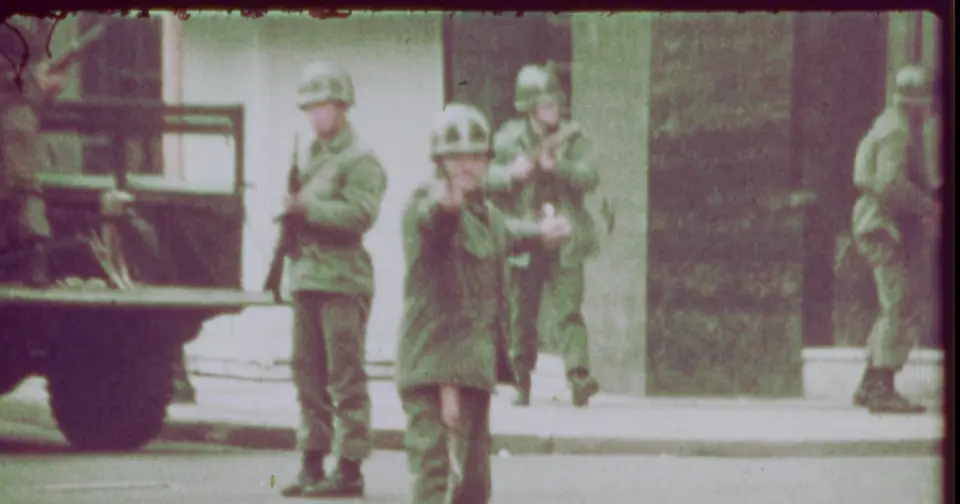
What he recorded in the following minutes is one of the most disturbing images in twentieth-century journalism. The camera shows a crowd fleeing towards the lens, some raising their fists. It shows the arrival of a truck full of soldiers that brakes abruptly. It shows the junior non-commissioned officer in command pointing his pistol at a civilian lying in the street.
And then the non-commissioned officer saw Henrichsen. He saw the camera. He shouted an order. He aimed.
Henrichsen did not lower the camera.
"Don't shoot, can't you see we are journalists?!", he managed to shout. The first shot missed. The second also missed. The third, fired from the truck bed by second corporal Héctor Hernán Bustamante Gómez, did not.
The camera fell when Henrichsen fell. But it kept filming. From the ground, pointing at the sky, it recorded the final seconds of the life of the man who had just captured his own murder.
Sandquist ran towards him and held his head. "Jan, I'm dying," Henrichsen managed to tell him. Those were his last words. One of the soldiers approached, grabbed the camera and tore out one of the two reels to destroy it. The other remained intact.
Saving the Material
There are several versions of how the footage was saved. One holds that a neighbour named Eduardo Labarca saw the military throw the camera into a sewer and destroy a blank reel by mistake. That night he went to look for it and sent it to Buenos Aires. According to another version, collected by filmmaker Andrés Habbeger in his documentary Imagen Final, the camera was rescued by Allende's personal guard, reached the Palacio de La Moneda and the president himself intervened to hand it over to Chile Films, which had better equipment to develop it.
What is not in dispute is the result: the images survived. Henrichsen's final shots—the crowd in flight, the officer who aims, the sky of Santiago—became a historical document and a symbol of the price paid by journalists who do not lower the camera.
Source: Google News CL — Crime