Santo Domingo hosts regional summit of EL PAcCTO 2.0 against transnational organised crime
Authorities from justice and security sectors across Latin America, the Caribbean and Europe are meeting in Santo Domingo until Thursday to strengthen cooperation against organised crime.
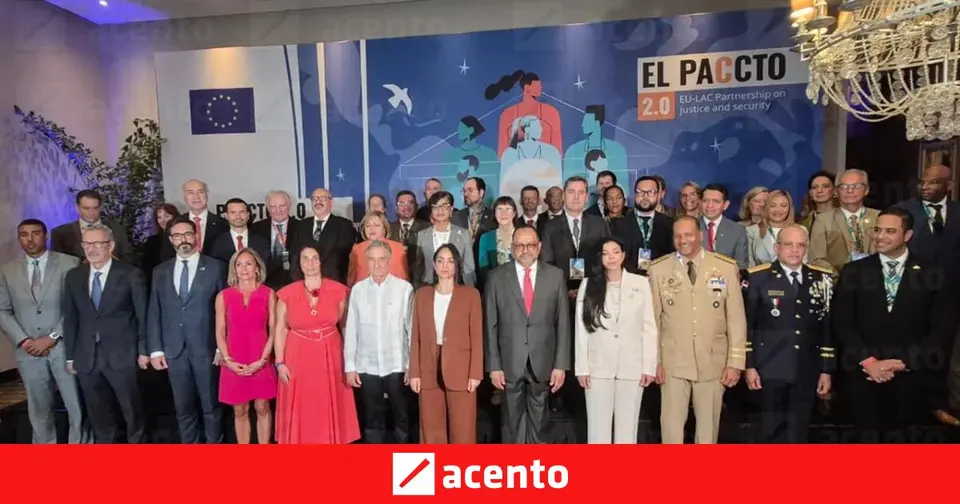
Annual EL PAcCTO 2.0 meeting debates bi-regional cooperation against transnational crime
The 2026 Annual Meeting of the EL PAcCTO 2.0 Programme began this Tuesday in Santo Domingo with the participation of authorities and representatives from justice and security institutions from Latin America, the Caribbean and Europe. According to acento.com.do, participants will work until Thursday on the challenges posed by international cooperation against organised crime.
The opening session took place in the Opal Room of the Embassy Suites by Hilton Hotel and was formally opened by the Minister of Interior and Police, Faride Raful. Also speaking were the Minister of Justice, Antoliano Peralta; the Attorney General of the Republic, Yeni Berenice Reynoso Gómez; and the Ambassador of the European Union to the Dominican Republic, Raúl Fuentes Milani. The Director General of the National Police, Major General Ernesto Rodríguez García, also attended.
No single state can act alone, warns Justice Minister
The authorities agreed that coordination between countries is essential in the face of criminal organisations that operate simultaneously in different jurisdictions and exploit new technologies. Peralta argued that no single state can confront transnational organised crime alone and proposed advancing towards more agile mechanisms of legal assistance, penitentiary cooperation and information exchange.
"This reality reminds us that organised crime knows no borders and our responses cannot be limited by them either," the minister stated.
Attorney General demands twenty-first century methods
Yeni Berenice Reynoso focused her remarks on the gap between the speed of evolution of criminal structures and the slowness of traditional judicial cooperation procedures.
"Twenty-first century organised crime will not be efficiently combated with the methodology and strategy of the eighteenth, nineteenth or twentieth century," she declared.
The Attorney General advocated for advancing towards transnational strategic criminal prosecution, noting that crimes such as drug trafficking, human trafficking, money laundering, cybercrime and synthetic drug trafficking increasingly involve organisations distributed across different countries and continents.
EU highlights programme's role as bridge between policy and action
Ambassador Raúl Fuentes Milani emphasised that cooperation in security and justice between Europe, Latin America and the Caribbean is a priority given a threat that, in his words, affects societies, weakens institutions and puts citizens at risk. Fuentes Milani highlighted the role of EL PAcCTO 2.0 as a mechanism for converting political commitments into concrete actions between the participating institutions.
Raful: artificial intelligence is already in the hands of illicit networks
Upon formally opening the meeting, Minister Faride Raful warned that criminal networks are advancing faster than many institutional procedures and that tools such as artificial intelligence are already being used by organisations linked to illicit activities.
"Criminal networks attack faster than procedures do. Artificial intelligence is already in the hands of those trafficking illicit financial flows," she stated.
Raful reported that 26 Dominican institutions linked to internal security have collaborated with counterpart bodies within the programme. Between 2024 and 2025, 147 officials—including police officers, prosecutors, penitentiary staff, financial analysts and cybersecurity specialists—participated in 82 activities.
The minister also highlighted the Dominican Republic's participation in a multinational operation against human trafficking carried out in ten countries, which allowed the rescue of 153 victims, in addition to cooperation actions against arms trafficking and for the identification of assets linked to criminal activities.
Agenda until 2030
The meetings will also serve to define cooperation priorities between the European Union, Latin America and the Caribbean for the period 2027–2030. Raful concluded her remarks by noting that bi-regional cooperation is sustained "when each country provides real capabilities, shares information in a timely manner and fulfils what it agrees to".
Source: Google News DO — Crime