Mossos investigates who organised Barcelona unrest: 128 arrested, 72 minors
Catalan police investigate those responsible for a social media call-out that mobilised groups of young people to loot shops in central Barcelona on Saturday.
Investigation into the organisers of the unrest
Mossos d'Esquadra are investigating who was behind the unrest in central Barcelona on Saturday, according to La Vanguardia. The call-out was spread via TikTok, Telegram, WhatsApp and the anonymous platform Blocus, urging people to replicate in Spanish cities the mobilisations taking place in France. Investigators suspect the action did not arise spontaneously, although sources from the investigation admit that "establishing its origin will be complicated".
Mossos chief commissioner Sílvia Catà stated on RAC1 that "we are working on the networks to find out who is behind this call-out and what the profile of the organisers and participants is". The president of the Generalitat, Salvador Illa, assured at a PSC rally in Tarragona that "we will know who they are", those responsible for the vandal acts.
Arrests and profile of participants
Groups of young people, many of them minors, responded to the call launched on TikTok to gather at 17:00 in Plaça de Catalunya. Mossos arrested 128 people on Saturday night, of whom 72 were minors. From 17:00 on Sunday onwards they began to be brought before the juvenile judge, who could impose precautionary measures including detention. The Public Prosecutor's Office is studying requesting restraining orders preventing the arrested individuals from participating in further disturbances.
Commissioner Catà stressed that "we are not dealing with a demonstration like those we are used to protecting" but rather "with criminal acts promoted and coordinated via social networks". Social media expert Marcelino Madrigal explained that "this was not an ideological protest, but a call-out whose sole objective was to loot shops", without any concrete demands regarding education or the dignity of secondary schools.
Organisation through digital platforms
The violent action was initially organised on TikTok and subsequently transferred to private Telegram and WhatsApp groups, where meeting points and objectives were specified. In the exchanged messages, bracelets allegedly stolen from the Pandora jewellery shop on Passeig de Gràcia were displayed and people were encouraged to repeat looting in luxury establishments. An active group called Blocus BCN urged participants to return to the streets on 31 October for fresh violent action in Plaça de Catalunya, Gran Vía and the Splau shopping centre in Cornellà de Llobregat, with explicit instructions: "Everyone in black and with hoods".
Madrigal warned on Friday on Bluesky that young people were being recruited at several Catalan secondary schools. On RAC1, he noted that "in Barcelona, some influencers with considerable followers echoed the call-out. They are not attracted to protesting or achieving better educational conditions, but to obtaining luxury products for free. That is why they attacked shops such as PC Componentes, Nike or Decathlon".
Development of the incidents
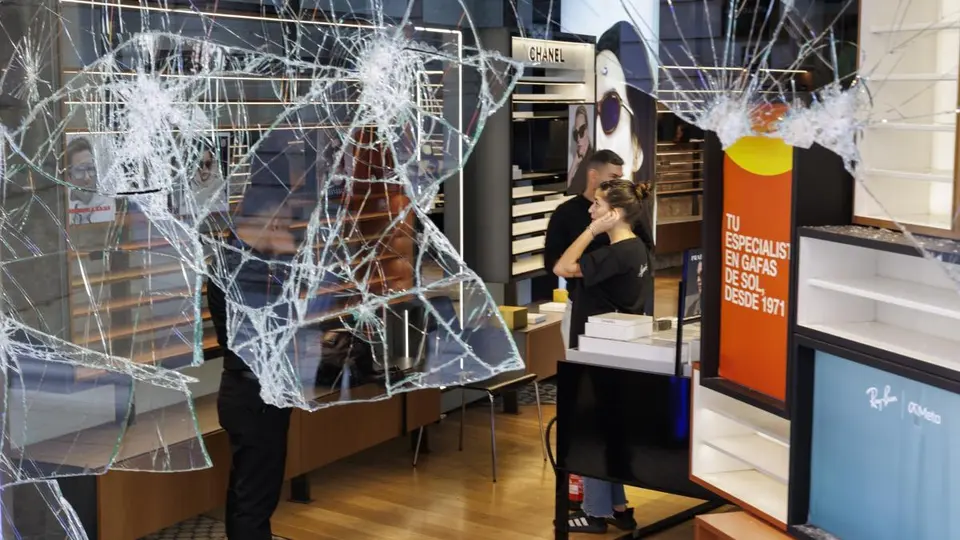
The incidents began around 18:00, when groups of young people with covered faces broke windows of electronics, clothing, footwear and optical shops. There was no defined route or centralised gathering. The groups, made up of between five and twenty people, moved through different areas of the city centre destroying urban furniture and looting establishments. They also set fire to bins, café awnings, motorcycles, bicycles and street furniture, as well as erecting barricades around Plaça de Catalunya.
The fire service intervened to extinguish 33 fires, whilst at least 14 establishments were damaged or looted. Mossos deployed approximately 300 officers from the Mobile Brigade and plain-clothes personnel, with support from the Municipal Police.
European context without concrete demands
The Interior Councillor, Núria Parlon, spoke of a possible "mirror effect" from European mobilisations, although she insisted that nothing that occurred in Barcelona responded to any concrete demand. Although the initial call-out mentioned "dignity of secondary schools", investigators concluded that the real objective was simply the looting of luxury shops, without underlying ideological or social motivation.
Source: La Vanguardia