Massacre in Kenscoff: Gangs murder 47 people and burn down church
Gang members in Haiti have killed at least 47 people and murdered displaced persons who had sought shelter in a church. According to experts, planned elections in December are hardly realistic.
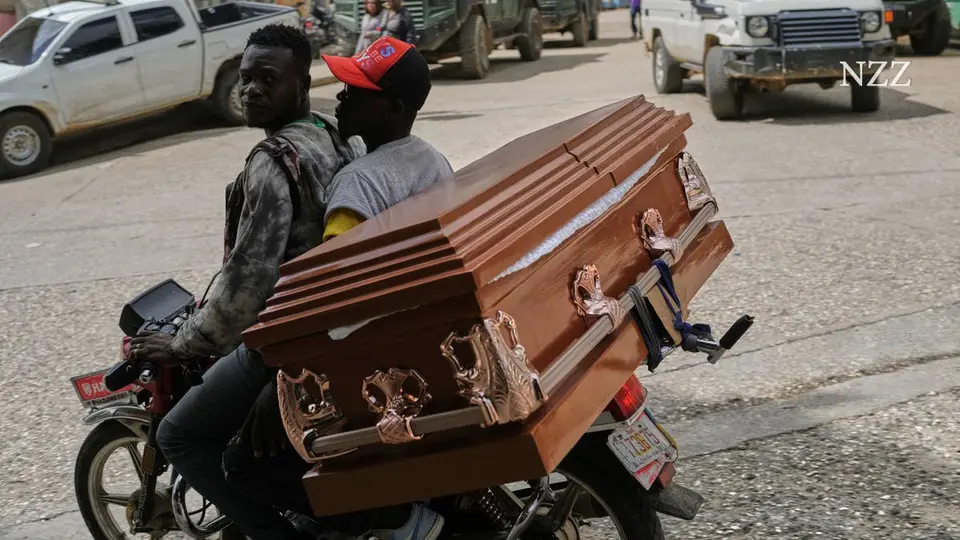
Gangs kill displaced persons in church – Haiti's spiral of violence continues
In the night from Sunday to Monday, criminal gangs attacked the municipality of Kenscoff south of Port-au-Prince and killed at least 47 residents. According to the NZZ, the attackers set fire to houses and a church in which displaced persons from other parts of the country had sought shelter. According to the United Nations, 22 of these people were murdered in the church. Additionally, gang members abducted fifty people and threatened to kill them if security forces move against the groups.
UN Secretary-General António Guterres condemned the attack on the platform X. "The relentless gang attacks on communities and the loss of civilian lives underscore the alarming security conditions in Haiti and underscore the urgent need to intensify Haitian and international security measures to combat gangs," Guterres wrote.
The mayor of Kenscoff holds the alliance Viv Ansanm responsible for the attack – derived from the French "vivre ensemble". The group is led by former police officer Jimmy Chérizier, who claims to be fighting against Haitian oligarchs and American imperialism. In practice, the organisation, which controls large parts of Port-au-Prince, also terrorises the civilian population and is responsible for massacres, abductions and extortion. The Trump administration declared Viv Ansanm a terrorist organisation in October 2025.
Kenscoff: From resort town to battlefield
Kenscoff lies at 1,500 metres above sea level and was once a quiet place – noticeably cooler than Port-au-Prince ten kilometres away, with country houses for the capital's upper class and a market for farmers from the surrounding area. Since the beginning of last year, the municipality, which lies on a strategically important road to the south of the country, has become a scene of bloody fighting. In an attack in January 2025, fifty people died; in March over 250 – half of them uninvolved civilians.
In addition to Viv Ansanm, other gangs such as Gran Grif and Kraze Baryè operate in the country. The state crisis began in July 2018 with protests against rising petrol prices, corruption and poverty. Since then, state control has steadily eroded. 1.5 million people have fled within Haiti from the gangs, and according to the NZZ, rape is part of everyday life.
Assassinated president, weak interim government
Jovenel Moïse, who won the last reasonably regular presidential election in 2016, was murdered in his residence in 2021 by Colombian mercenaries – possibly because he had attempted to stop the cocaine smuggling from Colombia through Haiti to the United States and Europe. His successor as interim president, Ariel Henry, is himself suspected of involvement in the assassination. Since November 2024, former businessman Alix Didier Fils-Aimé has led the interim government.
Development organisations and donors holding back
Esther Belliger, responsible for Latin America and the Caribbean at the development organisation Helvetas, is following the situation in close consultation with colleagues on the ground. Her staff can still work in their priority region in the south of the country. "However, the security situation and the humanitarian situation in Haiti have deteriorated noticeably in recent weeks, particularly in the capital and surrounding regions," Belliger says.
Other aid organisations and Western states, she observes, are showing great restraint. According to Belliger, many potential donors want to speak up funding only when there is a minimum level of stability and a democratically legitimised government exists. "But the preconditions for this are not currently in place."
UN special unit far below target strength
The UN Security Council has established the so-called Gang Suppression Force (GSF), which is to restore state control in cooperation with Haitian authorities. A target strength of 5,500 soldiers and police officers is aimed for by autumn. However, only around 500 GSF members have arrived in Haiti so far, Belliger says. "And it is completely unclear how a further 5,000 people are to be financed, housed and supplied with food."
Elections in December – gangs threaten voters
Elections are scheduled for 13 December for the first time in ten years. Voter registration has been ongoing since July. However, the majority of the population lives in gang-controlled areas, and the criminal groups threaten to kill everyone who appears at a polling station.
Belliger's contacts on the island do not expect an improvement in the near future. "The criminal gangs have an interest in sabotaging the democratic process. Because a strengthened state would endanger their power," she says. Even if the vote takes place, according to Belliger, very low voter turnout is to be expected – and she currently considers a free election accessible to all citizens hardly feasible.
Source: NZZ