Irish man sentenced to 14 years in prison for murder of American woman in Budapest
A Budapest court has sentenced an Irish man to 14 years in prison after he was found guilty of killing an American woman whom he met in a Budapest bar in November 2024.
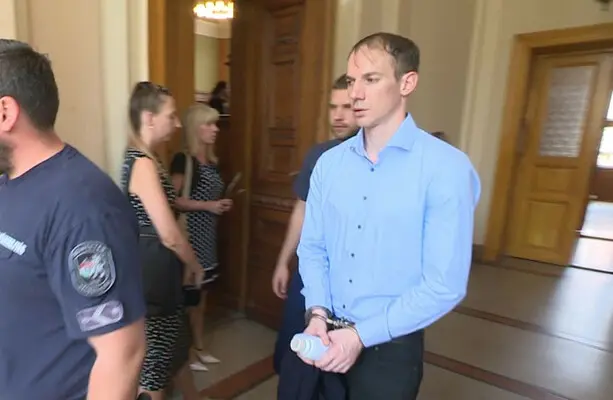
Irish man sentenced to 14 years in prison for murder of American woman in Budapest
A Budapest court last Wednesday found guilty and sentenced an Irish citizen to 14 years in prison for the murder of an American woman in the Hungarian capital in November 2024.
The 38-year-old Lorcan Tadgh Murphy, born in Dublin, was found guilty of killing Mackenzie Elizabeth Michalski. Michalski was a 31-year-old nurse from Oregon. According to The Journal, Murphy was referred to in the Hungarian court's verdict by the initials LTM, as the Hungarian press traditionally does not name individuals involved in criminal proceedings.
The court proceedings revealed that Murphy met Michalski in a Budapest nightspot in November 2024, then took her to his own apartment, where he bound her, strangled her, and placed her body in a suitcase. He then cleaned the apartment and drove to a wooded area near Lake Balaton, where he hid the victim's body.
The court rejected Murphy's claim that Michalski died in an accident during a sexual encounter. According to investigators, Murphy's internet search history included questions such as whether pigs eat corpses, about the presence of wild boar in the Lake Balaton region, and how reliable the Budapest police force is.
In its statement, the court emphasised: "The defendant did not attempt to resuscitate the deceased, nor did he call for help; the court found that he acted intentionally, and his aim was the death of the victim."
Murphy was arrested two days after the murder in Budapest. He subsequently assisted investigators in finding Michalski's body, but continued to claim that the victim's death was an accident.
Murphy's defence has already indicated that it will appeal the verdict. If the appeal is unsuccessful, Murphy will have to serve the 14-year prison sentence — minus the 18 months he has already spent in pre-trial detention — and will then be deported from Hungary and banned from the country for 10 years.
The Hungarian press's decision not to name Murphy has elicited mixed reactions. Legal experts consulted by The Journal explained that whilst Hungarian law does not strictly prohibit the naming of individuals involved in criminal proceedings, preserving anonymity in the press is a convention, except where the person is a public figure. Pál Bátki, a Budapest criminal lawyer, stated that the protection of personal rights and reputation is based on the principles of the Civil Code, which advises the media to be cautious when identifying individuals.
Csongor Herke, a law professor at the University of Pécs, added that the withholding of the full name "does not stem from a single legal prohibition, but from the presumption of innocence", which is also enshrined in Hungary's Fundamental Law. The individuals concerned are protected by civil law, data protection rules, and the case law of the Curia, the Constitutional Court and the European Court of Human Rights.
Michalski's family was deeply shaken by the verdict. Mackenzie's brother, Nicholas Michalski, told journalists: "I cannot see any point in saying anything to him. I searched for some trace of humanity, but there is nothing behind his eyes." He added that according to experts, Murphy presents a high risk of reoffending and is "incurable".
Mackenzie's father, William Michalski, made the following statement about the 14-year sentence: "No court can replace the loss of our beloved, Kenzie, and all the broken lives that this has caused, so a sentence can never be long enough. At the same time, we find consolation in the fact that a verdict has been delivered."
Source: TheJournal.ie