Election fraud charge against Honduran green card holder dropped to unrelated misdemeanor
The Trump DOJ's high-profile voter fraud arrest of Darwin Rivera Flores collapsed into a minor unrelated charge. The felony election count was dropped entirely.
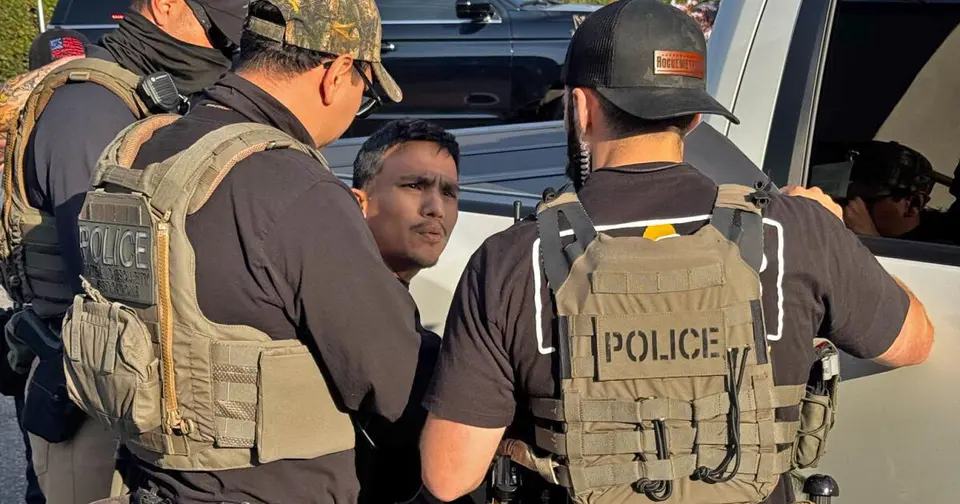
Election fraud case that DOJ called 'first of many' ends with unrelated misdemeanor plea
A federal voter fraud case that the Trump administration's Justice Department promoted as the opening salvo in a sweeping crackdown on election crime has ended in a misdemeanor conviction entirely unrelated to voting, the Los Angeles Times reports.
Darwin Rivera Flores, a 31-year-old Honduran national living legally in the United States on a green card, was arrested in a staged operation outside a skilled nursing facility in Ventura, California, where he worked as a caregiver. Federal agents in police vests held him against a truck, hands cuffed behind his back.
"What did I do?" Rivera asked as agents restrained him. "Can you tell me what I did?"
The original charge
Federal prosecutors accused Rivera of falsely claiming U.S. citizenship when he registered to vote — a felony — though they acknowledged he never actually cast a ballot. First Assistant U.S. Attorney Bill Essayli, the top federal prosecutor in Los Angeles, posted a brief video of the arrest on X and described it as the "first of many to come" as his office escalated efforts to prosecute election-related crimes.
The arrest was announced with a formal news release. It drew wide attention as a centrepiece of what Essayli billed as a systematic effort to root out noncitizen voter fraud.
Case collapses before trial
The felony charge never went to trial. On 9 November, Rivera pleaded guilty to a misdemeanor — admitting he shouted "vulgar obscenities and profanities" at federal employees in Camarillo roughly ten months earlier. The offence has no connection to voting. Prosecutors dropped the felony election charge entirely.
U.S. District Judge Mark C. Scarsi sentenced Rivera to a year of unsupervised probation. The U.S. attorney's office, which had issued a news release announcing the arrest, did not issue one when the case was resolved.
When asked why the election-related charge was dropped, Ciaran McEvoy, a spokesperson for the U.S. attorney's office in Los Angeles, said the office does not comment on such decisions. Rivera could not be reached for comment, and his public defenders did not respond to inquiries from the Times.
Broader crackdown under scrutiny
The outcome is the latest setback for Essayli's office after a series of voter fraud enforcement efforts that have stumbled. Last month, Essayli argued in court that roughly 20,000 ballots should be set aside pending citizenship verification. A federal judge rejected the request, a U.S. 9th Circuit Court of Appeals panel upheld that rejection, and the U.S. Supreme Court declined to intervene.
Ahead of the November election, federal authorities in California charged more than 30 people under "Operation Protect the Vote." The collapse of the Rivera prosecution has raised questions about the strength of those cases.
Laurie Levenson, a professor of law at Loyola Law School and a former federal prosecutor, said the resolution amounted to "less than a slap on the wrist."
"I don't know what to say other than I think the public should be aware and beware that this push against voter fraud may not have the credibility that the Justice Department wanted you to believe," Levenson said. "Why, when they made a big deal about the voter fraud charge, did they back down?"
Trump administration officials have stated they intend to continue prosecuting noncitizens on election fraud charges, though a Washington Post review of federal court records identified only two new cases since the midterm elections.
Questions over the investigation's timeline
Court filings submitted by Rivera's public defenders, Howard Shneider and Daniel T. Lee, cast doubt on the government's account of how Rivera came to their attention.
Essayli had said publicly that a text message Rivera sent — referencing midterm elections and suggesting federal agents could face indictment once qualified immunity no longer applied — was what drew investigators to check whether Rivera was registered to vote.
"That's how he came on their radar," Essayli said on Fox News after the arrest.
But records turned over in discovery, as outlined in an October 26 federal filing by Rivera's defenders, showed that the investigating agent, Christopher Kuzma of Homeland Security Investigations, had already searched Rivera's voter registration status more than two months before that text message was sent. A printout of Rivera's "My Voter Status" page from the California secretary of state's website, dated 25 February, was among the records — one week after Kuzma had cited Rivera for a separate confrontation involving an ICE employee at a federal building in Camarillo.
According to the same discovery records filed in federal court on 8 April, nearly three weeks before the midterms text arrived, Kuzma had already served a summons on the Los Angeles County registrar's office seeking Rivera's voter registration records.
Rivera, who was born in Choloma, Honduras, has lived in the United States since 2002, according to a criminal complaint filed in the case. When he went to renew his green card in February, Kuzma issued him a misdemeanor citation related to the earlier building confrontation — describing it as intended to "correct [his] bad behavior," according to an investigative report filed in court.
Rivera pleaded guilty to that citation and was placed on unsupervised probation. The felony voter fraud charge that the Justice Department had placed at the centre of its election integrity messaging did not survive to trial.
Source: Google News MT — Crime (en)