Boca's goalscorer and national team player, imprisoned twice for murder: the story of Benjamín Delgado
Benjamín "Negro" Delgado shone in the 1926 Copa América and won titles with Boca Juniors, but murdered his wife in 1940 and killed again in 1953.
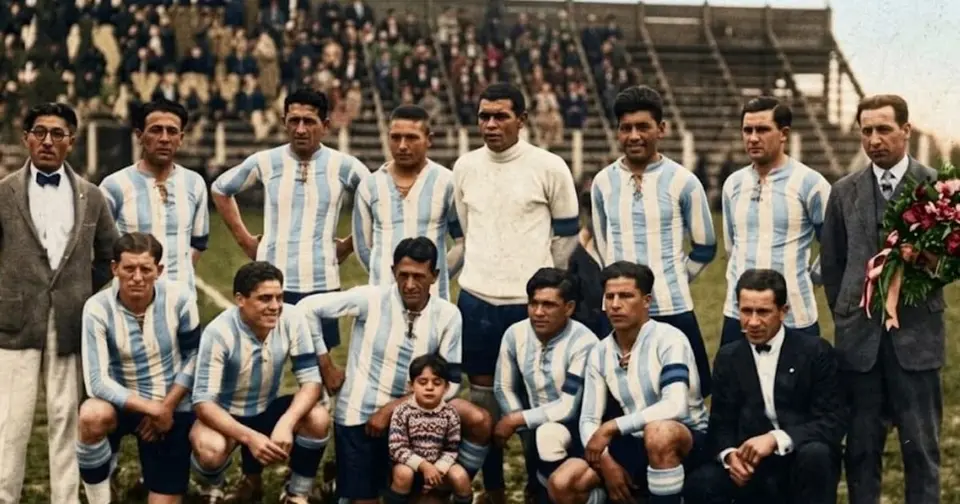
The championship winger who ended up twice behind bars
Benjamín "Negro" Delgado was a goalscorer for the Argentine national team, a champion with Boca Juniors and one of the leading figures in amateur football during the 1920s. According to radiomitre.cienradios.com's reconstruction, he was also convicted of murdering his wife, pardoned by Juan Domingo Perón and later arrested a second time after committing another homicide.
Delgado was born on 1 July 1897 in San Lorenzo, Santa Fe. He played for Tigre in 1922 and joined San Fernando the following year, the club from which he received his first call-up to the national team. His international debut took place on 20 May 1923 against Paraguay, a match Argentina lost 2–0. In that encounter he figured in an episode that was recorded in history: he deliberately missed a penalty because the squad considered the decision to have been made incorrectly.
During those years he combined football with other activities. He was a bank employee, sports journalist and civil register assistant, occupations that the amateur system of the time allowed.
Copa América 1926 and the title with Boca
In July 1926, Delgado joined Boca Juniors following the club's celebrated European tour. He shared the squad with Américo Tesorieri, Mario Fortunato, Roberto Cherro and Mario Evaristo. His time there lasted just under ten months, but it was enough for him to win the championship and the 1926 Copa Estímulo.
That same year he played in the Copa América in Chile. Argentina finished second behind Uruguay, and Delgado participated in four matches, scoring three goals: one in the 5–0 rout against Bolivia and two in the historic 8–0 victory over Paraguay. Only Gabino Sosa surpassed his tally in that competition, with four goals.
After the Copa América he was not called up to the national team again. He continued his career at Argentinos Juniors, BAP, Atlanta and Tigre, until in 1933 he definitively ended his stage as a professional footballer.
The 1940 crime
On 17 September 1940, during an argument, Delgado drew a weapon and fired five times at his wife, Josefa Scaglia. One of the shots mortally wounded her; the woman died approximately 30 hours later. The former footballer then attempted to take his own life with a shot to the head, but survived.
The courts sentenced him to 18 years in prison. He served an initial period in Sierra Chica and was later transferred to the Ushuaia penal facility, known as the prison at the end of the world, where he remained for six years before returning to Buenos Aires.
During his incarceration he remained connected to football. He participated in matches organised for inmates and, in 1948, put on a Boca shirt again in a makeshift pitch inside the National Penitentiary.
The campaign for his release and Perón's pardon
The popularity that Delgado had built during his career did not disappear entirely. Former teammates, sports journalists, club officials and Boca supporters began to call for his freedom. Argentine players who had won the 1947 Copa América also joined the appeal. Boca's leadership submitted a petition and, according to chronicles from the time, the campaign gathered tens of thousands of signatures.
On 5 June 1948, after 7 years, 8 months and 18 days in prison, Delgado received a pardon signed by Juan Domingo Perón. A delegation linked to Boca went to the prison to deliver the document to him; Delgado broke down in tears. Days later he returned to La Bombonera and received a tribute before a match between Boca and San Lorenzo.
Second homicide and return to prison
Delgado promised to begin a new life. He settled in Rosario and formed a relationship; they had a daughter, but the relationship ended years later.
In 1953, five years after regaining his freedom, he became involved in another crime. On learning that his former partner was in a relationship with another man, he waited for that man at a street corner in Rosario. On 4 November 1953 he shot Jenaro Tisera five times, who died at the scene. Delgado was arrested and returned to prison.
Following that second crime, his life became distanced from the world of football that had made him famous. Over time he became associated again with figures in the sporting world, but his story was marked forever by the two homicides.
Death in the Paraná
Benjamín Delgado died in 1967 in Rosario. According to records cited by journalistic investigations into his life, he went to the area by the Paraná river, at the level of the Monumento a la Bandera, and threw himself into the water. His death was classified as suicide.
His trajectory concentrates some of the most extreme contrasts in the history of Argentine football: a national team figure, a Copa América goalscorer, a champion with Boca in the amateur era, and the perpetrator of two homicides that erased from collective memory everything he had built within a football pitch.
Source: Google News AR — Crime