Trial for triple lesbian killing in Barracas: prosecution seeks life imprisonment for hate crime
Prosecution and complainant parties agreed in requesting life imprisonment for Justo Fernando Barrientos for the explosive attack that killed three lesbian women in Buenos Aires.
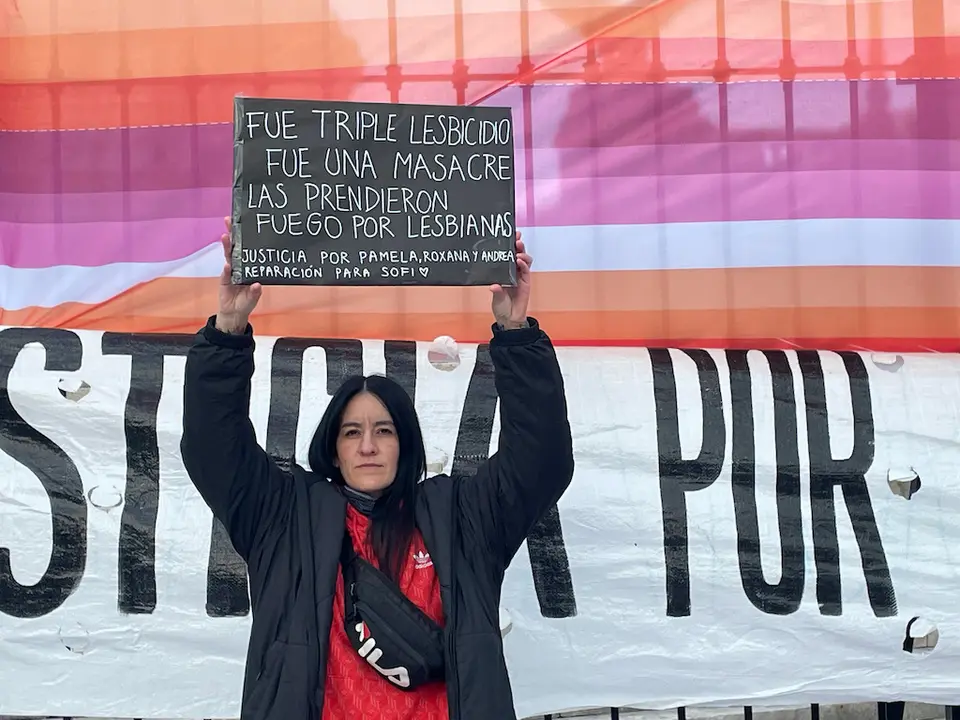
Final submissions in trial for triple lesbian killing in Barracas
The trial for the triple lesbian killing that occurred in the Buenos Aires neighbourhood of Barracas entered its final stage. According to agenciapresentes.org, hearings for final submissions took place on 26 and 28 October, in which the prosecution and complainant parties agreed in requesting life imprisonment for Justo Fernando Barrientos, the sole defendant, and in framing the act as lesbicide, femicide and hate crime.
The victims were Pamela Cobbas, Roxana Figueroa and Andrea Amarante, all three deceased. Sofía Riglos Castro, the only survivor, was left with serious consequences. The four attacks took place on the night of 5 May 2024, when Barrientos—69 years old and resident in the same boarding house as the women—threw an explosive device into the room where they were sleeping.
"The motive for the crime was hatred"
Chief prosecutor Manuel Fernández Buzzi presented before the Criminal and Correctional Oral Court (TOCC) No. 5 that the evidence collected during the proceedings allowed him to conclude that "the crime was motivated by a very profound and visceral feeling: the hatred he felt towards the victims. He not only set them alight alive but did so at night, inside their bedroom, where they lived together".
Fernández Buzzi stressed that Barrientos displayed "contempt and aversion" towards the women because of their sexual orientation, and that this hatred did not arise on the day of the attack. The prosecution deemed it proven that there was a prior history of harassment. "The victims lived harassed and discriminated against by Barrientos for being lesbians and for being women," the prosecutor said, adding that the defendant took advantage of their vulnerability. "He believed himself superior, allowed himself to discriminate against and despise these women because they did not conform to the stereotype society assigns to them. It was not an ordinary homicide: he set them alight in a deliberate manner, with the objective of burning them alive, of causing them suffering and agony."
The prosecution requested that the sentence contemplate homicide aggravated by cruelty, by the mediation of gender-based violence and by hatred of sexual orientation in the cases of Pamela, Roxana and Andrea, and in attempted form with regard to Sofía. The prosecution also stated that "this crime expresses the worst of social interaction: sexism, intolerance, discrimination and hatred".
Legal framing as hate crime, following initial resistance
Recognition of the act as a hate crime—in the terms of article 80, paragraph 4, of the Argentine Penal Code—was not immediate. At the start of the investigation, the investigating court refused to admit that classification. It was thanks to the persistent work of lawyers and activists that this legal framing was finally incorporated into the proceedings.
The collective complainant party of the Argentine Federation of Lesbians, Gays, Bisexuals and Trans (FALGBT), composed of lawyers Samanta Pedrozo and Flavia Massenzio, and legal assistant Sofía Saavedra Chávez, also presented at the hearing on 28 October. Pedrozo opened her intervention by recalling that on repeated occasions the FALGBT had been denied the possibility of acting as a complainant party. "We kept insisting until in December 2024 we reached the Criminal Cassation Court. From that moment we were able to take part in this process and it is historic to be here," she said.
The lawyer contextualised the scope of the case beyond the four women directly affected. "What happened to Andrea, to Pamela, to Roxana and to Sofía did not happen only to them, it happened to all of us people who from birth have to learn to live with hatred and discrimination," she said.
"We need to ask the State to protect our identities"
Pedrozo also referred to the symbolic dimension of the attack. The fire that Barrientos started, she said, "not only consumed their bodies, leaving them without skin and without hair. It took their lives and their hopes of living in a better society". And she concluded with a direct demand: "We need to ask the State to protect our identities. We cannot live in fear that a person like Barrientos will decide to set us alight for being who we are and how we live".
The FALGBT complainant party requested life imprisonment, with the double aggravating factor of hatred of the victims' sexual orientation and of gender-based violence. Pedrozo also emphasised the social context of the victims: in addition to being lesbians, they were "four poor women, who came from living on the street, surviving from aggressors and also from State violence".
Sentencing pending
With the submissions of the prosecution and complainant parties concluded, the court must now hand down its sentence. The accusing parties hope that the ruling will explicitly set out the framing as lesbicide and femicide, thereby consolidating jurisprudence regarding hate crimes based on sexual orientation in Argentina. The defence of Barrientos has yet to present its final arguments before TOCC No. 5.
Source: Google News AR — Crime