Schlossberg gang terrorised southern Styria after end of war in 1945
After 1945, the armed Schlossberg gang kept the southern Styrian borderland in terror. Murders, abductions and looting characterised the region until the arrests in 1947.
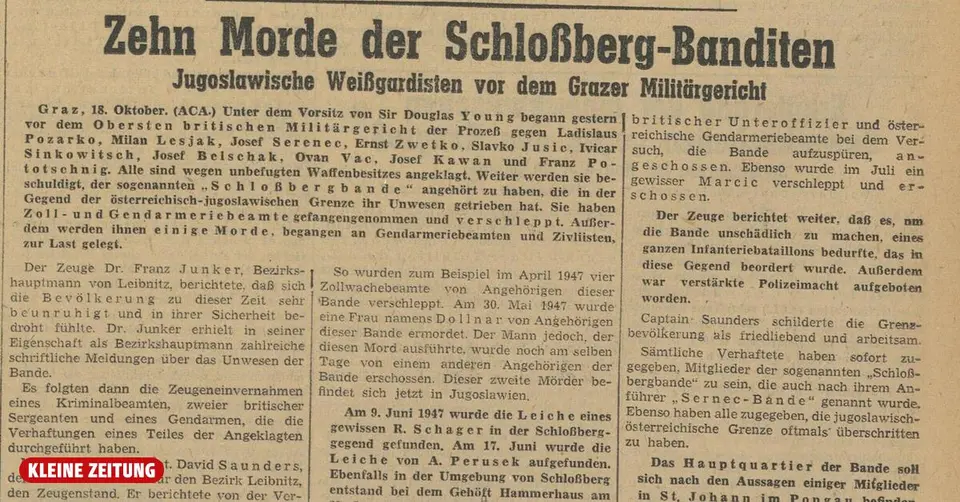
Armed gang held southern Styria in fear after end of war
On 27 June 1947, shots rang out at the Hammerkautz farm in Großwalz. Two residents of the farmstead were killed, four were wounded. A gendarmerie patrol was dispatched — two officers were shot, another was abducted later. A memorial stone bearing the names of the victims still commemorates the incident today. As the Kleine Zeitung reports, the perpetrators could never be definitively identified; the feared Schlossberg gang, also known as the Sernec gang, was suspected.
Led by Ferdo Sernec, the group gathered around two dozen men, including his two brothers. The gang saw itself as a fascist rallying point against communist Yugoslavia. After the collapse of the Nazi regime and the victory of Tito's partisans, its members had fled to Austria and hidden themselves in the wooded hills and scattered farms in the Leutschach border region.
From there, they spread terror throughout the entire region. The Schlossberg gang maintained connections to a camp for stateless persons in Salzburg, from which the associated White Guard movement was coordinated. "Their goal was to overthrow communism — if necessary, by means of civil war. In that sense, they were a product of the Cold War," says historian Christian Promitzer of the Institute for Southeast European History and Anthropology at the University of Graz. Whether the Western occupying powers initially tolerated the group remains unclear to this day, according to Promitzer. They also received support from former Nazis in the region.
The political context was charged: In November 1945, the first free elections after the Second World War took place; Styria was under British occupation. At the same time, Yugoslavia was still making territorial claims on Soboth, Radkersburg and Leutschach. The borderland population — including many Slovene speakers — became caught between the fronts. Speaking Slovene and professing oneself to be Austrian did not preclude one another.
After the fatal shooting at the Hammerkautz farm, both sides of the border acted against the gang. The Yugoslav secret service infiltrated agents. In July 1947, twelve men stood trial in Ljubljana; seven were executed, five received prison sentences. Further gang members were charged on the Austrian side before the Supreme British Military Court in Graz — for abductions, murders, smuggling and looting. Due to lack of evidence, some of the charges remained unpunished.
The subsequent biography of the leaders is documented according to an online publication by Gabriel Haring: Ferdo Sernec later lived in northern Germany and worked as a porter. His brother Alojz joined the French Foreign Legion, Josef Sernec became a miner. Many questions surrounding this chapter of southern Styrian borderland history remain open to this day.
Source: Kleine Zeitung