Aguirre demands firm action against organised crime in Santa Cruz and calls for more police
The acting governor denounced the infiltration of organised crime into state institutions and demanded 5,000 additional police officers from the national government.
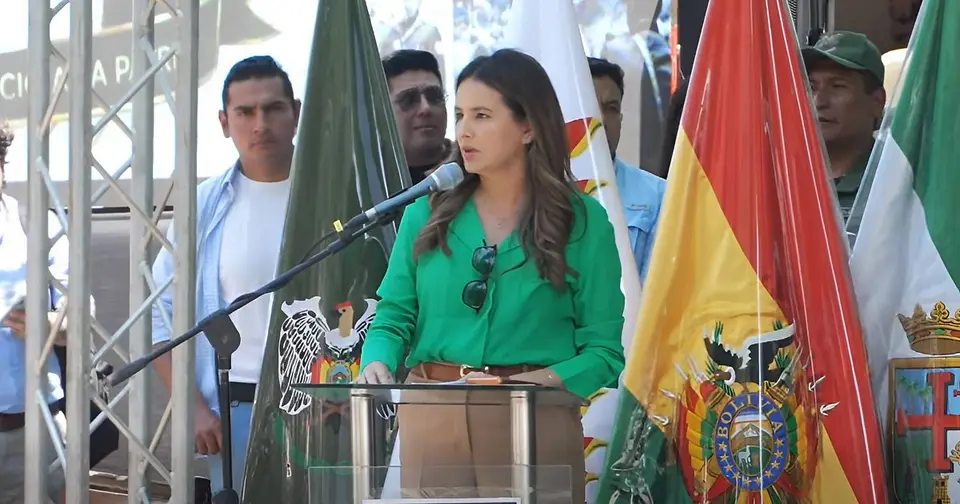
Santa Cruz calls for greater security in face of advancing organised crime
The acting governor of Santa Cruz, Paola Aguirre, publicly warned that organised crime has chosen the department as its operational base and demanded urgent measures from the national government. The message was delivered during the presentation of the "Secure Border 2.0" plan, according to El Deber.
"Santa Cruz is Bolivia's economic engine and that is precisely why organised crime wants it, for its roads, for its border, for its airport, for its money," Aguirre declared. The official was emphatic: "Let organised crime know that it will no longer find refuge in Santa Cruz".
Violence that is no longer common crime
Aguirre described a pattern that, in her view, goes beyond ordinary criminality. "Behind each of these incidents is the same logic. Routes, money, weapons, corruption and much fear and uncertainty among citizens. This is no longer common crime, this is organised crime," she said.
The vice-governor mentioned the case of Uruguayan drug trafficker Sebastián Marset as an example of the impunity that reigns in the department. According to her account, Marset lived for years in Santa Cruz with his family, played football under false documents and appeared in televised matches. In 2023 he escaped from an operation and, according to the government itself, shortly afterwards his seized assets were returned to him. Currently, senior fiscal authorities are being investigated for allegedly protecting that criminal network.
"They have come to establish themselves and in many cases in an absolutely public and unpunished manner," Aguirre emphasised.
A deficit of 5,000 police officers in Bolivia's most populated department
One of the acting governor's main demands was aimed directly at the distribution of police officers in the country. Santa Cruz has just over 5,000 police officers, despite being Bolivia's most populated department with approximately four million inhabitants.
Aguirre cited a concrete comparison with La Paz: whilst in that department there is one police officer for every 300 inhabitants, in Santa Cruz the proportion is one for every 600. "We lack at least 5,000 police officers, Mr Minister. 5,000 is not a regional whim, it is a debt owed by the State to the people of Santa Cruz," she stated.
The official called on Government Minister Marco Antonio Oviedo to promote a redistribution of officers through a plan of progressive and verifiable allocation. She also requested equipment, vehicles and infrastructure to ensure adequate working conditions. Although she valued the police reinforcement announced for the coming days, she argued that this measure is insufficient to close the gap.
Proposal: restore the governor's operational command of the Police
Aguirre also proposed a reform in the structure of departmental security. She noted that the governor, despite being elected by popular vote and chairing the Departmental Council for Public Safety, lacks the authority to directly order patrols in the territory.
"I say this without hesitation. We want the governor to be the general commander of the department again. Commander to coordinate law enforcement forces when the lives of people in Santa Cruz are at risk. Commander to order patrols, inspections and operations without asking anyone's permission when crime strikes," she stated.
The official clarified that her proposal does not seek to fracture the police institution or diminish the Government Ministry's conduct of national security policy. "The police will continue to be a single national institution and the Government Ministry will retain the conduct of security policy. What we are asking for is that in the territory where the danger is, there be an authority with command voice that articulates all forces," she argued.
Infiltration in the justice system and institutional framework
During her remarks, Aguirre also warned of investigations by the Brazilian Police related to alleged irregularities in the Bolivian judicial system, among them the disappearance of arrest warrants against members of the First Command of the Capital (PCC), the Brazilian criminal organisation.
"Organised crime has penetrated justice within our institutions. It bought silence, protection and impunity. When the one who must prosecute protects and the one who must order a search denies it, the citizen is left alone," she said.
Aguirre emphasised that the fight against criminal organisations must include officials who have decided to protect them. "To eradicate crime from the streets, one must first eradicate crime from institutions," she concluded.
The acting governor also indicated that the Gobernación is working on the incorporation of technology and intelligence as part of a comprehensive response to the security crisis in the department.
Source: El Deber