Interior Minister Oviedo denies scientific proof of drugs in Bolivian timber seized in Chile
Minister Marco Antonio Oviedo stated to the Legislative Assembly that Bolivia never received samples of the shipments retained in Chile to verify Chilean analyses.
Bolivia questions Chilean results on cocaine in exported timber
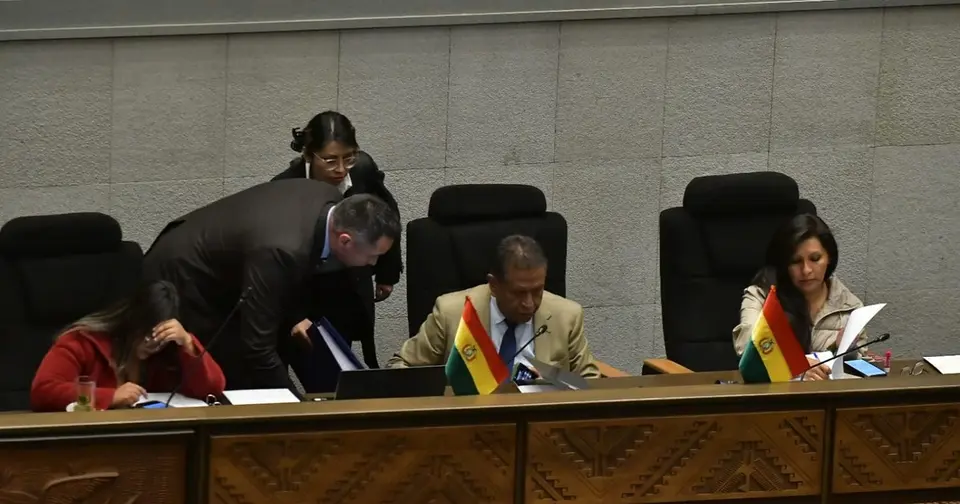
Interior Minister Marco Antonio Oviedo appeared before the Legislative Assembly on Wednesday to answer a set of 11 questions about shipments of Bolivian timber seized in Chile, and stated that to date Bolivia has not received samples to allow verification of the results presented by Chilean authorities.
According to El Deber, the questionnaire was submitted by deputies from Alianza Popular Claudia Herbas Siles, Rolando Santos Pacheco Chávez, Edwin Huiza Sandagorda and Juan Carlos Poma Tapia, who inquired about controls applied to three shipments totalling 67.8 tonnes of timber and rubber contaminated, the intelligence capacity of the Special Force to Combat Drug Trafficking (FELCN) and investigations into assets linked to the alleged organisation responsible.
June operation and Chilean estimates
During his report, Oviedo expanded on his explanations regarding the operation announced in June by Chile, which encompassed 45 containers with 1,080.8 tonnes of timber from Bolivia. The Chilean Public Prosecutor's Office reported that analyses by its Institute of Public Health confirmed the presence of cocaine, ketamine and other substances, and estimated that between 10% and 20% of the cargo corresponded to illicit components, which would imply a seizure of over 100 tonnes of drugs. That figure is an estimate of substances contained in the timber and does not correspond to drugs separated and weighed after extraction.
"To date it has not been demonstrated scientifically the presence and form of impregnation of controlled substances in the timber shipments seized in the neighbouring country of Chile," Oviedo stated.
Information requests without response
The minister explained that the FELCN requested information from the OS7 Drug Department of the Chilean Carabineros on 25 March, without obtaining a response. The request was reiterated on 15 April to the Intelligence Division of the Chilean Maritime Police, which communicated that the investigation was under confidentiality and that the exchange of information should take place through cooperation channels between the public prosecutors' offices of both countries.
Oviedo asserted that authorities from the Interior Ministry, the Foreign Ministry, the Public Prosecutor's Office and the FELCN made efforts to obtain samples, and that an international verification mission was also requested with participation from European bodies, the United Nations and the DEA.
"To say lightly, by an Arica prosecutor from Chile, irresponsibly, that 108 tonnes of drugs left Bolivia makes no sense to anyone," the minister stated.
Investigation in preliminary stage in Santa Cruz
The FELCN opened case SC-X-036/2026 on 24 March for drug trafficking offences. The investigation is in preliminary stage under the functional direction of the Public Prosecutor's Office of Santa Cruz.
When asked whether the evidence was forwarded to the Financial Investigation Unit (UIF) to investigate possible money laundering, Oviedo did not answer with a yes or no. He explained that this crime requires the prior existence of a proven illegal act and that it is incumbent upon the assigned prosecutor to request information from the UIF when they deem it necessary. He also did not specify how many natural or legal persons linked to the exporting companies are under investigation.
Raids and seized assets
Oviedo reported that the FELCN conducted raids and seized three properties, two forklift vehicles, two mobile phones, a laptop computer, a storage device and seven industrial machines. The preliminary value of the affected assets amounts to 921,844 dollars: 770,000 for the properties, 79,600 for the vehicles, 400 for the phones and 71,844 for the machines. The assets are in the custody of the Public Prosecutor's Office of Santa Cruz.
Inspections and export controls
By 25 August, 373 inspections were carried out on timber export shipments, with a further 27 pending review as they had not yet arrived at border customs facilities. In 2025, according to the ministerial report, 15 shipments were inspected.
The minister also recalled that Bolivia signed in 2018 a memorandum with the United Nations Office on Drugs and Crime to participate in the Container Control Programme, a mechanism that applies risk analysis, information exchange and selective controls on import and export shipments. He added that through Administrative Resolution 02/2026 of 24 March, ketamine was incorporated into Bolivian control and supervision mechanisms for substances with psychoactive potential.
Previous operations and general balance
Regarding seizures recorded at foreign ports over the past five years, Oviedo mentioned only the "Tiles" case, discovered in 2023 at the Peruvian port of Callao. He also cited two operations carried out this year before shipments left Bolivia: in Operation Renacer, on 8 July, 124.25 kilograms of cocaine concealed in scrap metal from a backhoe with final destination Libya were seized; in Operation Pinagreta, conducted on 27 July in Pisiga, 1.852 tonnes of cocaine hidden in bottles destined for Luxembourg were seized.
When asked specifically about actions to dismantle the organisation linked to the so-called "narco-timber", the minister presented a general balance of 541 operations carried out in Oruro.
Source: El Deber